

170
This is just an aside, but about 2 years ago, I participated in a German-Japanese
conference on economics in Berlin. My visit then left a strong impression on me. As
you know, Germany is also a country undergoing a severe population decline, and
they recognized that as a problem. Their solution to the problem of a declining
population was immigration, but leaving that specific approach aside, there was
absolutely no pessimistic theorizing that the German economy will falter and
decline from here on out. The basic atmosphere was that the German economy
would continue to be strong into the future.
To introduce some numbers, it is well known that in real terms, the Japanese
economy grew by approximately 10% during Japan’s economic boom, which is
approximately from 1955 to the early 1970s. However, what most people do not
know is the rate of growth in the workforce population. The answer is 1%; to be
more precise, the actual figure may have been about more like 1.2%. The difference
of 9% between the 10% growth in the economy and the 1% growth in the workforce
population accounts for a 9% increase in income per person. As to why income
increased, that can basically be attributed to innovation and investment in capital
stock. Metaphorically speaking, imagine that bulldozers, cranes, etc. are introduced
to a construction site where there only used to be picks and shovels. Just the way
you must have technology for that, you also at the same time actually need to have
the bulldozers, cranes, etc., introduced at the construction site. That’s what I mean.
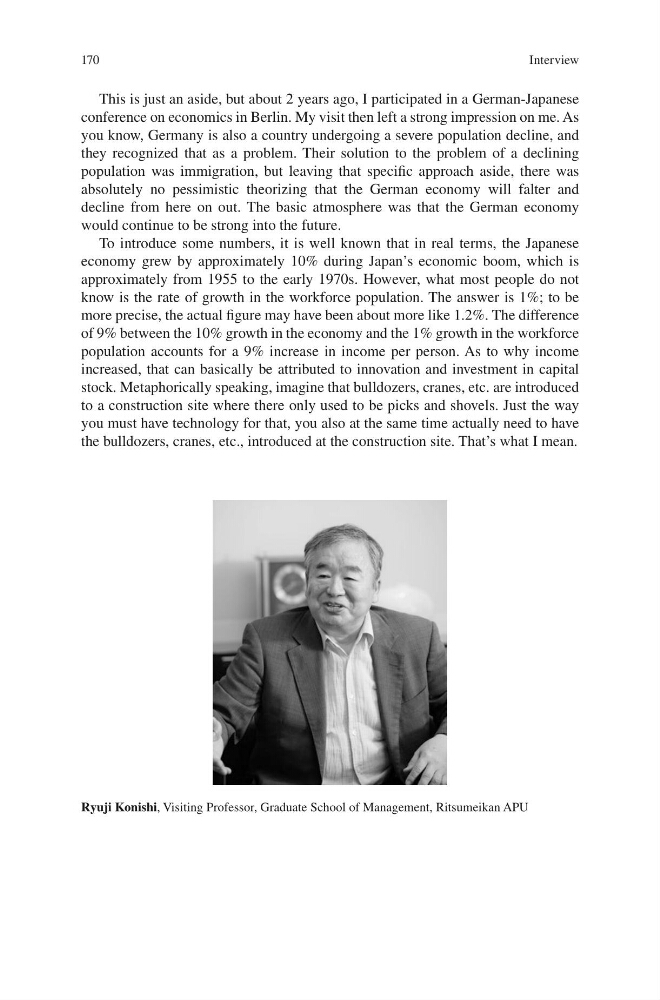
Ryuji Konishi, Visiting Professor, Graduate School of Management, Ritsumeikan APU
Interview
This is just an aside, but about 2 years ago, I participated in a German-Japanese
conference on economics in Berlin. My visit then left a strong impression on me. As
you know, Germany is also a country undergoing a severe population decline, and
they recognized that as a problem. Their solution to the problem of a declining
population was immigration, but leaving that specific approach aside, there was
absolutely no pessimistic theorizing that the German economy will falter and
decline from here on out. The basic atmosphere was that the German economy
would continue to be strong into the future.
To introduce some numbers, it is well known that in real terms, the Japanese
economy grew by approximately 10% during Japan’s economic boom, which is
approximately from 1955 to the early 1970s. However, what most people do not
know is the rate of growth in the workforce population. The answer is 1%; to be
more precise, the actual figure may have been about more like 1.2%. The difference
of 9% between the 10% growth in the economy and the 1% growth in the workforce
population accounts for a 9% increase in income per person. As to why income
increased, that can basically be attributed to innovation and investment in capital
stock. Metaphorically speaking, imagine that bulldozers, cranes, etc. are introduced
to a construction site where there only used to be picks and shovels. Just the way
you must have technology for that, you also at the same time actually need to have
the bulldozers, cranes, etc., introduced at the construction site. That’s what I mean.
Ryuji Konishi, Visiting Professor, Graduate School of Management, Ritsumeikan APU
Interview