

142
Tanegashima has various kinds of agriculture and livestock industries such as
sugar cane, sweet potatoes including the Anno variety for the fruit and vegetable
market as well as other kinds of sweet potato for making Japanese shochu (white
liquor) or starch, wet-rice cultivation, and the raising of Wagyu cattle. Out of these,
sugar cane holds a special place as part of the island’s culture and the sugar cane
industry, including the manufacturing of raw sugar, is one of the key industries of
the island.
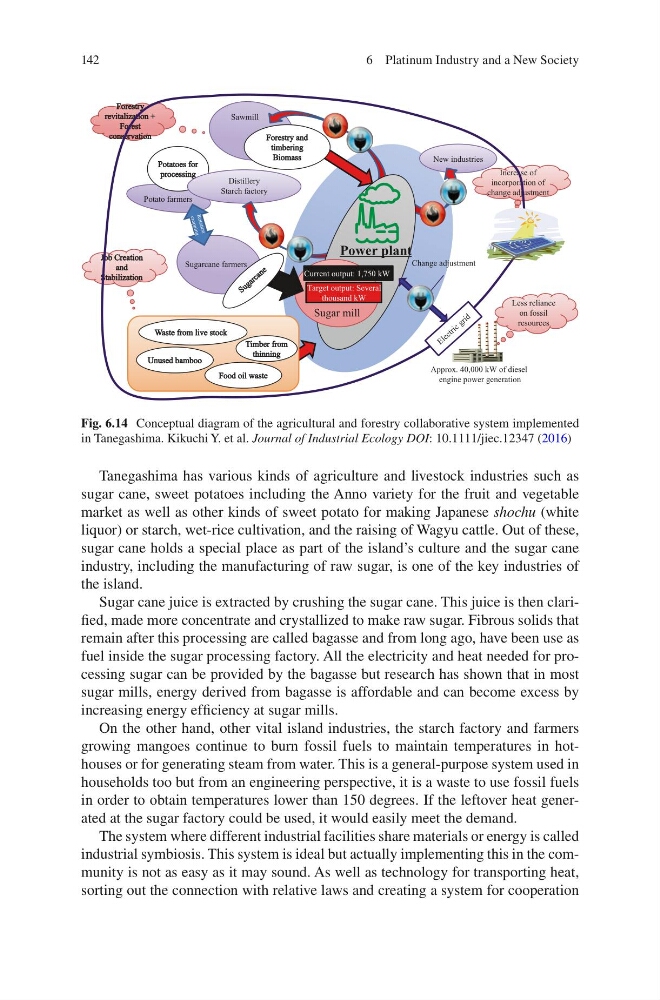
Sugar cane juice is extracted by crushing the sugar cane. This juice is then clarified, made more concentrate and crystallized to make raw sugar. Fibrous solids that
remain after this processing are called bagasse and from long ago, have been use as
fuel inside the sugar processing factory. All the electricity and heat needed for processing sugar can be provided by the bagasse but research has shown that in most
sugar mills, energy derived from bagasse is affordable and can become excess by
increasing energy efficiency at sugar mills.
On the other hand, other vital island industries, the starch factory and farmers
growing mangoes continue to burn fossil fuels to maintain temperatures in hothouses or for generating steam from water. This is a general-purpose system used in
households too but from an engineering perspective, it is a waste to use fossil fuels
in order to obtain temperatures lower than 150 degrees. If the leftover heat generated at the sugar factory could be used, it would easily meet the demand.
The system where different industrial facilities share materials or energy is called
industrial symbiosis. This system is ideal but actually implementing this in the community is not as easy as it may sound. As well as technology for transporting heat,
sorting out the connection with relative laws and creating a system for cooperation
Less reliance
on fossil
resources
Increase of
incorporation of
change adjustment
New industries
Sawmill
Potato farmers
Distillery
Starch factory
Power plant
Sugar mill
Current output: 1,750 kW
Sugarcane farmers
Approx. 40,000 kW of diesel
engine power generation
Change adjustment
Target output: Several
thousand kW
Fig. 6.14 Conceptual diagram of the agricultural and forestry collaborative system implemented
in Tanegashima. Kikuchi Y. et al. Journal of Industrial Ecology DOI: 10.1111/jiec.12347 (2016)
6 Platinum Industry and a New Society
Tanegashima has various kinds of agriculture and livestock industries such as
sugar cane, sweet potatoes including the Anno variety for the fruit and vegetable
market as well as other kinds of sweet potato for making Japanese shochu (white
liquor) or starch, wet-rice cultivation, and the raising of Wagyu cattle. Out of these,
sugar cane holds a special place as part of the island’s culture and the sugar cane
industry, including the manufacturing of raw sugar, is one of the key industries of
the island.
Sugar cane juice is extracted by crushing the sugar cane. This juice is then clarified, made more concentrate and crystallized to make raw sugar. Fibrous solids that
remain after this processing are called bagasse and from long ago, have been use as
fuel inside the sugar processing factory. All the electricity and heat needed for processing sugar can be provided by the bagasse but research has shown that in most
sugar mills, energy derived from bagasse is affordable and can become excess by
increasing energy efficiency at sugar mills.
On the other hand, other vital island industries, the starch factory and farmers
growing mangoes continue to burn fossil fuels to maintain temperatures in hothouses or for generating steam from water. This is a general-purpose system used in
households too but from an engineering perspective, it is a waste to use fossil fuels
in order to obtain temperatures lower than 150 degrees. If the leftover heat generated at the sugar factory could be used, it would easily meet the demand.
The system where different industrial facilities share materials or energy is called
industrial symbiosis. This system is ideal but actually implementing this in the community is not as easy as it may sound. As well as technology for transporting heat,
sorting out the connection with relative laws and creating a system for cooperation
Less reliance
on fossil
resources
Increase of
incorporation of
change adjustment
New industries
Sawmill
Potato farmers
Distillery
Starch factory
Power plant
Sugar mill
Current output: 1,750 kW
Sugarcane farmers
Approx. 40,000 kW of diesel
engine power generation
Change adjustment
Target output: Several
thousand kW
Fig. 6.14 Conceptual diagram of the agricultural and forestry collaborative system implemented
in Tanegashima. Kikuchi Y. et al. Journal of Industrial Ecology DOI: 10.1111/jiec.12347 (2016)
6 Platinum Industry and a New Society