

139
must act based on solid knowledge and multifaceted ways of thought. Therefore, the
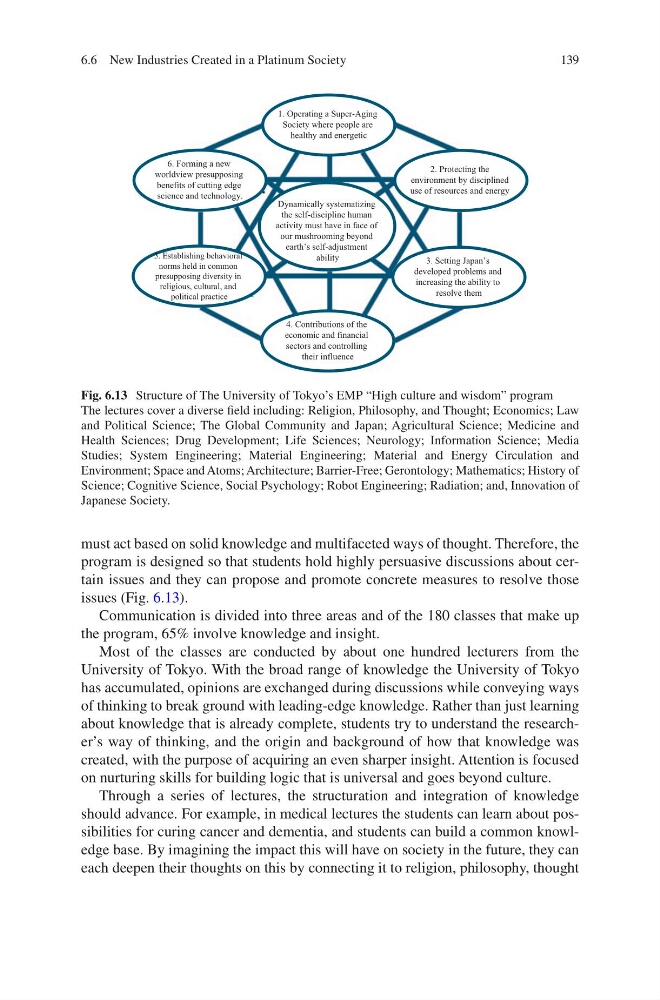
program is designed so that students hold highly persuasive discussions about certain issues and they can propose and promote concrete measures to resolve those
issues (Fig. 6.13).
Communication is divided into three areas and of the 180 classes that make up
the program, 65% involve knowledge and insight.
Most of the classes are conducted by about one hundred lecturers from the
University of Tokyo. With the broad range of knowledge the University of Tokyo
has accumulated, opinions are exchanged during discussions while conveying ways
of thinking to break ground with leading-edge knowledge. Rather than just learning
about knowledge that is already complete, students try to understand the researcher’s way of thinking, and the origin and background of how that knowledge was
created, with the purpose of acquiring an even sharper insight. Attention is focused
on nurturing skills for building logic that is universal and goes beyond culture.
Through a series of lectures, the structuration and integration of knowledge
should advance. For example, in medical lectures the students can learn about possibilities for curing cancer and dementia, and students can build a common knowledge base. By imagining the impact this will have on society in the future, they can
each deepen their thoughts on this by connecting it to religion, philosophy, thought
1. Operating a Super-Aging
Society where people are
healthy and energetic
2. Protecting the
environment by disciplined
use of resources and energy
3. Setting Japan’s
developed problems and
increasing the ability to
resolve them
4. Contributions of the
economic and financial
sectors and controlling
their influence
5. Establishing behavioral
norms held in common
presupposing diversity in
religious, cultural, and
political practice
6. Forming a new
worldview presupposing
benefits of cutting edge
science and technology.
Dynamically systematizing
the self-discipline human
activity must have in face of
our mushrooming beyond
earth’s self-adjustment
ability
Fig. 6.13 Structure of The University of Tokyo’s EMP “High culture and wisdom” program
The lectures cover a diverse field including: Religion, Philosophy, and Thought; Economics; Law
and Political Science; The Global Community and Japan; Agricultural Science; Medicine and
Health Sciences; Drug Development; Life Sciences; Neurology; Information Science; Media
Studies; System Engineering; Material Engineering; Material and Energy Circulation and
Environment; Space and Atoms; Architecture; Barrier-Free; Gerontology; Mathematics; History of
Science; Cognitive Science, Social Psychology; Robot Engineering; Radiation; and, Innovation of
Japanese Society.
6.6 New Industries Created in a Platinum Society
must act based on solid knowledge and multifaceted ways of thought. Therefore, the
program is designed so that students hold highly persuasive discussions about certain issues and they can propose and promote concrete measures to resolve those
issues (Fig. 6.13).
Communication is divided into three areas and of the 180 classes that make up
the program, 65% involve knowledge and insight.
Most of the classes are conducted by about one hundred lecturers from the
University of Tokyo. With the broad range of knowledge the University of Tokyo
has accumulated, opinions are exchanged during discussions while conveying ways
of thinking to break ground with leading-edge knowledge. Rather than just learning
about knowledge that is already complete, students try to understand the researcher’s way of thinking, and the origin and background of how that knowledge was
created, with the purpose of acquiring an even sharper insight. Attention is focused
on nurturing skills for building logic that is universal and goes beyond culture.
Through a series of lectures, the structuration and integration of knowledge
should advance. For example, in medical lectures the students can learn about possibilities for curing cancer and dementia, and students can build a common knowledge base. By imagining the impact this will have on society in the future, they can
each deepen their thoughts on this by connecting it to religion, philosophy, thought
1. Operating a Super-Aging
Society where people are
healthy and energetic
2. Protecting the
environment by disciplined
use of resources and energy
3. Setting Japan’s
developed problems and
increasing the ability to
resolve them
4. Contributions of the
economic and financial
sectors and controlling
their influence
5. Establishing behavioral
norms held in common
presupposing diversity in
religious, cultural, and
political practice
6. Forming a new
worldview presupposing
benefits of cutting edge
science and technology.
Dynamically systematizing
the self-discipline human
activity must have in face of
our mushrooming beyond
earth’s self-adjustment
ability
Fig. 6.13 Structure of The University of Tokyo’s EMP “High culture and wisdom” program
The lectures cover a diverse field including: Religion, Philosophy, and Thought; Economics; Law
and Political Science; The Global Community and Japan; Agricultural Science; Medicine and
Health Sciences; Drug Development; Life Sciences; Neurology; Information Science; Media
Studies; System Engineering; Material Engineering; Material and Energy Circulation and
Environment; Space and Atoms; Architecture; Barrier-Free; Gerontology; Mathematics; History of
Science; Cognitive Science, Social Psychology; Robot Engineering; Radiation; and, Innovation of
Japanese Society.
6.6 New Industries Created in a Platinum Society