

100
1. Structural change of industries to services with low CO 2 emissions per valueadded and further reduction of CO 2 emissions.
2. As exemplified in the high-emission steel industry, the intra-industry system
change is required centered on recycled products.
3. Promotion of energy conservation in all industrial fields.
4. Introduction of low carbon power supply systems through establishment of a
large amount of renewable energy production.
5. Creation of new low-carbon industries.
6. Development of new functional materials supporting the above changes.
5.3.2 Value-Added by Industry and CO 2 Emissions in 2050
As we have seen so far, reducing 80% of CO 2 emission by 2050 in the power sector
as well as the other three sectors (household, steel, and transport), which together
account for 81% of total CO 2 emissions, is now within reach. If we can reduce the
remaining 19% of the total CO 2 emissions by 80%, we can achieve an overall reduction of 80% in 2050. Since we can see this much improvement at this stage, we have
also applied the same numbers to related industries. The remaining amount is small,
so we decided on an emission reduction of roughly 50 to 90% (on average 80%)
considering the situation of each industry.
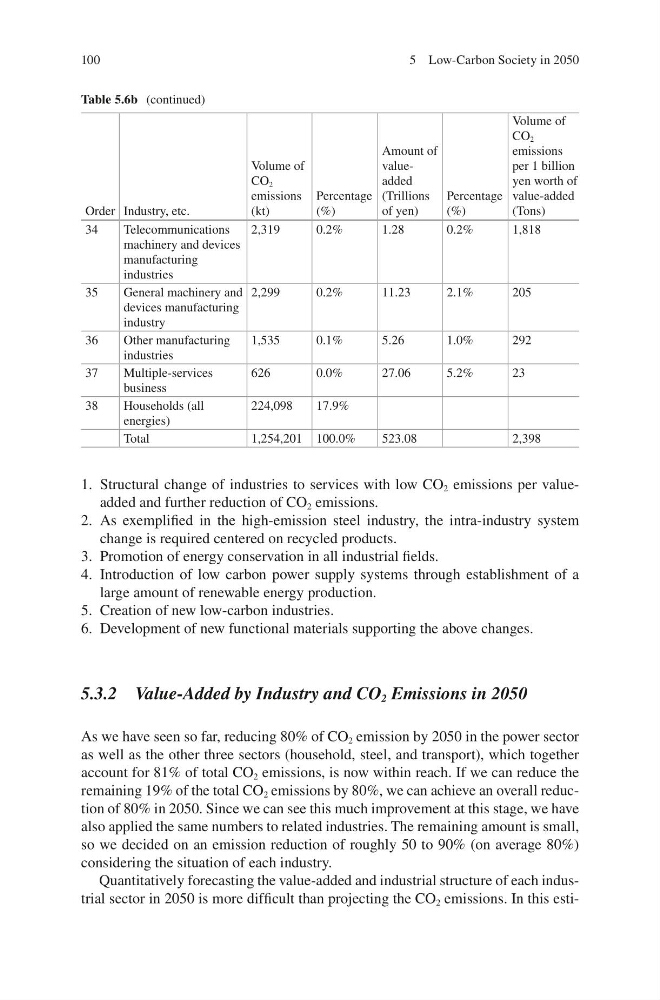
Quantitatively forecasting the value-added and industrial structure of each industrial sector in 2050 is more difficult than projecting the CO 2 emissions. In this estiTable 5.6b (continued)
Order Industry, etc.
Volume of
CO 2
emissions
(kt)
Percentage
(%)
Amount of
valueadded
(Trillions
of yen)
Percentage
(%)
Volume of
CO 2
emissions
per 1 billion
yen worth of
value-added
(Tons)
34
Telecommunications
machinery and devices
manufacturing
industries
2,319
0.2%
1.28
0.2%
1,818
35
General machinery and
devices manufacturing
industry
2,299
0.2%
11.23
2.1%
205
36
Other manufacturing
industries
1,535
0.1%
5.26
1.0%
292
37
Multiple-services
business
626
0.0%
27.06
5.2%
23
38
Households (all
energies)
224,098
17.9%
Total
1,254,201 100.0%
523.08
2,398
5 Low-Carbon Society in 2050
1. Structural change of industries to services with low CO 2 emissions per valueadded and further reduction of CO 2 emissions.
2. As exemplified in the high-emission steel industry, the intra-industry system
change is required centered on recycled products.
3. Promotion of energy conservation in all industrial fields.
4. Introduction of low carbon power supply systems through establishment of a
large amount of renewable energy production.
5. Creation of new low-carbon industries.
6. Development of new functional materials supporting the above changes.
5.3.2 Value-Added by Industry and CO 2 Emissions in 2050
As we have seen so far, reducing 80% of CO 2 emission by 2050 in the power sector
as well as the other three sectors (household, steel, and transport), which together
account for 81% of total CO 2 emissions, is now within reach. If we can reduce the
remaining 19% of the total CO 2 emissions by 80%, we can achieve an overall reduction of 80% in 2050. Since we can see this much improvement at this stage, we have
also applied the same numbers to related industries. The remaining amount is small,
so we decided on an emission reduction of roughly 50 to 90% (on average 80%)
considering the situation of each industry.
Quantitatively forecasting the value-added and industrial structure of each industrial sector in 2050 is more difficult than projecting the CO 2 emissions. In this estiTable 5.6b (continued)
Order Industry, etc.
Volume of
CO 2
emissions
(kt)
Percentage
(%)
Amount of
valueadded
(Trillions
of yen)
Percentage
(%)
Volume of
CO 2
emissions
per 1 billion
yen worth of
value-added
(Tons)
34
Telecommunications
machinery and devices
manufacturing
industries
2,319
0.2%
1.28
0.2%
1,818
35
General machinery and
devices manufacturing
industry
2,299
0.2%
11.23
2.1%
205
36
Other manufacturing
industries
1,535
0.1%
5.26
1.0%
292
37
Multiple-services
business
626
0.0%
27.06
5.2%
23
38
Households (all
energies)
224,098
17.9%
Total
1,254,201 100.0%
523.08
2,398
5 Low-Carbon Society in 2050