

74
Therefore, when I proposed Vision 2050, I thought that we cannot expect much
from biomass, but recently new possibilities have emerged. This is because many
people have come to understand that expanding domestically produced wood consumption leads to healthy forests.
Currently, Japanese forestry has weakened as a result of losing in price competition with foreign countries. In Japan, 55% of timber products are used for construction and 40% for pulp and chips, among which only 30% of domestic resources are
used. This amount represents only around 20–30% of Japanese forest resources. It
is an important task to keep Japanese forest healthy and to reform forestry into a
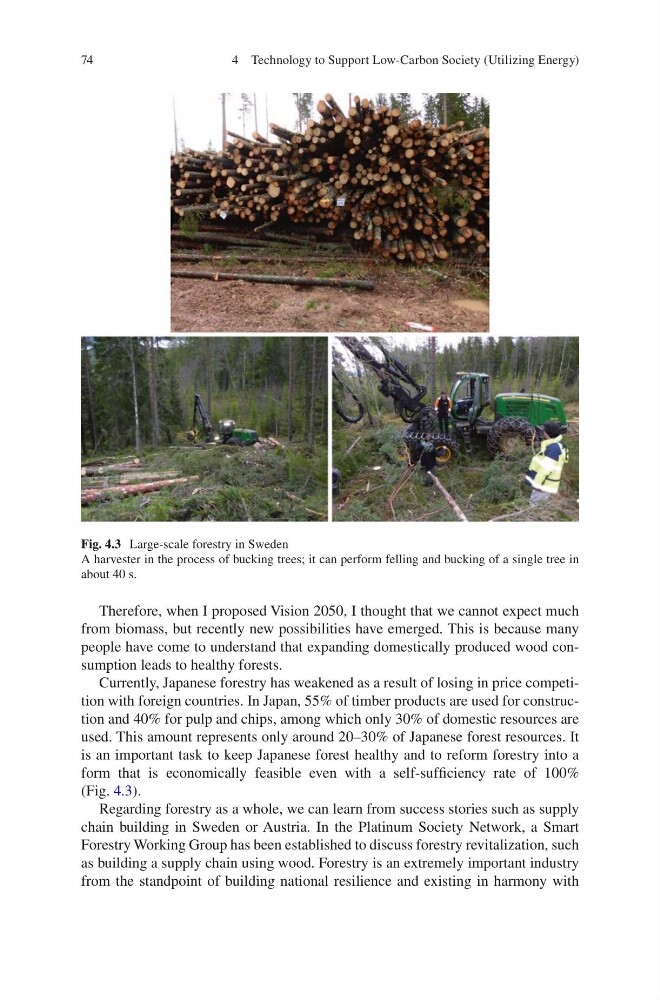
form that is economically feasible even with a self-sufficiency rate of 100%
(Fig. 4.3).
Regarding forestry as a whole, we can learn from success stories such as supply
chain building in Sweden or Austria. In the Platinum Society Network, a Smart
Forestry Working Group has been established to discuss forestry revitalization, such
as building a supply chain using wood. Forestry is an extremely important industry
from the standpoint of building national resilience and existing in harmony with
Fig. 4.3 Large-scale forestry in Sweden
A harvester in the process of bucking trees; it can perform felling and bucking of a single tree in
about 40 s.
4 Technology to Support Low-Carbon Society (Utilizing Energy)
Therefore, when I proposed Vision 2050, I thought that we cannot expect much
from biomass, but recently new possibilities have emerged. This is because many
people have come to understand that expanding domestically produced wood consumption leads to healthy forests.
Currently, Japanese forestry has weakened as a result of losing in price competition with foreign countries. In Japan, 55% of timber products are used for construction and 40% for pulp and chips, among which only 30% of domestic resources are
used. This amount represents only around 20–30% of Japanese forest resources. It
is an important task to keep Japanese forest healthy and to reform forestry into a
form that is economically feasible even with a self-sufficiency rate of 100%
(Fig. 4.3).
Regarding forestry as a whole, we can learn from success stories such as supply
chain building in Sweden or Austria. In the Platinum Society Network, a Smart
Forestry Working Group has been established to discuss forestry revitalization, such
as building a supply chain using wood. Forestry is an extremely important industry
from the standpoint of building national resilience and existing in harmony with
Fig. 4.3 Large-scale forestry in Sweden
A harvester in the process of bucking trees; it can perform felling and bucking of a single tree in
about 40 s.
4 Technology to Support Low-Carbon Society (Utilizing Energy)