

58
Fortunately for Japan, where electronic devices are widespread, large amounts of
rare metals are dormant, so it is said that if all unused products can be recovered,
these urban mines alone can satisfy domestic demand. To that end, it is of course
necessary to establish a mechanism for material cycling.
It was precisely for this reason that the Small Home Appliance Recycling Act
was enacted in April 2013. In the past, small appliances such as personal computers,
mobile phones, smart phones, digital cameras, and gaming devices were not subject
to recycling laws, and had been classified as non-combustible waste. The intention
here is to turn these appliances into resources by properly creating a mechanism of
recycling.
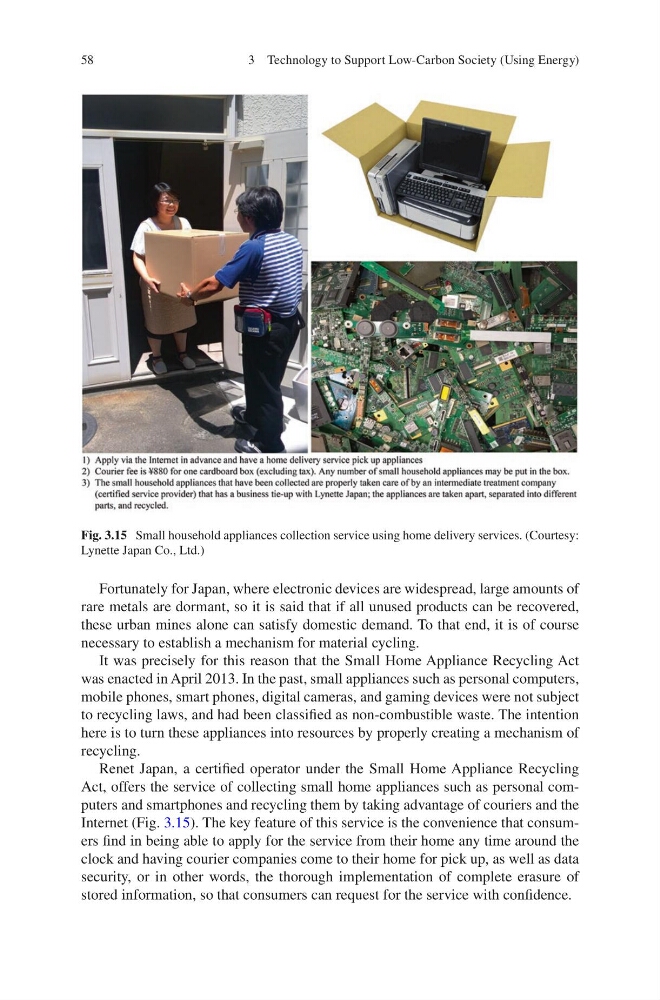
Renet Japan, a certified operator under the Small Home Appliance Recycling
Act, offers the service of collecting small home appliances such as personal computers and smartphones and recycling them by taking advantage of couriers and the
Internet (Fig. 3.15). The key feature of this service is the convenience that consumers find in being able to apply for the service from their home any time around the
clock and having courier companies come to their home for pick up, as well as data
security, or in other words, the thorough implementation of complete erasure of
stored information, so that consumers can request for the service with confidence.
Fig. 3.15 Small household appliances collection service using home delivery services. (Courtesy:
Lynette Japan Co., Ltd.)
3 Technology to Support Low-Carbon Society (Using Energy)
Fortunately for Japan, where electronic devices are widespread, large amounts of
rare metals are dormant, so it is said that if all unused products can be recovered,
these urban mines alone can satisfy domestic demand. To that end, it is of course
necessary to establish a mechanism for material cycling.
It was precisely for this reason that the Small Home Appliance Recycling Act
was enacted in April 2013. In the past, small appliances such as personal computers,
mobile phones, smart phones, digital cameras, and gaming devices were not subject
to recycling laws, and had been classified as non-combustible waste. The intention
here is to turn these appliances into resources by properly creating a mechanism of
recycling.
Renet Japan, a certified operator under the Small Home Appliance Recycling
Act, offers the service of collecting small home appliances such as personal computers and smartphones and recycling them by taking advantage of couriers and the
Internet (Fig. 3.15). The key feature of this service is the convenience that consumers find in being able to apply for the service from their home any time around the
clock and having courier companies come to their home for pick up, as well as data
security, or in other words, the thorough implementation of complete erasure of
stored information, so that consumers can request for the service with confidence.
Fig. 3.15 Small household appliances collection service using home delivery services. (Courtesy:
Lynette Japan Co., Ltd.)
3 Technology to Support Low-Carbon Society (Using Energy)