

3.3 Limits on the Parameters ε and m A
59
[MeV]
χ
m
1
1 0
2
10
3
10
4
)
A'
/m
χ
(m
D
α
2
ε
y=
15
−
10
14
−
10
13
−
10
12
−
10
11
−
10
10
−
10
9
−
10
8
−
10
7
−
10
BaBar
, N)
-
MiniBooNE (e
N A 64
E137
L SN D
CRESST-II
XEN ON 10/10 0
r e li c d e n s it y
Elastic Scalar Dark Matter
S E N S E I - 2 g
= 0.1
D
α
= 3
χ
/m
A'
m
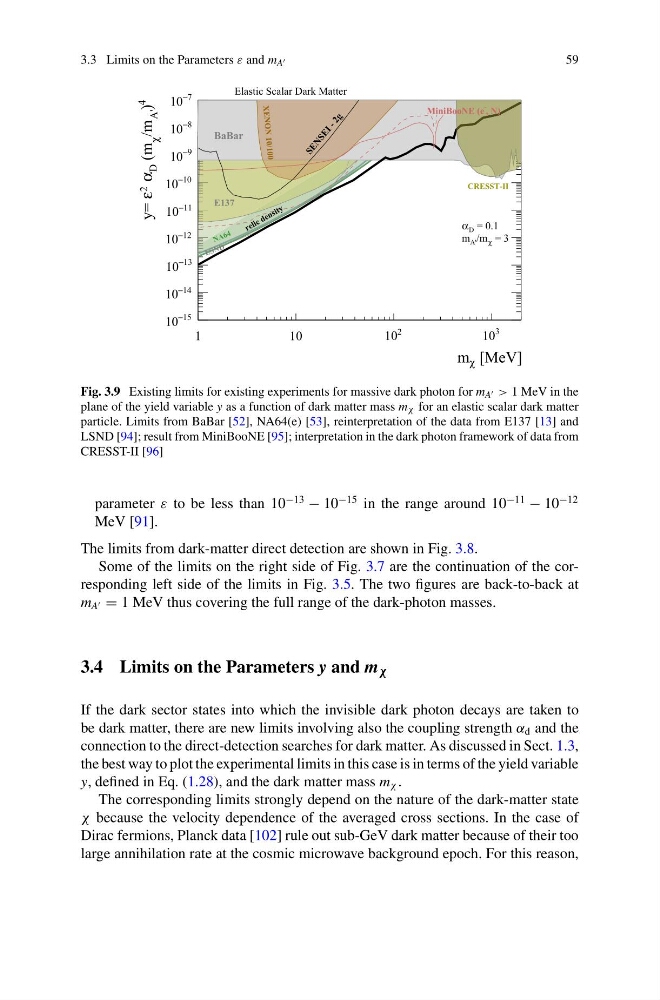
Fig. 3.9 Existing limits for existing experiments for massive dark photon for m A > 1 MeV in the
plane of the yield variable y as a function of dark matter mass m χ for an elastic scalar dark matter
particle. Limits from BaBar [52], NA64(e) [53], reinterpretation of the data from E137 [13] and
LSND [94]; result from MiniBooNE [95]; interpretation in the dark photon framework of data from
CRESST-II [96]
parameter ε to be less than 10
−13
− 10
−15 in the range around 10
−11
− 10
−12
MeV [91].
The limits from dark-matter direct detection are shown in Fig. 3.8.
Some of the limits on the right side of Fig. 3.7 are the continuation of the corresponding left side of the limits in Fig. 3.5. The two figures are back-to-back at
m A = 1 MeV thus covering the full range of the dark-photon masses.
3.4 Limits on the Parameters y and m χ
If the dark sector states into which the invisible dark photon decays are taken to
be dark matter, there are new limits involving also the coupling strength α d and the
connection to the direct-detection searches for dark matter. As discussed in Sect. 1.3,
the best way to plot the experimental limits in this case is in terms of the yield variable
y, defined in Eq. (1.28), and the dark matter mass m χ .
The corresponding limits strongly depend on the nature of the dark-matter state
χ because the velocity dependence of the averaged cross sections. In the case of
Dirac fermions, Planck data [102] rule out sub-GeV dark matter because of their too
large annihilation rate at the cosmic microwave background epoch. For this reason,
59
[MeV]
χ
m
1
1 0
2
10
3
10
4
)
A'
/m
χ
(m
D
α
2
ε
y=
15
−
10
14
−
10
13
−
10
12
−
10
11
−
10
10
−
10
9
−
10
8
−
10
7
−
10
BaBar
, N)
-
MiniBooNE (e
N A 64
E137
L SN D
CRESST-II
XEN ON 10/10 0
r e li c d e n s it y
Elastic Scalar Dark Matter
S E N S E I - 2 g
= 0.1
D
α
= 3
χ
/m
A'
m
Fig. 3.9 Existing limits for existing experiments for massive dark photon for m A > 1 MeV in the
plane of the yield variable y as a function of dark matter mass m χ for an elastic scalar dark matter
particle. Limits from BaBar [52], NA64(e) [53], reinterpretation of the data from E137 [13] and
LSND [94]; result from MiniBooNE [95]; interpretation in the dark photon framework of data from
CRESST-II [96]
parameter ε to be less than 10
−13
− 10
−15 in the range around 10
−11
− 10
−12
MeV [91].
The limits from dark-matter direct detection are shown in Fig. 3.8.
Some of the limits on the right side of Fig. 3.7 are the continuation of the corresponding left side of the limits in Fig. 3.5. The two figures are back-to-back at
m A = 1 MeV thus covering the full range of the dark-photon masses.
3.4 Limits on the Parameters y and m χ
If the dark sector states into which the invisible dark photon decays are taken to
be dark matter, there are new limits involving also the coupling strength α d and the
connection to the direct-detection searches for dark matter. As discussed in Sect. 1.3,
the best way to plot the experimental limits in this case is in terms of the yield variable
y, defined in Eq. (1.28), and the dark matter mass m χ .
The corresponding limits strongly depend on the nature of the dark-matter state
χ because the velocity dependence of the averaged cross sections. In the case of
Dirac fermions, Planck data [102] rule out sub-GeV dark matter because of their too
large annihilation rate at the cosmic microwave background epoch. For this reason,