

52
3 Phenomenology of the Massive Dark Photon
[GeV]
A'
m
3
−
10
2
−
10
1
−
10
1
1 0
2
10
3
10
ε
9
−
10
8
−
10
7
−
10
6
−
10
5
−
10
4
−
10
3
−
10
2
−
10
e
(g -2 )
BaBar
CMS
LHCb
A1
NA48/2
KLOE
E137
E141
NA64(e)
E774
SN1987A
n u - C a l
CHARM
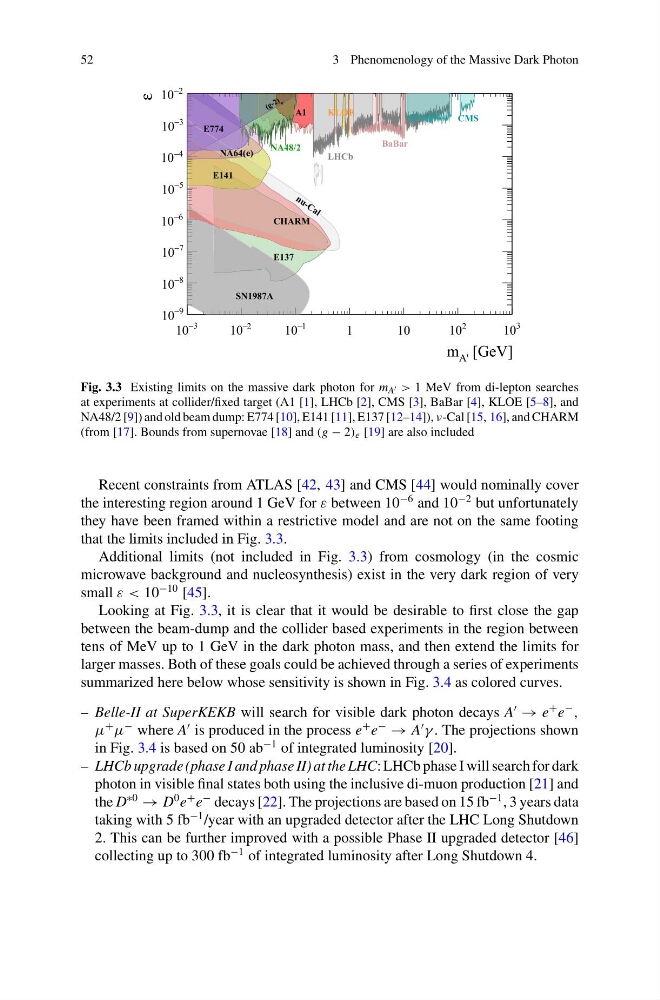
Fig. 3.3 Existing limits on the massive dark photon for m A > 1 MeV from di-lepton searches
at experiments at collider/fixed target (A1 [1], LHCb [2], CMS [3], BaBar [4], KLOE [5–8], and
NA48/2 [9]) and old beam dump: E774 [10], E141 [11], E137 [12–14]), ν-Cal [15, 16], and CHARM
(from [17]. Bounds from supernovae [18] and (g − 2) e [19] are also included
Recent constraints from ATLAS [42, 43] and CMS [44] would nominally cover
the interesting region around 1 GeV for ε between 10
−6 and 10
−2 but unfortunately
they have been framed within a restrictive model and are not on the same footing
that the limits included in Fig. 3.3.
Additional limits (not included in Fig. 3.3) from cosmology (in the cosmic
microwave background and nucleosynthesis) exist in the very dark region of very
small ε < 10
−10 [45].
Looking at Fig. 3.3, it is clear that it would be desirable to first close the gap
between the beam-dump and the collider based experiments in the region between
tens of MeV up to 1 GeV in the dark photon mass, and then extend the limits for
larger masses. Both of these goals could be achieved through a series of experiments
summarized here below whose sensitivity is shown in Fig. 3.4 as colored curves.
– Belle-II at SuperKEKB will search for visible dark photon decays A
→ e
+ e
−
,
μ
+
μ
− where A
is produced in the process e
+ e
−
→ A
γ . The projections shown
in Fig. 3.4 is based on 50 ab
−1 of integrated luminosity [20].
– LHCb upgrade (phase I and phase II) at the LHC: LHCb phase I will search for dark
photon in visible final states both using the inclusive di-muon production [21] and
the D
∗0
→ D
0 e
+ e
− decays [22]. The projections are based on 15 fb
−1 , 3 years data
taking with 5 fb
−1 /year with an upgraded detector after the LHC Long Shutdown
2. This can be further improved with a possible Phase II upgraded detector [46]
collecting up to 300 fb
−1 of integrated luminosity after Long Shutdown 4.
3 Phenomenology of the Massive Dark Photon
[GeV]
A'
m
3
−
10
2
−
10
1
−
10
1
1 0
2
10
3
10
ε
9
−
10
8
−
10
7
−
10
6
−
10
5
−
10
4
−
10
3
−
10
2
−
10
e
(g -2 )
BaBar
CMS
LHCb
A1
NA48/2
KLOE
E137
E141
NA64(e)
E774
SN1987A
n u - C a l
CHARM
Fig. 3.3 Existing limits on the massive dark photon for m A > 1 MeV from di-lepton searches
at experiments at collider/fixed target (A1 [1], LHCb [2], CMS [3], BaBar [4], KLOE [5–8], and
NA48/2 [9]) and old beam dump: E774 [10], E141 [11], E137 [12–14]), ν-Cal [15, 16], and CHARM
(from [17]. Bounds from supernovae [18] and (g − 2) e [19] are also included
Recent constraints from ATLAS [42, 43] and CMS [44] would nominally cover
the interesting region around 1 GeV for ε between 10
−6 and 10
−2 but unfortunately
they have been framed within a restrictive model and are not on the same footing
that the limits included in Fig. 3.3.
Additional limits (not included in Fig. 3.3) from cosmology (in the cosmic
microwave background and nucleosynthesis) exist in the very dark region of very
small ε < 10
−10 [45].
Looking at Fig. 3.3, it is clear that it would be desirable to first close the gap
between the beam-dump and the collider based experiments in the region between
tens of MeV up to 1 GeV in the dark photon mass, and then extend the limits for
larger masses. Both of these goals could be achieved through a series of experiments
summarized here below whose sensitivity is shown in Fig. 3.4 as colored curves.
– Belle-II at SuperKEKB will search for visible dark photon decays A
→ e
+ e
−
,
μ
+
μ
− where A
is produced in the process e
+ e
−
→ A
γ . The projections shown
in Fig. 3.4 is based on 50 ab
−1 of integrated luminosity [20].
– LHCb upgrade (phase I and phase II) at the LHC: LHCb phase I will search for dark
photon in visible final states both using the inclusive di-muon production [21] and
the D
∗0
→ D
0 e
+ e
− decays [22]. The projections are based on 15 fb
−1 , 3 years data
taking with 5 fb
−1 /year with an upgraded detector after the LHC Long Shutdown
2. This can be further improved with a possible Phase II upgraded detector [46]
collecting up to 300 fb
−1 of integrated luminosity after Long Shutdown 4.