

50
3 Phenomenology of the Massive Dark Photon
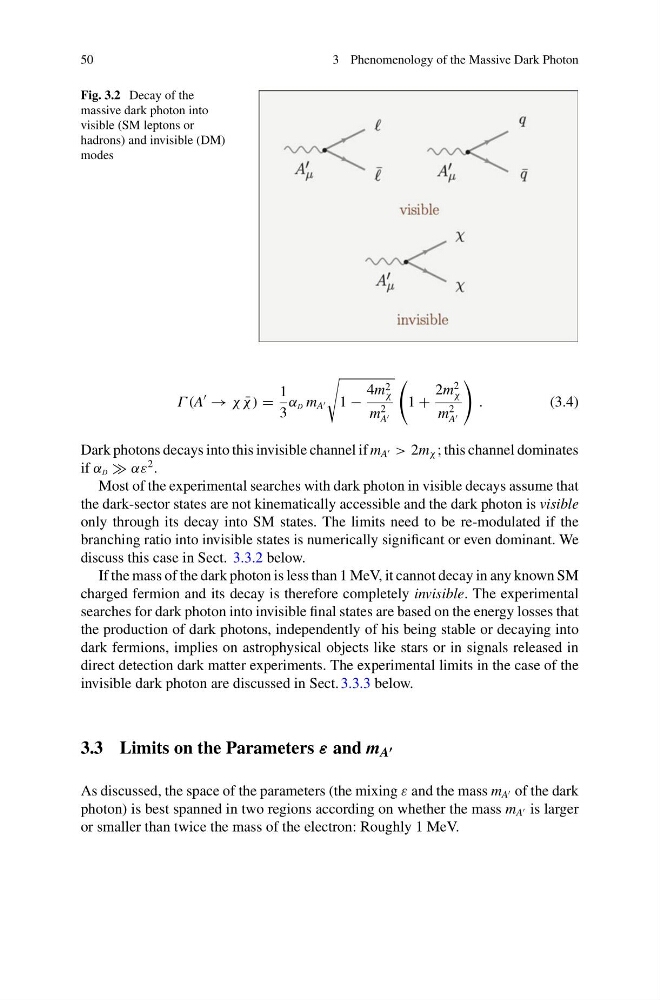
Fig. 3.2 Decay of the
massive dark photon into
visible (SM leptons or
hadrons) and invisible (DM)
modes
Γ (A
→ χ ¯
χ) =
1
3
α D m A
1 −
4m 2
χ
m
2
A
1 +
2m
2
χ
m
2
A
.
(3.4)
Dark photons decays into this invisible channel if m A > 2m χ ; this channel dominates
if α D αε
2 .
Most of the experimental searches with dark photon in visible decays assume that
the dark-sector states are not kinematically accessible and the dark photon is visible
only through its decay into SM states. The limits need to be re-modulated if the
branching ratio into invisible states is numerically significant or even dominant. We
discuss this case in Sect. 3.3.2 below.
If the mass of the dark photon is less than 1 MeV, it cannot decay in any known SM
charged fermion and its decay is therefore completely invisible. The experimental
searches for dark photon into invisible final states are based on the energy losses that
the production of dark photons, independently of his being stable or decaying into
dark fermions, implies on astrophysical objects like stars or in signals released in
direct detection dark matter experiments. The experimental limits in the case of the
invisible dark photon are discussed in Sect. 3.3.3 below.
3.3 Limits on the Parameters ε and m A
As discussed, the space of the parameters (the mixing ε and the mass m A of the dark
photon) is best spanned in two regions according on whether the mass m A is larger
or smaller than twice the mass of the electron: Roughly 1 MeV.
3 Phenomenology of the Massive Dark Photon
Fig. 3.2 Decay of the
massive dark photon into
visible (SM leptons or
hadrons) and invisible (DM)
modes
Γ (A
→ χ ¯
χ) =
1
3
α D m A
1 −
4m 2
χ
m
2
A
1 +
2m
2
χ
m
2
A
.
(3.4)
Dark photons decays into this invisible channel if m A > 2m χ ; this channel dominates
if α D αε
2 .
Most of the experimental searches with dark photon in visible decays assume that
the dark-sector states are not kinematically accessible and the dark photon is visible
only through its decay into SM states. The limits need to be re-modulated if the
branching ratio into invisible states is numerically significant or even dominant. We
discuss this case in Sect. 3.3.2 below.
If the mass of the dark photon is less than 1 MeV, it cannot decay in any known SM
charged fermion and its decay is therefore completely invisible. The experimental
searches for dark photon into invisible final states are based on the energy losses that
the production of dark photons, independently of his being stable or decaying into
dark fermions, implies on astrophysical objects like stars or in signals released in
direct detection dark matter experiments. The experimental limits in the case of the
invisible dark photon are discussed in Sect. 3.3.3 below.
3.3 Limits on the Parameters ε and m A
As discussed, the space of the parameters (the mixing ε and the mass m A of the dark
photon) is best spanned in two regions according on whether the mass m A is larger
or smaller than twice the mass of the electron: Roughly 1 MeV.