

48
3 Phenomenology of the Massive Dark Photon
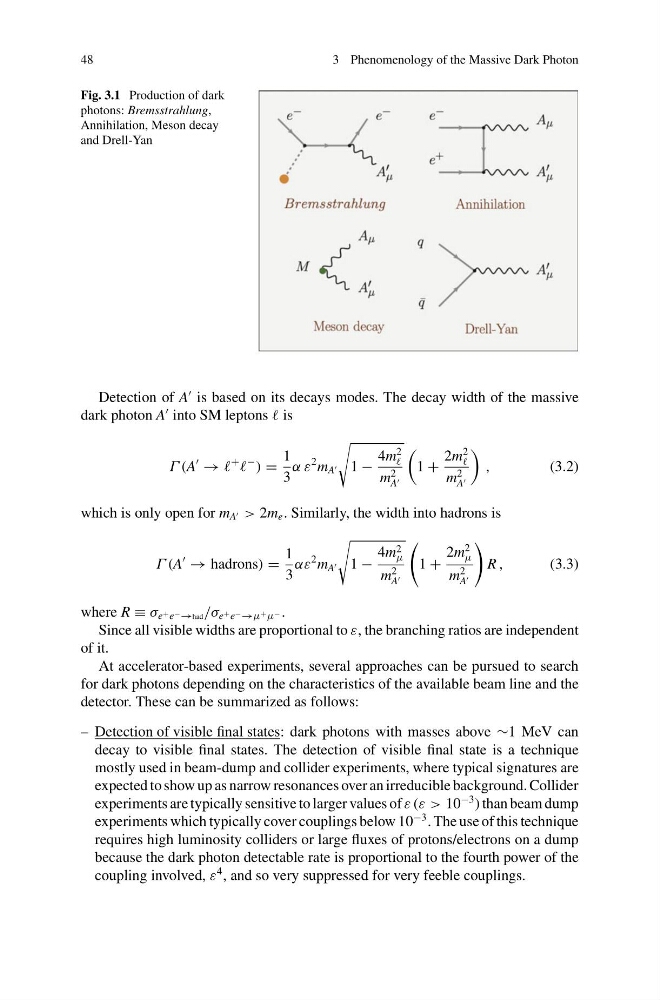
Fig. 3.1 Production of dark
photons: Bremsstrahlung,
Annihilation, Meson decay
and Drell-Yan
Detection of A
is based on its decays modes. The decay width of the massive
dark photon A
into SM leptons is
Γ (A
→
+
−
) =
1
3
α ε
2 m A
1 −
4m
2
m
2
A
1 +
2m
2
m
2
A
,
(3.2)
which is only open for m A > 2m e . Similarly, the width into hadrons is
Γ (A
→ hadrons) =
1
3
αε
2 m A
1 −
4m 2
μ
m
2
A
1 +
2m
2
μ
m
2
A
R ,
(3.3)
where R ≡ σ e + e − →had /σ e + e − →μ + μ − .
Since all visible widths are proportional to ε, the branching ratios are independent
of it.
At accelerator-based experiments, several approaches can be pursued to search
for dark photons depending on the characteristics of the available beam line and the
detector. These can be summarized as follows:
– Detection of visible final states: dark photons with masses above ∼1 MeV can
decay to visible final states. The detection of visible final state is a technique
mostly used in beam-dump and collider experiments, where typical signatures are
expected to show up as narrow resonances over an irreducible background. Collider
experiments are typically sensitive to larger values of ε (ε > 10
−3 ) than beam dump
experiments which typically cover couplings below 10
−3 . The use of this technique
requires high luminosity colliders or large fluxes of protons/electrons on a dump
because the dark photon detectable rate is proportional to the fourth power of the
coupling involved, ε
4 , and so very suppressed for very feeble couplings.
3 Phenomenology of the Massive Dark Photon
Fig. 3.1 Production of dark
photons: Bremsstrahlung,
Annihilation, Meson decay
and Drell-Yan
Detection of A
is based on its decays modes. The decay width of the massive
dark photon A
into SM leptons is
Γ (A
→
+
−
) =
1
3
α ε
2 m A
1 −
4m
2
m
2
A
1 +
2m
2
m
2
A
,
(3.2)
which is only open for m A > 2m e . Similarly, the width into hadrons is
Γ (A
→ hadrons) =
1
3
αε
2 m A
1 −
4m 2
μ
m
2
A
1 +
2m
2
μ
m
2
A
R ,
(3.3)
where R ≡ σ e + e − →had /σ e + e − →μ + μ − .
Since all visible widths are proportional to ε, the branching ratios are independent
of it.
At accelerator-based experiments, several approaches can be pursued to search
for dark photons depending on the characteristics of the available beam line and the
detector. These can be summarized as follows:
– Detection of visible final states: dark photons with masses above ∼1 MeV can
decay to visible final states. The detection of visible final state is a technique
mostly used in beam-dump and collider experiments, where typical signatures are
expected to show up as narrow resonances over an irreducible background. Collider
experiments are typically sensitive to larger values of ε (ε > 10
−3 ) than beam dump
experiments which typically cover couplings below 10
−3 . The use of this technique
requires high luminosity colliders or large fluxes of protons/electrons on a dump
because the dark photon detectable rate is proportional to the fourth power of the
coupling involved, ε
4 , and so very suppressed for very feeble couplings.