

4
1 Introduction
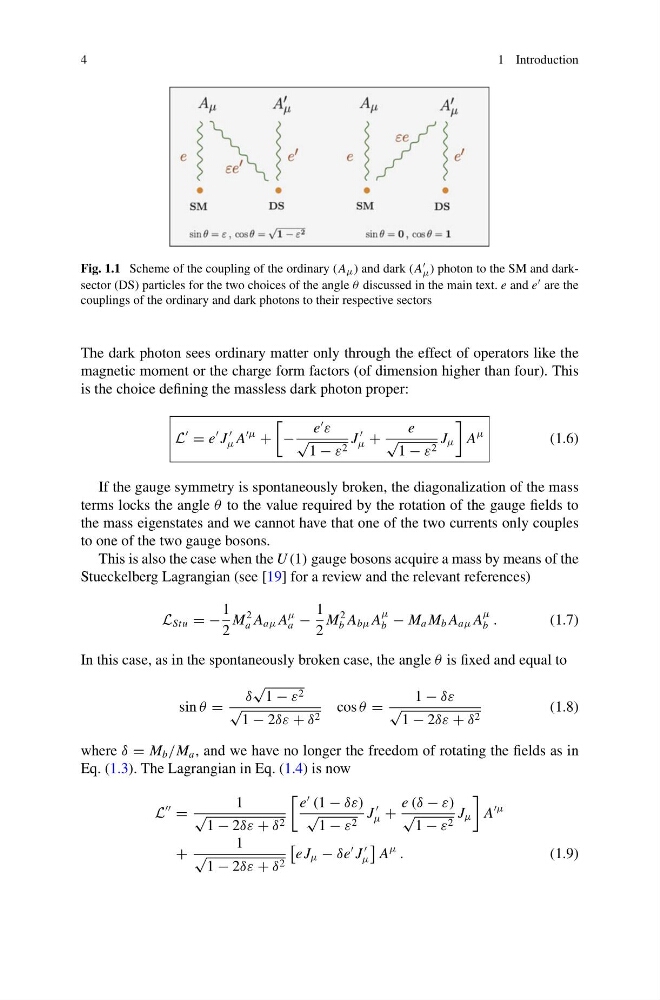
Fig. 1.1 Scheme of the coupling of the ordinary (A μ ) and dark (A
μ ) photon to the SM and darksector (DS) particles for the two choices of the angle θ discussed in the main text. e and e are the
couplings of the ordinary and dark photons to their respective sectors
The dark photon sees ordinary matter only through the effect of operators like the
magnetic moment or the charge form factors (of dimension higher than four). This
is the choice defining the massless dark photon proper:
L
= e
J
μ A
μ
+
−
e
ε
√
1 − ε 2
J
μ +
e
√
1 − ε 2
J μ
A
μ
(1.6)
If the gauge symmetry is spontaneously broken, the diagonalization of the mass
terms locks the angle θ to the value required by the rotation of the gauge fields to
the mass eigenstates and we cannot have that one of the two currents only couples
to one of the two gauge bosons.
This is also the case when the U (1) gauge bosons acquire a mass by means of the
Stueckelberg Lagrangian (see [19] for a review and the relevant references)
L Stu = −
1
2
M
2
a A aμ A
μ
a −
1
2
M
2
b A bμ A
μ
b − M a M b A aμ A
μ
b .
(1.7)
In this case, as in the spontaneously broken case, the angle θ is fixed and equal to
sin θ =
δ
√
1 − ε 2
√
1 − 2δε + δ 2
cos θ =
1 − δε
√
1 − 2δε + δ 2
(1.8)
where δ = M b /M a , and we have no longer the freedom of rotating the fields as in
Eq. (1.3). The Lagrangian in Eq. (1.4) is now
L
=
1
√
1 − 2δε + δ 2
e
(1 − δε)
√
1 − ε 2
J
μ +
e (δ − ε)
√
1 − ε 2
J μ
A
μ
+
1
√
1 − 2δε + δ 2
e J μ − δe
J
μ
A
μ
.
(1.9)
1 Introduction
Fig. 1.1 Scheme of the coupling of the ordinary (A μ ) and dark (A
μ ) photon to the SM and darksector (DS) particles for the two choices of the angle θ discussed in the main text. e and e are the
couplings of the ordinary and dark photons to their respective sectors
The dark photon sees ordinary matter only through the effect of operators like the
magnetic moment or the charge form factors (of dimension higher than four). This
is the choice defining the massless dark photon proper:
L
= e
J
μ A
μ
+
−
e
ε
√
1 − ε 2
J
μ +
e
√
1 − ε 2
J μ
A
μ
(1.6)
If the gauge symmetry is spontaneously broken, the diagonalization of the mass
terms locks the angle θ to the value required by the rotation of the gauge fields to
the mass eigenstates and we cannot have that one of the two currents only couples
to one of the two gauge bosons.
This is also the case when the U (1) gauge bosons acquire a mass by means of the
Stueckelberg Lagrangian (see [19] for a review and the relevant references)
L Stu = −
1
2
M
2
a A aμ A
μ
a −
1
2
M
2
b A bμ A
μ
b − M a M b A aμ A
μ
b .
(1.7)
In this case, as in the spontaneously broken case, the angle θ is fixed and equal to
sin θ =
δ
√
1 − ε 2
√
1 − 2δε + δ 2
cos θ =
1 − δε
√
1 − 2δε + δ 2
(1.8)
where δ = M b /M a , and we have no longer the freedom of rotating the fields as in
Eq. (1.3). The Lagrangian in Eq. (1.4) is now
L
=
1
√
1 − 2δε + δ 2
e
(1 − δε)
√
1 − ε 2
J
μ +
e (δ − ε)
√
1 − ε 2
J μ
A
μ
+
1
√
1 − 2δε + δ 2
e J μ − δe
J
μ
A
μ
.
(1.9)