

63
6.3.2 Assessing Access to ES
The assessment of the access to the four selected ES considered two main aspects,
mentioned in Table 6.1. First, service benefitting areas were identified based on the
flow of ES, by considering the specific spatial relation between providing and benefitting areas, direction, and scale that characterize each ES. Second, the presence
of physical or institutional barriers to access were verified in each case. The relevant
spatial characteristics of ES flow, the potential barriers to access, and the method
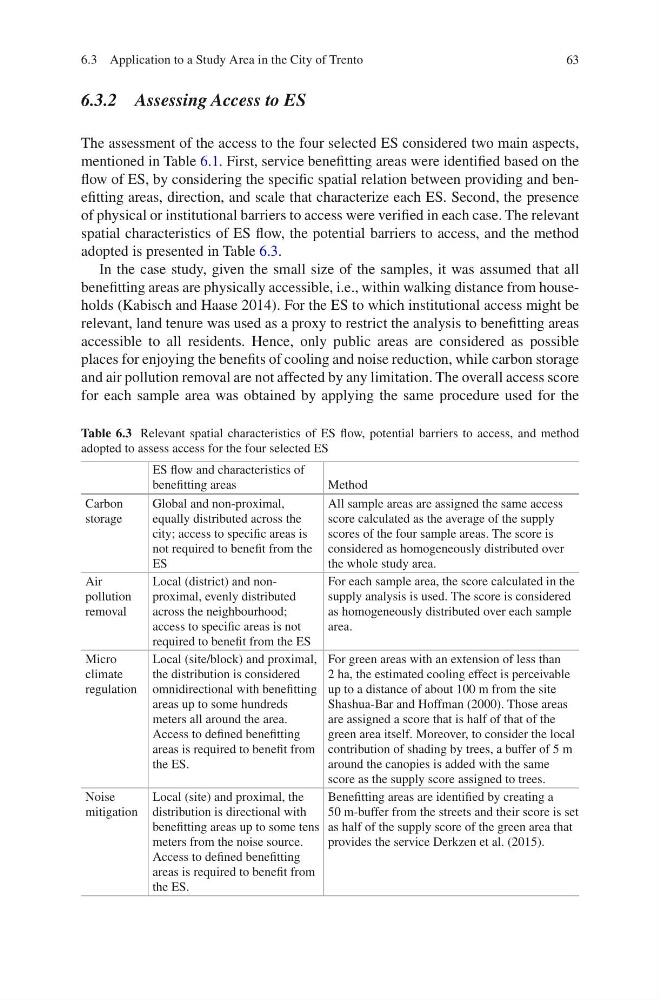
adopted is presented in Table 6.3.
In the case study, given the small size of the samples, it was assumed that all
benefitting areas are physically accessible, i.e., within walking distance from households (Kabisch and Haase 2014). For the ES to which institutional access might be
relevant, land tenure was used as a proxy to restrict the analysis to benefitting areas
accessible to all residents. Hence, only public areas are considered as possible
places for enjoying the benefits of cooling and noise reduction, while carbon storage
and air pollution removal are not affected by any limitation. The overall access score
for each sample area was obtained by applying the same procedure used for the
Table 6.3 Relevant spatial characteristics of ES flow, potential barriers to access, and method
adopted to assess access for the four selected ES
ES flow and characteristics of
benefitting areas
Method
Carbon
storage
Global and non-proximal,
equally distributed across the
city; access to specific areas is
not required to benefit from the
ES
All sample areas are assigned the same access
score calculated as the average of the supply
scores of the four sample areas. The score is
considered as homogeneously distributed over
the whole study area.
Air
pollution
removal
Local (district) and nonproximal, evenly distributed
across the neighbourhood;
access to specific areas is not
required to benefit from the ES
For each sample area, the score calculated in the
supply analysis is used. The score is considered
as homogeneously distributed over each sample
area.
Micro
climate
regulation
Local (site/block) and proximal,
the distribution is considered
omnidirectional with benefitting
areas up to some hundreds
meters all around the area.
Access to defined benefitting
areas is required to benefit from
the ES.
For green areas with an extension of less than
2 ha, the estimated cooling effect is perceivable
up to a distance of about 100 m from the site
Shashua-Bar and Hoffman (2000). Those areas
are assigned a score that is half of that of the
green area itself. Moreover, to consider the local
contribution of shading by trees, a buffer of 5 m
around the canopies is added with the same
score as the supply score assigned to trees.
Noise
mitigation
Local (site) and proximal, the
distribution is directional with
benefitting areas up to some tens
meters from the noise source.
Access to defined benefitting
areas is required to benefit from
the ES.
Benefitting areas are identified by creating a
50 m-buffer from the streets and their score is set
as half of the supply score of the green area that
provides the service Derkzen et al. (2015).
6.3 Application to a Study Area in the City of Trento
6.3.2 Assessing Access to ES
The assessment of the access to the four selected ES considered two main aspects,
mentioned in Table 6.1. First, service benefitting areas were identified based on the
flow of ES, by considering the specific spatial relation between providing and benefitting areas, direction, and scale that characterize each ES. Second, the presence
of physical or institutional barriers to access were verified in each case. The relevant
spatial characteristics of ES flow, the potential barriers to access, and the method
adopted is presented in Table 6.3.
In the case study, given the small size of the samples, it was assumed that all
benefitting areas are physically accessible, i.e., within walking distance from households (Kabisch and Haase 2014). For the ES to which institutional access might be
relevant, land tenure was used as a proxy to restrict the analysis to benefitting areas
accessible to all residents. Hence, only public areas are considered as possible
places for enjoying the benefits of cooling and noise reduction, while carbon storage
and air pollution removal are not affected by any limitation. The overall access score
for each sample area was obtained by applying the same procedure used for the
Table 6.3 Relevant spatial characteristics of ES flow, potential barriers to access, and method
adopted to assess access for the four selected ES
ES flow and characteristics of
benefitting areas
Method
Carbon
storage
Global and non-proximal,
equally distributed across the
city; access to specific areas is
not required to benefit from the
ES
All sample areas are assigned the same access
score calculated as the average of the supply
scores of the four sample areas. The score is
considered as homogeneously distributed over
the whole study area.
Air
pollution
removal
Local (district) and nonproximal, evenly distributed
across the neighbourhood;
access to specific areas is not
required to benefit from the ES
For each sample area, the score calculated in the
supply analysis is used. The score is considered
as homogeneously distributed over each sample
area.
Micro
climate
regulation
Local (site/block) and proximal,
the distribution is considered
omnidirectional with benefitting
areas up to some hundreds
meters all around the area.
Access to defined benefitting
areas is required to benefit from
the ES.
For green areas with an extension of less than
2 ha, the estimated cooling effect is perceivable
up to a distance of about 100 m from the site
Shashua-Bar and Hoffman (2000). Those areas
are assigned a score that is half of that of the
green area itself. Moreover, to consider the local
contribution of shading by trees, a buffer of 5 m
around the canopies is added with the same
score as the supply score assigned to trees.
Noise
mitigation
Local (site) and proximal, the
distribution is directional with
benefitting areas up to some tens
meters from the noise source.
Access to defined benefitting
areas is required to benefit from
the ES.
Benefitting areas are identified by creating a
50 m-buffer from the streets and their score is set
as half of the supply score of the green area that
provides the service Derkzen et al. (2015).
6.3 Application to a Study Area in the City of Trento