

60
6.3 Application to a Study Area in the City of Trento
A test application of the elements presented in the previous section has been conducted for different ES in the city of Trento (see Chap. 5 for more information about
the city). The assessment focused on four urban ES relevant in the local context.
Four 500-by-500 m sample areas were selected, roughly corresponding to four different residential neighbourhoods (see Fig. 6.1). The four sample areas are located
in the central part of the city, where population density is higher and presence of
public green spaces more limited than in the surrounding urban space, and are characterized by different socio-demographic conditions. The total extension of urban
ecosystems, including trees, grass and shrubs, and bare soil in the four sample areas
covers almost 300.000 m
2
, i.e. between one fourth and one third of the total surface.
The average per capita amount of green space is around 50 m
2
.
To compare the sample areas, four regulating ES were selected, namely, carbon
storage, air pollution removal, micro-climate regulation (cooling), and noise mitigation. The four ES differ significantly in terms of ecosystem functions that support
the provision, spatial relation between providing and benefitting areas, and type of
demand, hence they provide an interesting testbed to apply the elements described
in the previous section.
6.3.1 Assessing ES Supply
The assessment of the supply of the selected ES was based on average values for
different types of urban ecosystems retrieved from previous studies in urban contexts (McPhearson et al. 2013; Derkzen et al. 2015; Zardo et al. 2017). Table 6.2
summarizes the selected values harmonized with respect to four main land cover
types; namely, (i) built-up and sealed, (ii) bare soil, (iii) grass and shrubs, (iv) trees
and woodland. More in detail, carbon storage was estimated for coarse vegetation
(i.e. trees and woodland), fine vegetation (i.e., grass and shrubs), and soil adopting
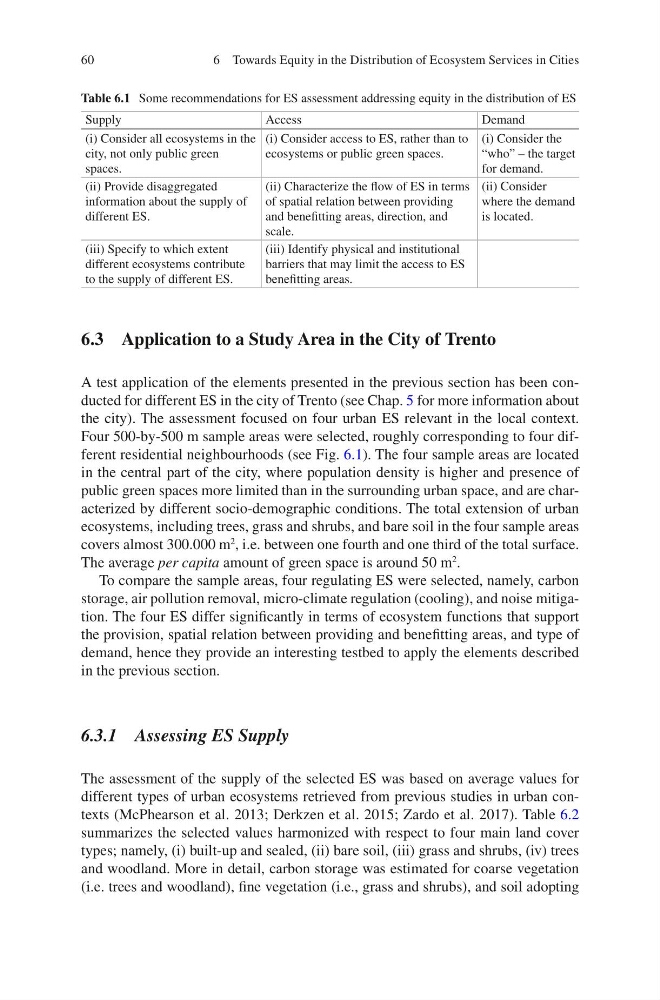
Table 6.1 Some recommendations for ES assessment addressing equity in the distribution of ES
Supply
Access
Demand
(i) Consider all ecosystems in the
city, not only public green
spaces.
(i) Consider access to ES, rather than to
ecosystems or public green spaces.
(i) Consider the
“who” – the target
for demand.
(ii) Provide disaggregated
information about the supply of
different ES.
(ii) Characterize the flow of ES in terms
of spatial relation between providing
and benefitting areas, direction, and
scale.
(ii) Consider
where the demand
is located.
(iii) Specify to which extent
different ecosystems contribute
to the supply of different ES.
(iii) Identify physical and institutional
barriers that may limit the access to ES
benefitting areas.
6 Towards Equity in the Distribution of Ecosystem Services in Cities
6.3 Application to a Study Area in the City of Trento
A test application of the elements presented in the previous section has been conducted for different ES in the city of Trento (see Chap. 5 for more information about
the city). The assessment focused on four urban ES relevant in the local context.
Four 500-by-500 m sample areas were selected, roughly corresponding to four different residential neighbourhoods (see Fig. 6.1). The four sample areas are located
in the central part of the city, where population density is higher and presence of
public green spaces more limited than in the surrounding urban space, and are characterized by different socio-demographic conditions. The total extension of urban
ecosystems, including trees, grass and shrubs, and bare soil in the four sample areas
covers almost 300.000 m
2
, i.e. between one fourth and one third of the total surface.
The average per capita amount of green space is around 50 m
2
.
To compare the sample areas, four regulating ES were selected, namely, carbon
storage, air pollution removal, micro-climate regulation (cooling), and noise mitigation. The four ES differ significantly in terms of ecosystem functions that support
the provision, spatial relation between providing and benefitting areas, and type of
demand, hence they provide an interesting testbed to apply the elements described
in the previous section.
6.3.1 Assessing ES Supply
The assessment of the supply of the selected ES was based on average values for
different types of urban ecosystems retrieved from previous studies in urban contexts (McPhearson et al. 2013; Derkzen et al. 2015; Zardo et al. 2017). Table 6.2
summarizes the selected values harmonized with respect to four main land cover
types; namely, (i) built-up and sealed, (ii) bare soil, (iii) grass and shrubs, (iv) trees
and woodland. More in detail, carbon storage was estimated for coarse vegetation
(i.e. trees and woodland), fine vegetation (i.e., grass and shrubs), and soil adopting
Table 6.1 Some recommendations for ES assessment addressing equity in the distribution of ES
Supply
Access
Demand
(i) Consider all ecosystems in the
city, not only public green
spaces.
(i) Consider access to ES, rather than to
ecosystems or public green spaces.
(i) Consider the
“who” – the target
for demand.
(ii) Provide disaggregated
information about the supply of
different ES.
(ii) Characterize the flow of ES in terms
of spatial relation between providing
and benefitting areas, direction, and
scale.
(ii) Consider
where the demand
is located.
(iii) Specify to which extent
different ecosystems contribute
to the supply of different ES.
(iii) Identify physical and institutional
barriers that may limit the access to ES
benefitting areas.
6 Towards Equity in the Distribution of Ecosystem Services in Cities