

48
to 100%. To assess opportunities for nature-based recreation, brownfields were
assigned to the land use class ‘green urban areas’, assuming the same presence of
infrastructures and facilities as in other parks of comparable size.
Similar indicators, based on the number of people affected by the transformation,
were used to assess the two ES. For each ES, vulnerable people, defined as citizens’
groups with a higher-than-average need for the specific service, were identified and
quantified as a sub-group of the total beneficiaries. In the case of cooling, beneficiaries were defined as citizens that experienced a positive change in the class of cooling
effect of their living place. Young children (< 5 years old) and the elderly (> 65 year
old) were selected as vulnerable groups, based on their higher sensitivity to heat
stress (Basu and Samet 2002; Kenny et al. 2010; Kabisch et al. 2017). In the case of
recreation, people living within 300 m from the new parks were considered as beneficiaries (Kabisch et al. 2016; Stessens et al. 2017). Children and teenagers (< 20 years
old) and the elderly (> 65 year old) were identified as vulnerable groups, based on the
higher demand for close-to-home recreation and relaxation areas (Kabisch and Haase
2014). Furthermore, those beneficiaries already served by high- level opportunities
for nature- based recreation in the current condition (i.e., living within 300 m from
areas classified in the highest class of ROS), were counted separately.
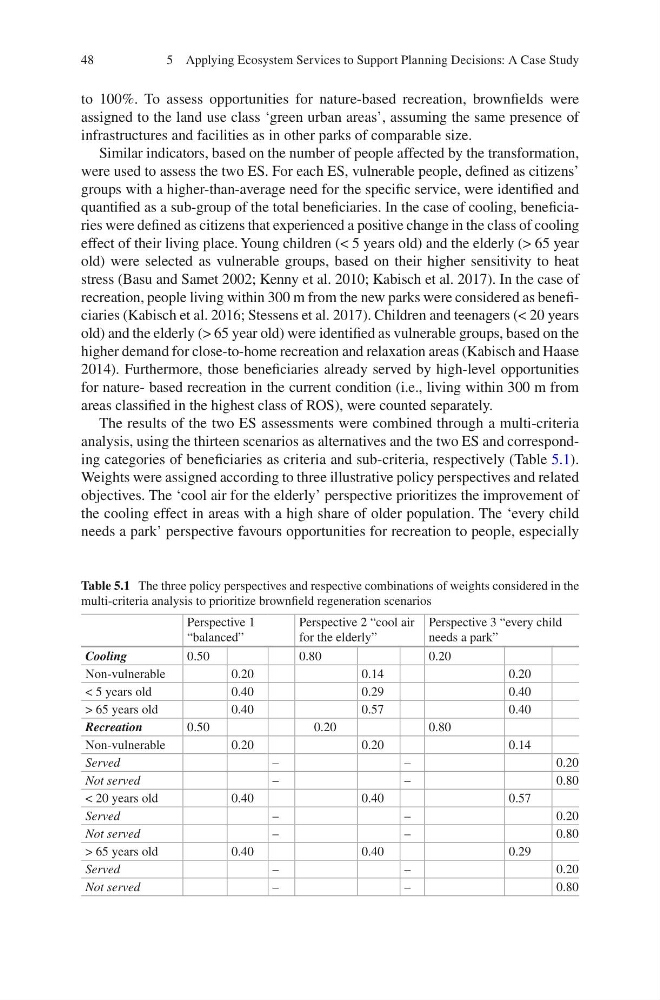
The results of the two ES assessments were combined through a multi-criteria
analysis, using the thirteen scenarios as alternatives and the two ES and corresponding categories of beneficiaries as criteria and sub-criteria, respectively (Table 5.1).
Weights were assigned according to three illustrative policy perspectives and related
objectives. The ‘cool air for the elderly’ perspective prioritizes the improvement of
the cooling effect in areas with a high share of older population. The ‘every child
needs a park’ perspective favours opportunities for recreation to people, especially
Table 5.1 The three policy perspectives and respective combinations of weights considered in the
multi-criteria analysis to prioritize brownfield regeneration scenarios
Perspective 1
“balanced”
Perspective 2 “cool air
for the elderly”
Perspective 3 “every child
needs a park”
Cooling
0.50
0.80
0.20
Non- vulnerable
0.20
0.14
0.20
< 5 years old
0.40
0.29
0.40
> 65 years old
0.40
0.57
0.40
Recreation
0.50
0.20
0.80
Non- vulnerable
0.20
0.20
0.14
Served
–
–
0.20
Not served
–
–
0.80
< 20 years old
0.40
0.40
0.57
Served
–
–
0.20
Not served
–
–
0.80
> 65 years old
0.40
0.40
0.29
Served
–
–
0.20
Not served
–
–
0.80
5 Applying Ecosystem Services to Support Planning Decisions: A Case Study
to 100%. To assess opportunities for nature-based recreation, brownfields were
assigned to the land use class ‘green urban areas’, assuming the same presence of
infrastructures and facilities as in other parks of comparable size.
Similar indicators, based on the number of people affected by the transformation,
were used to assess the two ES. For each ES, vulnerable people, defined as citizens’
groups with a higher-than-average need for the specific service, were identified and
quantified as a sub-group of the total beneficiaries. In the case of cooling, beneficiaries were defined as citizens that experienced a positive change in the class of cooling
effect of their living place. Young children (< 5 years old) and the elderly (> 65 year
old) were selected as vulnerable groups, based on their higher sensitivity to heat
stress (Basu and Samet 2002; Kenny et al. 2010; Kabisch et al. 2017). In the case of
recreation, people living within 300 m from the new parks were considered as beneficiaries (Kabisch et al. 2016; Stessens et al. 2017). Children and teenagers (< 20 years
old) and the elderly (> 65 year old) were identified as vulnerable groups, based on the
higher demand for close-to-home recreation and relaxation areas (Kabisch and Haase
2014). Furthermore, those beneficiaries already served by high- level opportunities
for nature- based recreation in the current condition (i.e., living within 300 m from
areas classified in the highest class of ROS), were counted separately.
The results of the two ES assessments were combined through a multi-criteria
analysis, using the thirteen scenarios as alternatives and the two ES and corresponding categories of beneficiaries as criteria and sub-criteria, respectively (Table 5.1).
Weights were assigned according to three illustrative policy perspectives and related
objectives. The ‘cool air for the elderly’ perspective prioritizes the improvement of
the cooling effect in areas with a high share of older population. The ‘every child
needs a park’ perspective favours opportunities for recreation to people, especially
Table 5.1 The three policy perspectives and respective combinations of weights considered in the
multi-criteria analysis to prioritize brownfield regeneration scenarios
Perspective 1
“balanced”
Perspective 2 “cool air
for the elderly”
Perspective 3 “every child
needs a park”
Cooling
0.50
0.80
0.20
Non- vulnerable
0.20
0.14
0.20
< 5 years old
0.40
0.29
0.40
> 65 years old
0.40
0.57
0.40
Recreation
0.50
0.20
0.80
Non- vulnerable
0.20
0.20
0.14
Served
–
–
0.20
Not served
–
–
0.80
< 20 years old
0.40
0.40
0.57
Served
–
–
0.20
Not served
–
–
0.80
> 65 years old
0.40
0.40
0.29
Served
–
–
0.20
Not served
–
–
0.80
5 Applying Ecosystem Services to Support Planning Decisions: A Case Study