

19
“internalization” that does not necessarily require rethinking or reshaping current
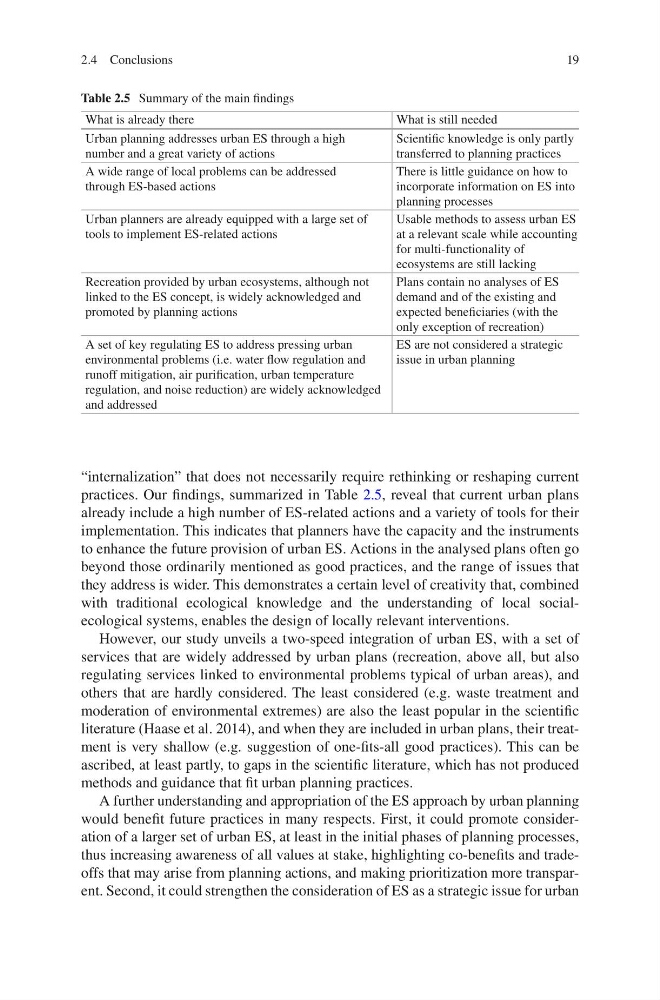
practices. Our findings, summarized in Table 2.5, reveal that current urban plans
already include a high number of ES-related actions and a variety of tools for their
implementation. This indicates that planners have the capacity and the instruments
to enhance the future provision of urban ES. Actions in the analysed plans often go
beyond those ordinarily mentioned as good practices, and the range of issues that
they address is wider. This demonstrates a certain level of creativity that, combined
with traditional ecological knowledge and the understanding of local socialecological systems, enables the design of locally relevant interventions.
However, our study unveils a two-speed integration of urban ES, with a set of
services that are widely addressed by urban plans (recreation, above all, but also
regulating services linked to environmental problems typical of urban areas), and
others that are hardly considered. The least considered (e.g. waste treatment and
moderation of environmental extremes) are also the least popular in the scientific
literature (Haase et al. 2014), and when they are included in urban plans, their treatment is very shallow (e.g. suggestion of one-fits-all good practices). This can be
ascribed, at least partly, to gaps in the scientific literature, which has not produced
methods and guidance that fit urban planning practices.
A further understanding and appropriation of the ES approach by urban planning
would benefit future practices in many respects. First, it could promote consideration of a larger set of urban ES, at least in the initial phases of planning processes,
thus increasing awareness of all values at stake, highlighting co-benefits and tradeoffs that may arise from planning actions, and making prioritization more transparent. Second, it could strengthen the consideration of ES as a strategic issue for urban
Table 2.5 Summary of the main findings
What is already there
What is still needed
Urban planning addresses urban ES through a high
number and a great variety of actions
Scientific knowledge is only partly
transferred to planning practices
A wide range of local problems can be addressed
through ES-based actions
There is little guidance on how to
incorporate information on ES into
planning processes
Urban planners are already equipped with a large set of
tools to implement ES-related actions
Usable methods to assess urban ES
at a relevant scale while accounting
for multi-functionality of
ecosystems are still lacking
Recreation provided by urban ecosystems, although not
linked to the ES concept, is widely acknowledged and
promoted by planning actions
Plans contain no analyses of ES
demand and of the existing and
expected beneficiaries (with the
only exception of recreation)
A set of key regulating ES to address pressing urban
environmental problems (i.e. water flow regulation and
runoff mitigation, air purification, urban temperature
regulation, and noise reduction) are widely acknowledged
and addressed
ES are not considered a strategic
issue in urban planning
2.4 Conclusions
“internalization” that does not necessarily require rethinking or reshaping current
practices. Our findings, summarized in Table 2.5, reveal that current urban plans
already include a high number of ES-related actions and a variety of tools for their
implementation. This indicates that planners have the capacity and the instruments
to enhance the future provision of urban ES. Actions in the analysed plans often go
beyond those ordinarily mentioned as good practices, and the range of issues that
they address is wider. This demonstrates a certain level of creativity that, combined
with traditional ecological knowledge and the understanding of local socialecological systems, enables the design of locally relevant interventions.
However, our study unveils a two-speed integration of urban ES, with a set of
services that are widely addressed by urban plans (recreation, above all, but also
regulating services linked to environmental problems typical of urban areas), and
others that are hardly considered. The least considered (e.g. waste treatment and
moderation of environmental extremes) are also the least popular in the scientific
literature (Haase et al. 2014), and when they are included in urban plans, their treatment is very shallow (e.g. suggestion of one-fits-all good practices). This can be
ascribed, at least partly, to gaps in the scientific literature, which has not produced
methods and guidance that fit urban planning practices.
A further understanding and appropriation of the ES approach by urban planning
would benefit future practices in many respects. First, it could promote consideration of a larger set of urban ES, at least in the initial phases of planning processes,
thus increasing awareness of all values at stake, highlighting co-benefits and tradeoffs that may arise from planning actions, and making prioritization more transparent. Second, it could strengthen the consideration of ES as a strategic issue for urban
Table 2.5 Summary of the main findings
What is already there
What is still needed
Urban planning addresses urban ES through a high
number and a great variety of actions
Scientific knowledge is only partly
transferred to planning practices
A wide range of local problems can be addressed
through ES-based actions
There is little guidance on how to
incorporate information on ES into
planning processes
Urban planners are already equipped with a large set of
tools to implement ES-related actions
Usable methods to assess urban ES
at a relevant scale while accounting
for multi-functionality of
ecosystems are still lacking
Recreation provided by urban ecosystems, although not
linked to the ES concept, is widely acknowledged and
promoted by planning actions
Plans contain no analyses of ES
demand and of the existing and
expected beneficiaries (with the
only exception of recreation)
A set of key regulating ES to address pressing urban
environmental problems (i.e. water flow regulation and
runoff mitigation, air purification, urban temperature
regulation, and noise reduction) are widely acknowledged
and addressed
ES are not considered a strategic
issue in urban planning
2.4 Conclusions