

Growing the Tree of Knowledge
43
becomes common, humans of the future will possess concepts that it is impossible for us to think today. With this expanded power of conceptualization, it
will be possible to develop science in ways which are now inconceivable.
Are Gestalts Real?
Are Gestalts real things of the world, or do groups of objects form unitary
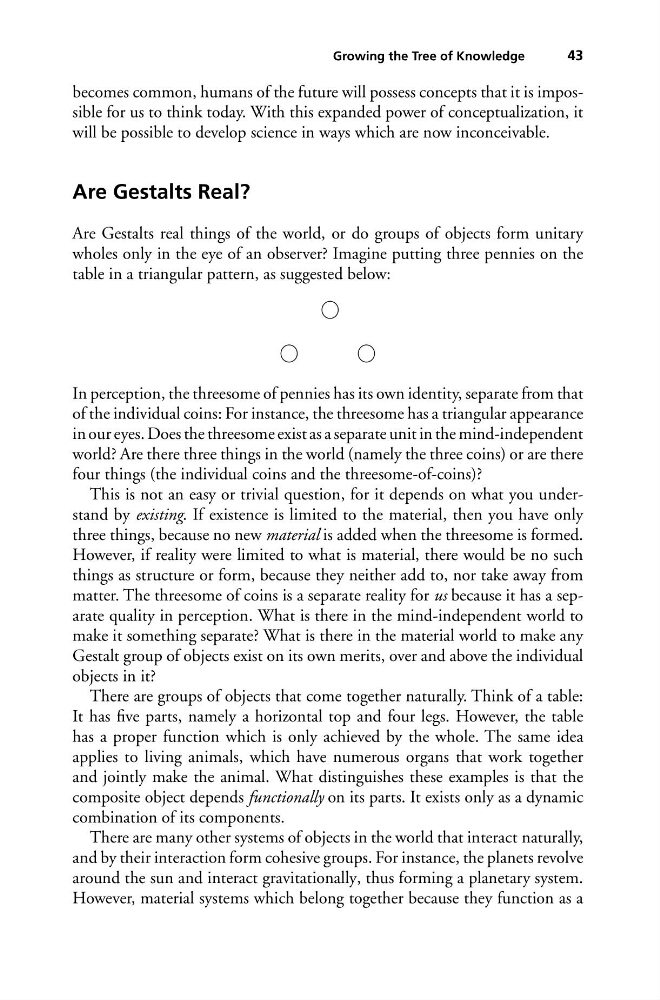
wholes only in the eye of an observer? Imagine putting three pennies on the
table in a triangular pattern, as suggested below:
In perception, the threesome of pennies has its own identity, separate from that
of the individual coins: For instance, the threesome has a triangular appearance
in our eyes. Does the threesome exist as a separate unit in the mind-independent
world? Are there three things in the world (namely the three coins) or are there
four things (the individual coins and the threesome-of-coins)?
This is not an easy or trivial question, for it depends on what you understand by existing. If existence is limited to the material, then you have only
three things, because no new material is added when the threesome is formed.
However, if reality were limited to what is material, there would be no such
things as structure or form, because they neither add to, nor take away from
matter. The threesome of coins is a separate reality for us because it has a separate quality in perception. What is there in the mind-independent world to
make it something separate? What is there in the material world to make any
Gestalt group of objects exist on its own merits, over and above the individual
objects in it?
There are groups of objects that come together naturally. Think of a table:
It has five parts, namely a horizontal top and four legs. However, the table
has a proper function which is only achieved by the whole. The same idea
applies to living animals, which have numerous organs that work together
and jointly make the animal. What distinguishes these examples is that the
composite object depends functionally on its parts. It exists only as a dynamic
combination of its components.
There are many other systems of objects in the world that interact naturally,
and by their interaction form cohesive groups. For instance, the planets revolve
around the sun and interact gravitationally, thus forming a planetary system.
However, material systems which belong together because they function as a
43
becomes common, humans of the future will possess concepts that it is impossible for us to think today. With this expanded power of conceptualization, it
will be possible to develop science in ways which are now inconceivable.
Are Gestalts Real?
Are Gestalts real things of the world, or do groups of objects form unitary
wholes only in the eye of an observer? Imagine putting three pennies on the
table in a triangular pattern, as suggested below:
In perception, the threesome of pennies has its own identity, separate from that
of the individual coins: For instance, the threesome has a triangular appearance
in our eyes. Does the threesome exist as a separate unit in the mind-independent
world? Are there three things in the world (namely the three coins) or are there
four things (the individual coins and the threesome-of-coins)?
This is not an easy or trivial question, for it depends on what you understand by existing. If existence is limited to the material, then you have only
three things, because no new material is added when the threesome is formed.
However, if reality were limited to what is material, there would be no such
things as structure or form, because they neither add to, nor take away from
matter. The threesome of coins is a separate reality for us because it has a separate quality in perception. What is there in the mind-independent world to
make it something separate? What is there in the material world to make any
Gestalt group of objects exist on its own merits, over and above the individual
objects in it?
There are groups of objects that come together naturally. Think of a table:
It has five parts, namely a horizontal top and four legs. However, the table
has a proper function which is only achieved by the whole. The same idea
applies to living animals, which have numerous organs that work together
and jointly make the animal. What distinguishes these examples is that the
composite object depends functionally on its parts. It exists only as a dynamic
combination of its components.
There are many other systems of objects in the world that interact naturally,
and by their interaction form cohesive groups. For instance, the planets revolve
around the sun and interact gravitationally, thus forming a planetary system.
However, material systems which belong together because they function as a