

406
S. Shi et al.
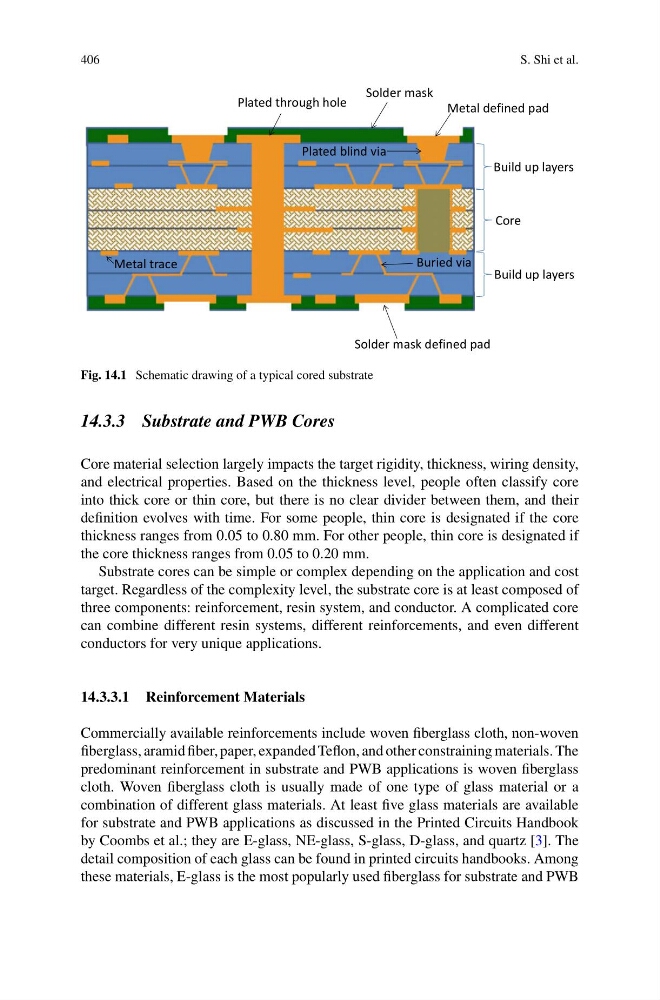
Core
Build up layers
Build up layers
Plated through hole
Solder mask
Buried via
Metal defined pad
Plated blind via
Solder mask defined pad
Metal trace
Fig. 14.1 Schematic drawing of a typical cored substrate
14.3.3 Substrate and PWB Cores
Core material selection largely impacts the target rigidity, thickness, wiring density,
and electrical properties. Based on the thickness level, people often classify core
into thick core or thin core, but there is no clear divider between them, and their
definition evolves with time. For some people, thin core is designated if the core
thickness ranges from 0.05 to 0.80 mm. For other people, thin core is designated if
the core thickness ranges from 0.05 to 0.20 mm.
Substrate cores can be simple or complex depending on the application and cost
target. Regardless of the complexity level, the substrate core is at least composed of
three components: reinforcement, resin system, and conductor. A complicated core
can combine different resin systems, different reinforcements, and even different
conductors for very unique applications.
14.3.3.1 Reinforcement Materials
Commercially available reinforcements include woven fiberglass cloth, non-woven
fiberglass, aramid fiber, paper, expanded Teflon, and other constraining materials. The
predominant reinforcement in substrate and PWB applications is woven fiberglass
cloth. Woven fiberglass cloth is usually made of one type of glass material or a
combination of different glass materials. At least five glass materials are available
for substrate and PWB applications as discussed in the Printed Circuits Handbook
by Coombs et al.; they are E-glass, NE-glass, S-glass, D-glass, and quartz [3]. The
detail composition of each glass can be found in printed circuits handbooks. Among
these materials, E-glass is the most popularly used fiberglass for substrate and PWB
S. Shi et al.
Core
Build up layers
Build up layers
Plated through hole
Solder mask
Buried via
Metal defined pad
Plated blind via
Solder mask defined pad
Metal trace
Fig. 14.1 Schematic drawing of a typical cored substrate
14.3.3 Substrate and PWB Cores
Core material selection largely impacts the target rigidity, thickness, wiring density,
and electrical properties. Based on the thickness level, people often classify core
into thick core or thin core, but there is no clear divider between them, and their
definition evolves with time. For some people, thin core is designated if the core
thickness ranges from 0.05 to 0.80 mm. For other people, thin core is designated if
the core thickness ranges from 0.05 to 0.20 mm.
Substrate cores can be simple or complex depending on the application and cost
target. Regardless of the complexity level, the substrate core is at least composed of
three components: reinforcement, resin system, and conductor. A complicated core
can combine different resin systems, different reinforcements, and even different
conductors for very unique applications.
14.3.3.1 Reinforcement Materials
Commercially available reinforcements include woven fiberglass cloth, non-woven
fiberglass, aramid fiber, paper, expanded Teflon, and other constraining materials. The
predominant reinforcement in substrate and PWB applications is woven fiberglass
cloth. Woven fiberglass cloth is usually made of one type of glass material or a
combination of different glass materials. At least five glass materials are available
for substrate and PWB applications as discussed in the Printed Circuits Handbook
by Coombs et al.; they are E-glass, NE-glass, S-glass, D-glass, and quartz [3]. The
detail composition of each glass can be found in printed circuits handbooks. Among
these materials, E-glass is the most popularly used fiberglass for substrate and PWB