

13 Fundamentals of Heat Dissipation in 3D IC Packaging …
381
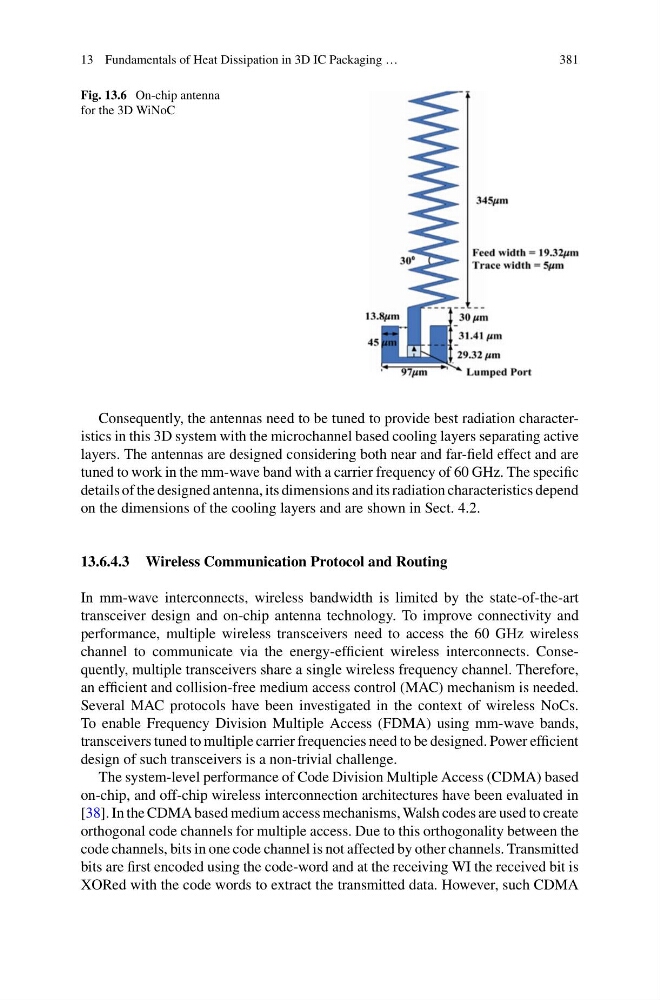
Fig. 13.6 On-chip antenna
for the 3D WiNoC
Consequently, the antennas need to be tuned to provide best radiation characteristics in this 3D system with the microchannel based cooling layers separating active
layers. The antennas are designed considering both near and far-field effect and are
tuned to work in the mm-wave band with a carrier frequency of 60 GHz. The specific
details of the designed antenna, its dimensions and its radiation characteristics depend
on the dimensions of the cooling layers and are shown in Sect. 4.2.
13.6.4.3 Wireless Communication Protocol and Routing
In mm-wave interconnects, wireless bandwidth is limited by the state-of-the-art
transceiver design and on-chip antenna technology. To improve connectivity and
performance, multiple wireless transceivers need to access the 60 GHz wireless
channel to communicate via the energy-efficient wireless interconnects. Consequently, multiple transceivers share a single wireless frequency channel. Therefore,
an efficient and collision-free medium access control (MAC) mechanism is needed.
Several MAC protocols have been investigated in the context of wireless NoCs.
To enable Frequency Division Multiple Access (FDMA) using mm-wave bands,
transceivers tuned to multiple carrier frequencies need to be designed. Power efficient
design of such transceivers is a non-trivial challenge.
The system-level performance of Code Division Multiple Access (CDMA) based
on-chip, and off-chip wireless interconnection architectures have been evaluated in
[38]. In the CDMA based medium access mechanisms, Walsh codes are used to create
orthogonal code channels for multiple access. Due to this orthogonality between the
code channels, bits in one code channel is not affected by other channels. Transmitted
bits are first encoded using the code-word and at the receiving WI the received bit is
XORed with the code words to extract the transmitted data. However, such CDMA
381
Fig. 13.6 On-chip antenna
for the 3D WiNoC
Consequently, the antennas need to be tuned to provide best radiation characteristics in this 3D system with the microchannel based cooling layers separating active
layers. The antennas are designed considering both near and far-field effect and are
tuned to work in the mm-wave band with a carrier frequency of 60 GHz. The specific
details of the designed antenna, its dimensions and its radiation characteristics depend
on the dimensions of the cooling layers and are shown in Sect. 4.2.
13.6.4.3 Wireless Communication Protocol and Routing
In mm-wave interconnects, wireless bandwidth is limited by the state-of-the-art
transceiver design and on-chip antenna technology. To improve connectivity and
performance, multiple wireless transceivers need to access the 60 GHz wireless
channel to communicate via the energy-efficient wireless interconnects. Consequently, multiple transceivers share a single wireless frequency channel. Therefore,
an efficient and collision-free medium access control (MAC) mechanism is needed.
Several MAC protocols have been investigated in the context of wireless NoCs.
To enable Frequency Division Multiple Access (FDMA) using mm-wave bands,
transceivers tuned to multiple carrier frequencies need to be designed. Power efficient
design of such transceivers is a non-trivial challenge.
The system-level performance of Code Division Multiple Access (CDMA) based
on-chip, and off-chip wireless interconnection architectures have been evaluated in
[38]. In the CDMA based medium access mechanisms, Walsh codes are used to create
orthogonal code channels for multiple access. Due to this orthogonality between the
code channels, bits in one code channel is not affected by other channels. Transmitted
bits are first encoded using the code-word and at the receiving WI the received bit is
XORed with the code words to extract the transmitted data. However, such CDMA