

234
Y. Dai and C. S. Tan
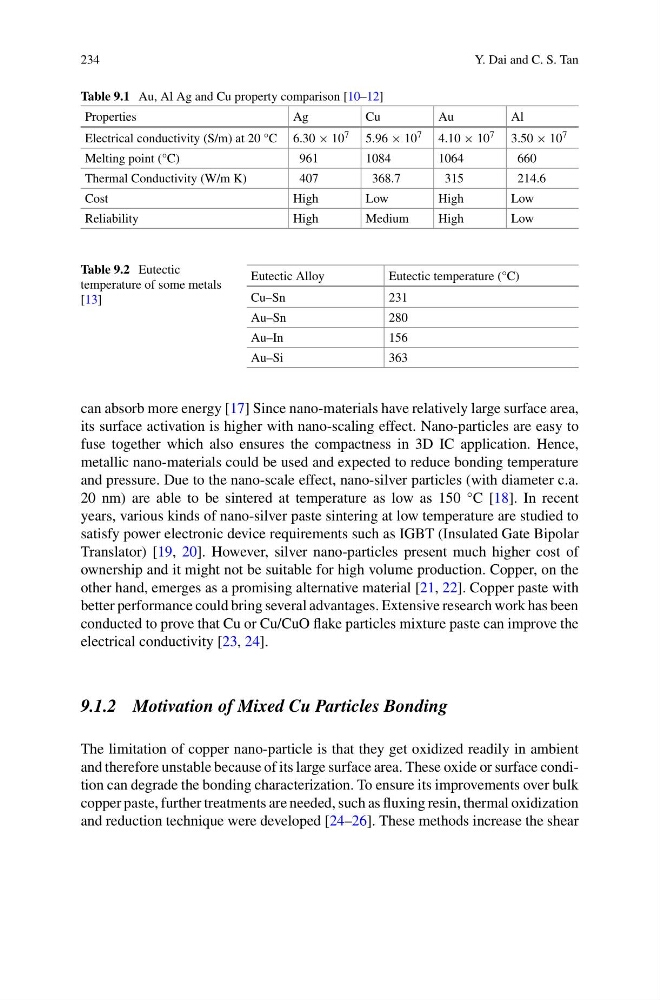
Table 9.1 Au, Al Ag and Cu property comparison [10–12]
Properties
Ag
Cu
Au
Al
Electrical conductivity (S/m) at 20 °C 6.30 × 10 7 5.96 × 10 7 4.10 × 10 7 3.50 × 10 7
Melting point (°C)
961
1084
1064
660
Thermal Conductivity (W/m K)
407
368.7
315
214.6
Cost
High
Low
High
Low
Reliability
High
Medium
High
Low
Table 9.2 Eutectic
temperature of some metals
[13]
Eutectic Alloy
Eutectic temperature (°C)
Cu–Sn
231
Au–Sn
280
Au–In
156
Au–Si
363
can absorb more energy [17] Since nano-materials have relatively large surface area,
its surface activation is higher with nano-scaling effect. Nano-particles are easy to
fuse together which also ensures the compactness in 3D IC application. Hence,
metallic nano-materials could be used and expected to reduce bonding temperature
and pressure. Due to the nano-scale effect, nano-silver particles (with diameter c.a.
20 nm) are able to be sintered at temperature as low as 150 °C [18]. In recent
years, various kinds of nano-silver paste sintering at low temperature are studied to
satisfy power electronic device requirements such as IGBT (Insulated Gate Bipolar
Translator) [19, 20]. However, silver nano-particles present much higher cost of
ownership and it might not be suitable for high volume production. Copper, on the
other hand, emerges as a promising alternative material [21, 22]. Copper paste with
better performance could bring several advantages. Extensive research work has been
conducted to prove that Cu or Cu/CuO flake particles mixture paste can improve the
electrical conductivity [23, 24].
9.1.2 Motivation of Mixed Cu Particles Bonding
The limitation of copper nano-particle is that they get oxidized readily in ambient
and therefore unstable because of its large surface area. These oxide or surface condition can degrade the bonding characterization. To ensure its improvements over bulk
copper paste, further treatments are needed, such as fluxing resin, thermal oxidization
and reduction technique were developed [24–26]. These methods increase the shear
Y. Dai and C. S. Tan
Table 9.1 Au, Al Ag and Cu property comparison [10–12]
Properties
Ag
Cu
Au
Al
Electrical conductivity (S/m) at 20 °C 6.30 × 10 7 5.96 × 10 7 4.10 × 10 7 3.50 × 10 7
Melting point (°C)
961
1084
1064
660
Thermal Conductivity (W/m K)
407
368.7
315
214.6
Cost
High
Low
High
Low
Reliability
High
Medium
High
Low
Table 9.2 Eutectic
temperature of some metals
[13]
Eutectic Alloy
Eutectic temperature (°C)
Cu–Sn
231
Au–Sn
280
Au–In
156
Au–Si
363
can absorb more energy [17] Since nano-materials have relatively large surface area,
its surface activation is higher with nano-scaling effect. Nano-particles are easy to
fuse together which also ensures the compactness in 3D IC application. Hence,
metallic nano-materials could be used and expected to reduce bonding temperature
and pressure. Due to the nano-scale effect, nano-silver particles (with diameter c.a.
20 nm) are able to be sintered at temperature as low as 150 °C [18]. In recent
years, various kinds of nano-silver paste sintering at low temperature are studied to
satisfy power electronic device requirements such as IGBT (Insulated Gate Bipolar
Translator) [19, 20]. However, silver nano-particles present much higher cost of
ownership and it might not be suitable for high volume production. Copper, on the
other hand, emerges as a promising alternative material [21, 22]. Copper paste with
better performance could bring several advantages. Extensive research work has been
conducted to prove that Cu or Cu/CuO flake particles mixture paste can improve the
electrical conductivity [23, 24].
9.1.2 Motivation of Mixed Cu Particles Bonding
The limitation of copper nano-particle is that they get oxidized readily in ambient
and therefore unstable because of its large surface area. These oxide or surface condition can degrade the bonding characterization. To ensure its improvements over bulk
copper paste, further treatments are needed, such as fluxing resin, thermal oxidization
and reduction technique were developed [24–26]. These methods increase the shear