

168
H. Ma et al.
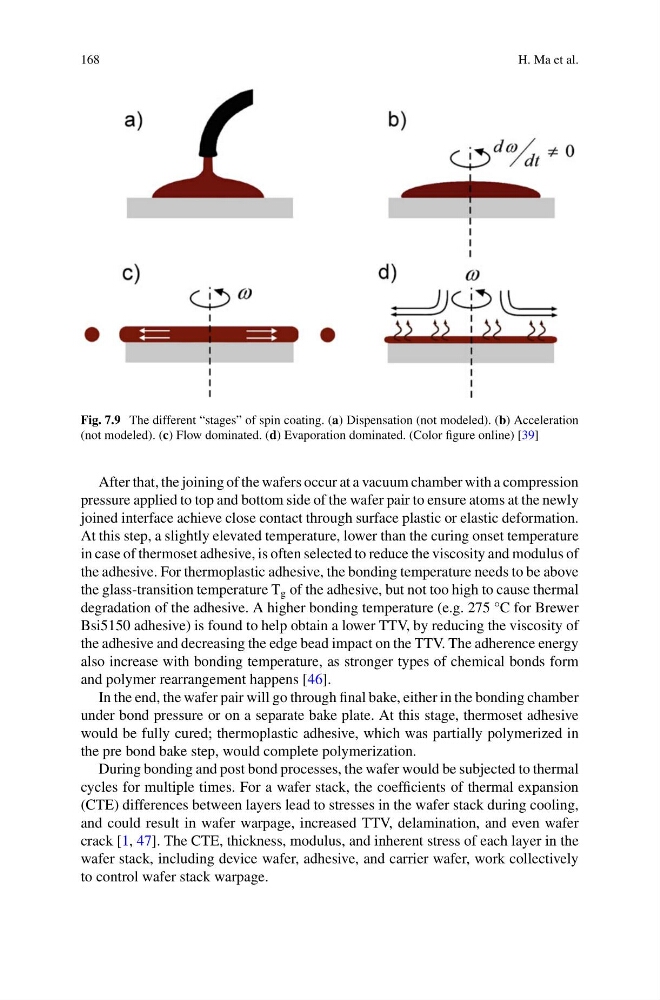
Fig. 7.9 The different “stages” of spin coating. (a) Dispensation (not modeled). (b) Acceleration
(not modeled). (c) Flow dominated. (d) Evaporation dominated. (Color figure online) [39]
After that, the joining of the wafers occur at a vacuum chamber with a compression
pressure applied to top and bottom side of the wafer pair to ensure atoms at the newly
joined interface achieve close contact through surface plastic or elastic deformation.
At this step, a slightly elevated temperature, lower than the curing onset temperature
in case of thermoset adhesive, is often selected to reduce the viscosity and modulus of
the adhesive. For thermoplastic adhesive, the bonding temperature needs to be above
the glass-transition temperature T g of the adhesive, but not too high to cause thermal
degradation of the adhesive. A higher bonding temperature (e.g. 275 °C for Brewer
Bsi5150 adhesive) is found to help obtain a lower TTV, by reducing the viscosity of
the adhesive and decreasing the edge bead impact on the TTV. The adherence energy
also increase with bonding temperature, as stronger types of chemical bonds form
and polymer rearrangement happens [46].
In the end, the wafer pair will go through final bake, either in the bonding chamber
under bond pressure or on a separate bake plate. At this stage, thermoset adhesive
would be fully cured; thermoplastic adhesive, which was partially polymerized in
the pre bond bake step, would complete polymerization.
During bonding and post bond processes, the wafer would be subjected to thermal
cycles for multiple times. For a wafer stack, the coefficients of thermal expansion
(CTE) differences between layers lead to stresses in the wafer stack during cooling,
and could result in wafer warpage, increased TTV, delamination, and even wafer
crack [1, 47]. The CTE, thickness, modulus, and inherent stress of each layer in the
wafer stack, including device wafer, adhesive, and carrier wafer, work collectively
to control wafer stack warpage.
H. Ma et al.
Fig. 7.9 The different “stages” of spin coating. (a) Dispensation (not modeled). (b) Acceleration
(not modeled). (c) Flow dominated. (d) Evaporation dominated. (Color figure online) [39]
After that, the joining of the wafers occur at a vacuum chamber with a compression
pressure applied to top and bottom side of the wafer pair to ensure atoms at the newly
joined interface achieve close contact through surface plastic or elastic deformation.
At this step, a slightly elevated temperature, lower than the curing onset temperature
in case of thermoset adhesive, is often selected to reduce the viscosity and modulus of
the adhesive. For thermoplastic adhesive, the bonding temperature needs to be above
the glass-transition temperature T g of the adhesive, but not too high to cause thermal
degradation of the adhesive. A higher bonding temperature (e.g. 275 °C for Brewer
Bsi5150 adhesive) is found to help obtain a lower TTV, by reducing the viscosity of
the adhesive and decreasing the edge bead impact on the TTV. The adherence energy
also increase with bonding temperature, as stronger types of chemical bonds form
and polymer rearrangement happens [46].
In the end, the wafer pair will go through final bake, either in the bonding chamber
under bond pressure or on a separate bake plate. At this stage, thermoset adhesive
would be fully cured; thermoplastic adhesive, which was partially polymerized in
the pre bond bake step, would complete polymerization.
During bonding and post bond processes, the wafer would be subjected to thermal
cycles for multiple times. For a wafer stack, the coefficients of thermal expansion
(CTE) differences between layers lead to stresses in the wafer stack during cooling,
and could result in wafer warpage, increased TTV, delamination, and even wafer
crack [1, 47]. The CTE, thickness, modulus, and inherent stress of each layer in the
wafer stack, including device wafer, adhesive, and carrier wafer, work collectively
to control wafer stack warpage.