

5 Phase-Field-Crystal Model: A Tool for Probing Atoms in TSV
117
c111fm = FindMaximum[Subscript[C, 2 _ 111], k]
c111m = c111fm[[1]];
c111mp = k /. c111fm[[2]];
c200fm = FindMaximum[Subscript[C, 2 _ 200], k]
c200m = c200fm[[1]];
c200mp = k /. c200fm[[2]];
c111cp = Max[k /. Solve[Subscript[C, 2 _ 111] == c111m/1.5, k]];
(*Model parameter for two-mode PFC*)
fsol = NSolve[
Cwu[c111mp] == c111m && Cwu[c111cp] == c111m/1.5 &&
Cwu[c200mp] == c200m, {r, Bx, R1}]
p4 = Plot[Cwu[k] /. fsol[[1]], {k, 0, 3}, PlotRange -> 1.5,
PlotStyle -> Red];
Show[p1, p2, p4]
Expand[Cwu[k] /. fsol[[1]]]
5.2.4 Governing Equation
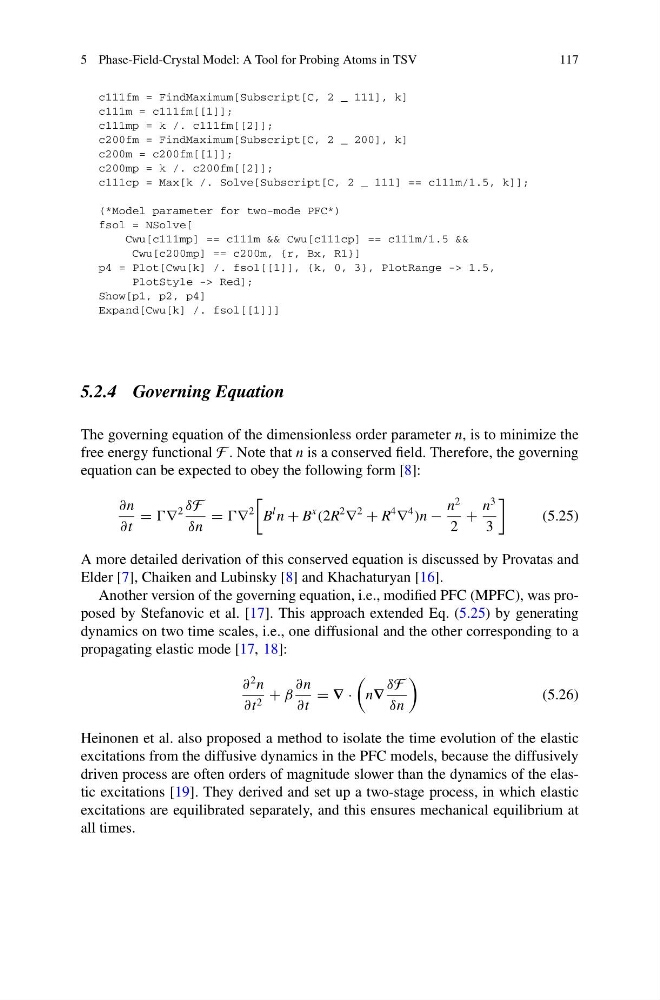
The governing equation of the dimensionless order parameter n, is to minimize the
free energy functional F . Note that n is a conserved field. Therefore, the governing
equation can be expected to obey the following form [8]:
∂n
∂t
= ∇
2 δF
δn
= ∇
2
B
l n + B
x
(2R
2
∇
2
+ R
4
∇
4
)n −
n
2
2
+
n
3
3
(5.25)
A more detailed derivation of this conserved equation is discussed by Provatas and
Elder [7], Chaiken and Lubinsky [8] and Khachaturyan [16].
Another version of the governing equation, i.e., modified PFC (MPFC), was proposed by Stefanovic et al. [17]. This approach extended Eq. (5.25) by generating
dynamics on two time scales, i.e., one diffusional and the other corresponding to a
propagating elastic mode [17, 18]:
∂
2 n
∂t 2 + β
∂n
∂t
= ∇ ·
n∇
δF
δn
(5.26)
Heinonen et al. also proposed a method to isolate the time evolution of the elastic
excitations from the diffusive dynamics in the PFC models, because the diffusively
driven process are often orders of magnitude slower than the dynamics of the elastic excitations [19]. They derived and set up a two-stage process, in which elastic
excitations are equilibrated separately, and this ensures mechanical equilibrium at
all times.
117
c111fm = FindMaximum[Subscript[C, 2 _ 111], k]
c111m = c111fm[[1]];
c111mp = k /. c111fm[[2]];
c200fm = FindMaximum[Subscript[C, 2 _ 200], k]
c200m = c200fm[[1]];
c200mp = k /. c200fm[[2]];
c111cp = Max[k /. Solve[Subscript[C, 2 _ 111] == c111m/1.5, k]];
(*Model parameter for two-mode PFC*)
fsol = NSolve[
Cwu[c111mp] == c111m && Cwu[c111cp] == c111m/1.5 &&
Cwu[c200mp] == c200m, {r, Bx, R1}]
p4 = Plot[Cwu[k] /. fsol[[1]], {k, 0, 3}, PlotRange -> 1.5,
PlotStyle -> Red];
Show[p1, p2, p4]
Expand[Cwu[k] /. fsol[[1]]]
5.2.4 Governing Equation
The governing equation of the dimensionless order parameter n, is to minimize the
free energy functional F . Note that n is a conserved field. Therefore, the governing
equation can be expected to obey the following form [8]:
∂n
∂t
= ∇
2 δF
δn
= ∇
2
B
l n + B
x
(2R
2
∇
2
+ R
4
∇
4
)n −
n
2
2
+
n
3
3
(5.25)
A more detailed derivation of this conserved equation is discussed by Provatas and
Elder [7], Chaiken and Lubinsky [8] and Khachaturyan [16].
Another version of the governing equation, i.e., modified PFC (MPFC), was proposed by Stefanovic et al. [17]. This approach extended Eq. (5.25) by generating
dynamics on two time scales, i.e., one diffusional and the other corresponding to a
propagating elastic mode [17, 18]:
∂
2 n
∂t 2 + β
∂n
∂t
= ∇ ·
n∇
δF
δn
(5.26)
Heinonen et al. also proposed a method to isolate the time evolution of the elastic
excitations from the diffusive dynamics in the PFC models, because the diffusively
driven process are often orders of magnitude slower than the dynamics of the elastic excitations [19]. They derived and set up a two-stage process, in which elastic
excitations are equilibrated separately, and this ensures mechanical equilibrium at
all times.