

80
rice straw has been demonstrated when methane production yield was found 7.9 and
13% higher, respectively, for sizes of 0.30 and 0.75 mm compared to 1.5 mm
(Chandra et al. 2015). Sharma et al. (1988) reported that methane production tends
to increase by from 43.5 to 52.0% when the particle size was gradually reduced
from 30 mm to 0.088 mm. However, rice straw sizes under 0.5 mm could be detrimental to the methane production process due to excessive accumulation of volatile
fatty acids (VFAs) that will reduce pH in biogas reactor, causing inhibition of anaerobic organisms.
Methane production from rice straw with sizes of 2, 5, and 10 mm illustrates that
there is no significant difference among treatments, but compared to the untreated
straw, methane production is from 8.3 to 9.3% higher. Comparing the methane
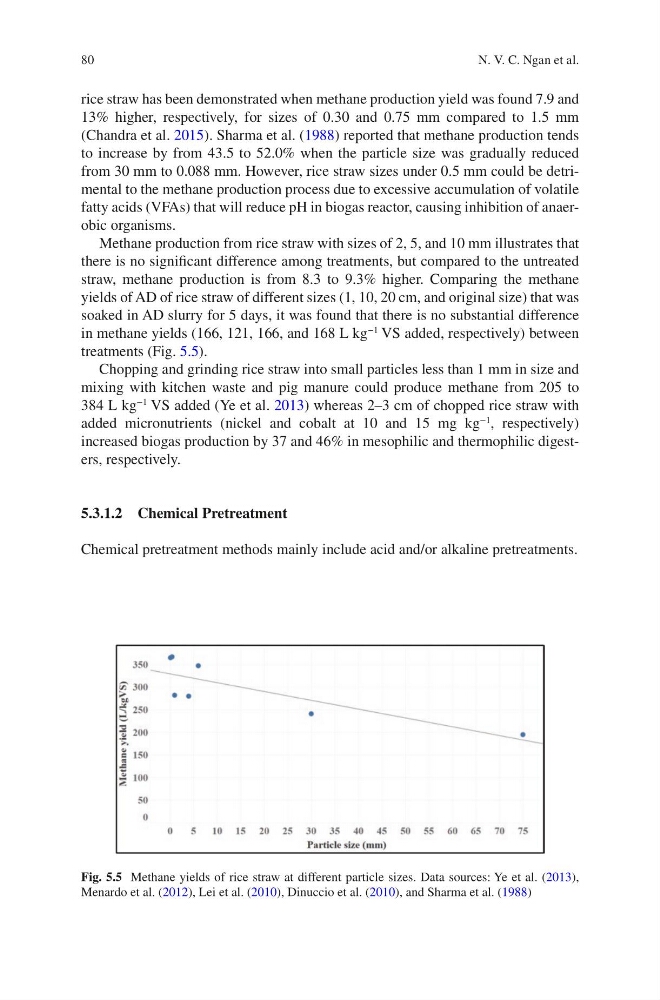
yields of AD of rice straw of different sizes (1, 10, 20 cm, and original size) that was
soaked in AD slurry for 5 days, it was found that there is no substantial difference
in methane yields (166, 121, 166, and 168 L kg
−1
VS added, respectively) between
treatments (Fig. 5.5).
Chopping and grinding rice straw into small particles less than 1 mm in size and
mixing with kitchen waste and pig manure could produce methane from 205 to
384 L kg
−1
VS added (Ye et al. 2013) whereas 2–3 cm of chopped rice straw with
added micronutrients (nickel and cobalt at 10 and 15 mg kg
−1
, respectively)
increased biogas production by 37 and 46% in mesophilic and thermophilic digesters, respectively.
5.3.1.2 Chemical Pretreatment
Chemical pretreatment methods mainly include acid and/or alkaline pretreatments.
Fig. 5.5 Methane yields of rice straw at different particle sizes. Data sources: Ye et al. (2013),
Menardo et al. (2012), Lei et al. (2010), Dinuccio et al. (2010), and Sharma et al. (1988)
N. V. C. Ngan et al.
rice straw has been demonstrated when methane production yield was found 7.9 and
13% higher, respectively, for sizes of 0.30 and 0.75 mm compared to 1.5 mm
(Chandra et al. 2015). Sharma et al. (1988) reported that methane production tends
to increase by from 43.5 to 52.0% when the particle size was gradually reduced
from 30 mm to 0.088 mm. However, rice straw sizes under 0.5 mm could be detrimental to the methane production process due to excessive accumulation of volatile
fatty acids (VFAs) that will reduce pH in biogas reactor, causing inhibition of anaerobic organisms.
Methane production from rice straw with sizes of 2, 5, and 10 mm illustrates that
there is no significant difference among treatments, but compared to the untreated
straw, methane production is from 8.3 to 9.3% higher. Comparing the methane
yields of AD of rice straw of different sizes (1, 10, 20 cm, and original size) that was
soaked in AD slurry for 5 days, it was found that there is no substantial difference
in methane yields (166, 121, 166, and 168 L kg
−1
VS added, respectively) between
treatments (Fig. 5.5).
Chopping and grinding rice straw into small particles less than 1 mm in size and
mixing with kitchen waste and pig manure could produce methane from 205 to
384 L kg
−1
VS added (Ye et al. 2013) whereas 2–3 cm of chopped rice straw with
added micronutrients (nickel and cobalt at 10 and 15 mg kg
−1
, respectively)
increased biogas production by 37 and 46% in mesophilic and thermophilic digesters, respectively.
5.3.1.2 Chemical Pretreatment
Chemical pretreatment methods mainly include acid and/or alkaline pretreatments.
Fig. 5.5 Methane yields of rice straw at different particle sizes. Data sources: Ye et al. (2013),
Menardo et al. (2012), Lei et al. (2010), Dinuccio et al. (2010), and Sharma et al. (1988)
N. V. C. Ngan et al.