

76
5.2.1.1 Biogas Plants Constructed On-Site
These plants include widely developed and used technologies such as fixed- dome,
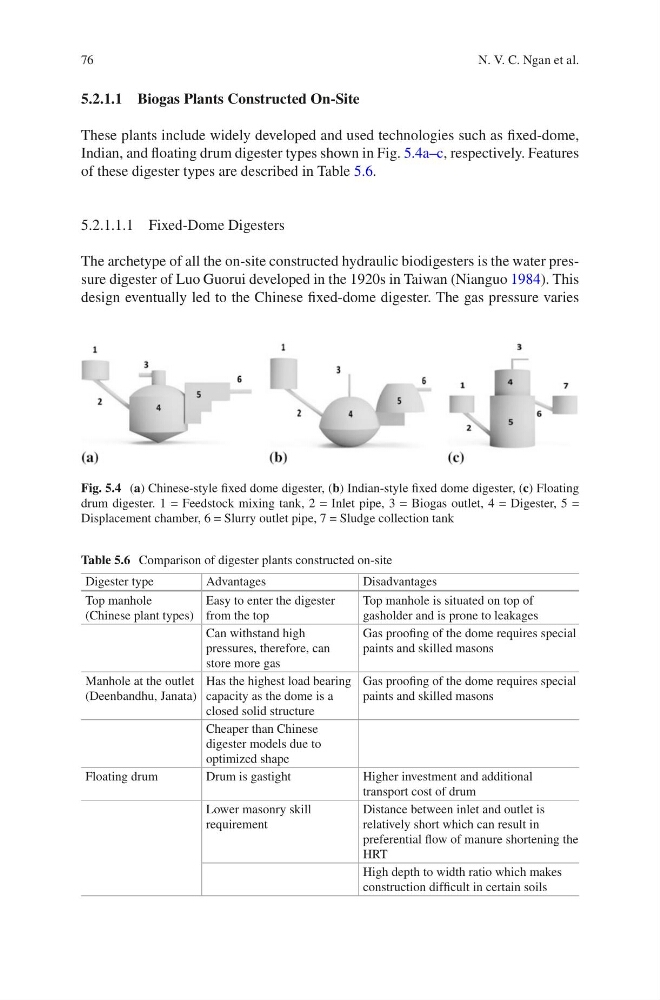
Indian, and floating drum digester types shown in Fig. 5.4a–c, respectively. Features
of these digester types are described in Table 5.6.
5.2.1.1.1 Fixed-Dome Digesters
The archetype of all the on-site constructed hydraulic biodigesters is the water pressure digester of Luo Guorui developed in the 1920s in Taiwan (Nianguo 1984). This
design eventually led to the Chinese fixed-dome digester. The gas pressure varies
Fig. 5.4 (a) Chinese-style fixed dome digester, (b) Indian-style fixed dome digester, (c) Floating
drum digester. 1 = Feedstock mixing tank, 2 = Inlet pipe, 3 = Biogas outlet, 4 = Digester, 5 =
Displacement chamber, 6 = Slurry outlet pipe, 7 = Sludge collection tank
Table 5.6 Comparison of digester plants constructed on-site
Digester type
Advantages
Disadvantages
Top manhole
(Chinese plant types)
Easy to enter the digester
from the top
Top manhole is situated on top of
gasholder and is prone to leakages
Can withstand high
pressures, therefore, can
store more gas
Gas proofing of the dome requires special
paints and skilled masons
Manhole at the outlet
(Deenbandhu, Janata)
Has the highest load bearing
capacity as the dome is a
closed solid structure
Gas proofing of the dome requires special
paints and skilled masons
Cheaper than Chinese
digester models due to
optimized shape
Floating drum
Drum is gastight
Higher investment and additional
transport cost of drum
Lower masonry skill
requirement
Distance between inlet and outlet is
relatively short which can result in
preferential flow of manure shortening the
HRT
High depth to width ratio which makes
construction difficult in certain soils
N. V. C. Ngan et al.
5.2.1.1 Biogas Plants Constructed On-Site
These plants include widely developed and used technologies such as fixed- dome,
Indian, and floating drum digester types shown in Fig. 5.4a–c, respectively. Features
of these digester types are described in Table 5.6.
5.2.1.1.1 Fixed-Dome Digesters
The archetype of all the on-site constructed hydraulic biodigesters is the water pressure digester of Luo Guorui developed in the 1920s in Taiwan (Nianguo 1984). This
design eventually led to the Chinese fixed-dome digester. The gas pressure varies
Fig. 5.4 (a) Chinese-style fixed dome digester, (b) Indian-style fixed dome digester, (c) Floating
drum digester. 1 = Feedstock mixing tank, 2 = Inlet pipe, 3 = Biogas outlet, 4 = Digester, 5 =
Displacement chamber, 6 = Slurry outlet pipe, 7 = Sludge collection tank
Table 5.6 Comparison of digester plants constructed on-site
Digester type
Advantages
Disadvantages
Top manhole
(Chinese plant types)
Easy to enter the digester
from the top
Top manhole is situated on top of
gasholder and is prone to leakages
Can withstand high
pressures, therefore, can
store more gas
Gas proofing of the dome requires special
paints and skilled masons
Manhole at the outlet
(Deenbandhu, Janata)
Has the highest load bearing
capacity as the dome is a
closed solid structure
Gas proofing of the dome requires special
paints and skilled masons
Cheaper than Chinese
digester models due to
optimized shape
Floating drum
Drum is gastight
Higher investment and additional
transport cost of drum
Lower masonry skill
requirement
Distance between inlet and outlet is
relatively short which can result in
preferential flow of manure shortening the
HRT
High depth to width ratio which makes
construction difficult in certain soils
N. V. C. Ngan et al.