

66
5.1 Introduction of Anaerobic Digestion Technology
5.1.1 Products of Anaerobic Digestion
Biogas is one of the major products of the anaerobic digestion (AD) of organic substances and is considered an alternative green energy resource. It is a mixture of
gases of which the composition depends on substrates and AD process conditions
such as temperature, pH, and retention time. Biogas mixture mainly consists of
CH 4 , CO 2 , O 2 , N 2 , H 2 S, and even other gas compositions. Methane (CH 4 ) is the most
important component of biogas because it has the highest energy density among the
biogas components. Therefore, the high CH 4 content of biogas is desired. Examples
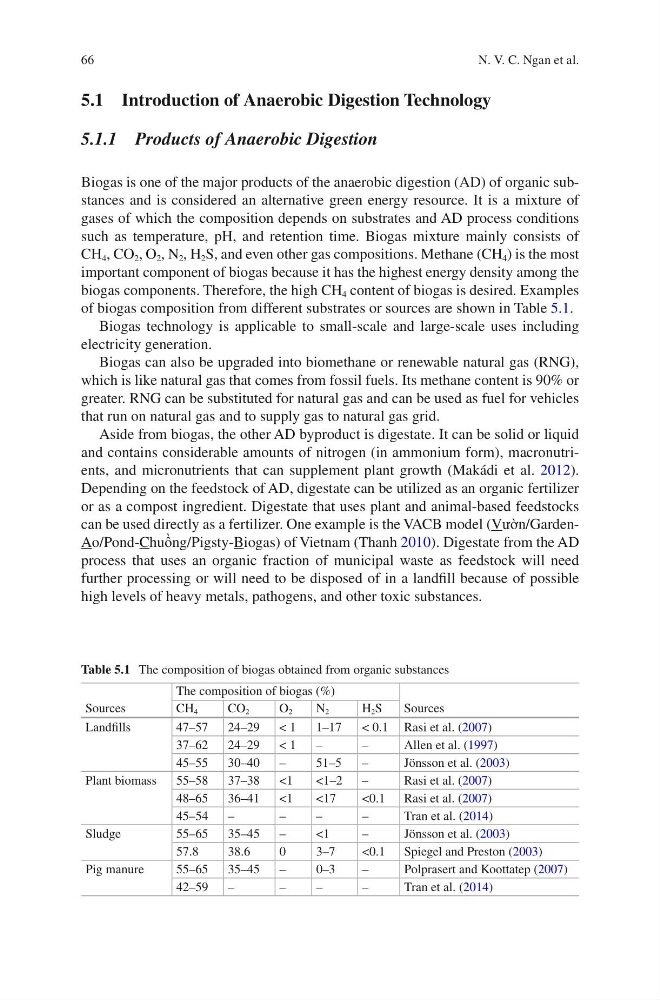
of biogas composition from different substrates or sources are shown in Table 5.1.
Biogas technology is applicable to small-scale and large-scale uses including
electricity generation.
Biogas can also be upgraded into biomethane or renewable natural gas (RNG),
which is like natural gas that comes from fossil fuels. Its methane content is 90% or
greater. RNG can be substituted for natural gas and can be used as fuel for vehicles
that run on natural gas and to supply gas to natural gas grid.
Aside from biogas, the other AD byproduct is digestate. It can be solid or liquid
and contains considerable amounts of nitrogen (in ammonium form), macronutrients, and micronutrients that can supplement plant growth (Makádi et al. 2012).
Depending on the feedstock of AD, digestate can be utilized as an organic fertilizer
or as a compost ingredient. Digestate that uses plant and animal-based feedstocks
can be used directly as a fertilizer. One example is the VACB model (Vườn/GardenAo/Pond-Chuồng/Pigsty-Biogas) of Vietnam (Thanh 2010). Digestate from the AD
process that uses an organic fraction of municipal waste as feedstock will need
further processing or will need to be disposed of in a landfill because of possible
high levels of heavy metals, pathogens, and other toxic substances.
Table 5.1 The composition of biogas obtained from organic substances
Sources
The composition of biogas (%)
Sources
CH 4
CO 2
O 2
N 2
H 2 S
Landfills
47–57
24–29
< 1
1–17
< 0.1 Rasi et al. (2007)
37–62
24–29
< 1
–
–
Allen et al. (1997)
45–55
30–40
–
51–5
–
Jönsson et al. (2003)
Plant biomass
55–58
37–38
<1
<1–2
–
Rasi et al. (2007)
48–65
36–41
<1
<17
<0.1 Rasi et al. (2007)
45–54
–
–
–
–
Tran et al. (2014)
Sludge
55–65
35–45
–
<1
–
Jönsson et al. (2003)
57.8
38.6
0
3–7
<0.1 Spiegel and Preston (2003)
Pig manure
55–65
35–45
–
0–3
–
Polprasert and Koottatep (2007)
42–59
–
–
–
–
Tran et al. (2014)
N. V. C. Ngan et al.
5.1 Introduction of Anaerobic Digestion Technology
5.1.1 Products of Anaerobic Digestion
Biogas is one of the major products of the anaerobic digestion (AD) of organic substances and is considered an alternative green energy resource. It is a mixture of
gases of which the composition depends on substrates and AD process conditions
such as temperature, pH, and retention time. Biogas mixture mainly consists of
CH 4 , CO 2 , O 2 , N 2 , H 2 S, and even other gas compositions. Methane (CH 4 ) is the most
important component of biogas because it has the highest energy density among the
biogas components. Therefore, the high CH 4 content of biogas is desired. Examples
of biogas composition from different substrates or sources are shown in Table 5.1.
Biogas technology is applicable to small-scale and large-scale uses including
electricity generation.
Biogas can also be upgraded into biomethane or renewable natural gas (RNG),
which is like natural gas that comes from fossil fuels. Its methane content is 90% or
greater. RNG can be substituted for natural gas and can be used as fuel for vehicles
that run on natural gas and to supply gas to natural gas grid.
Aside from biogas, the other AD byproduct is digestate. It can be solid or liquid
and contains considerable amounts of nitrogen (in ammonium form), macronutrients, and micronutrients that can supplement plant growth (Makádi et al. 2012).
Depending on the feedstock of AD, digestate can be utilized as an organic fertilizer
or as a compost ingredient. Digestate that uses plant and animal-based feedstocks
can be used directly as a fertilizer. One example is the VACB model (Vườn/GardenAo/Pond-Chuồng/Pigsty-Biogas) of Vietnam (Thanh 2010). Digestate from the AD
process that uses an organic fraction of municipal waste as feedstock will need
further processing or will need to be disposed of in a landfill because of possible
high levels of heavy metals, pathogens, and other toxic substances.
Table 5.1 The composition of biogas obtained from organic substances
Sources
The composition of biogas (%)
Sources
CH 4
CO 2
O 2
N 2
H 2 S
Landfills
47–57
24–29
< 1
1–17
< 0.1 Rasi et al. (2007)
37–62
24–29
< 1
–
–
Allen et al. (1997)
45–55
30–40
–
51–5
–
Jönsson et al. (2003)
Plant biomass
55–58
37–38
<1
<1–2
–
Rasi et al. (2007)
48–65
36–41
<1
<17
<0.1 Rasi et al. (2007)
45–54
–
–
–
–
Tran et al. (2014)
Sludge
55–65
35–45
–
<1
–
Jönsson et al. (2003)
57.8
38.6
0
3–7
<0.1 Spiegel and Preston (2003)
Pig manure
55–65
35–45
–
0–3
–
Polprasert and Koottatep (2007)
42–59
–
–
–
–
Tran et al. (2014)
N. V. C. Ngan et al.