

55
biomass, which is desirable especially if a high heating value is needed. The low
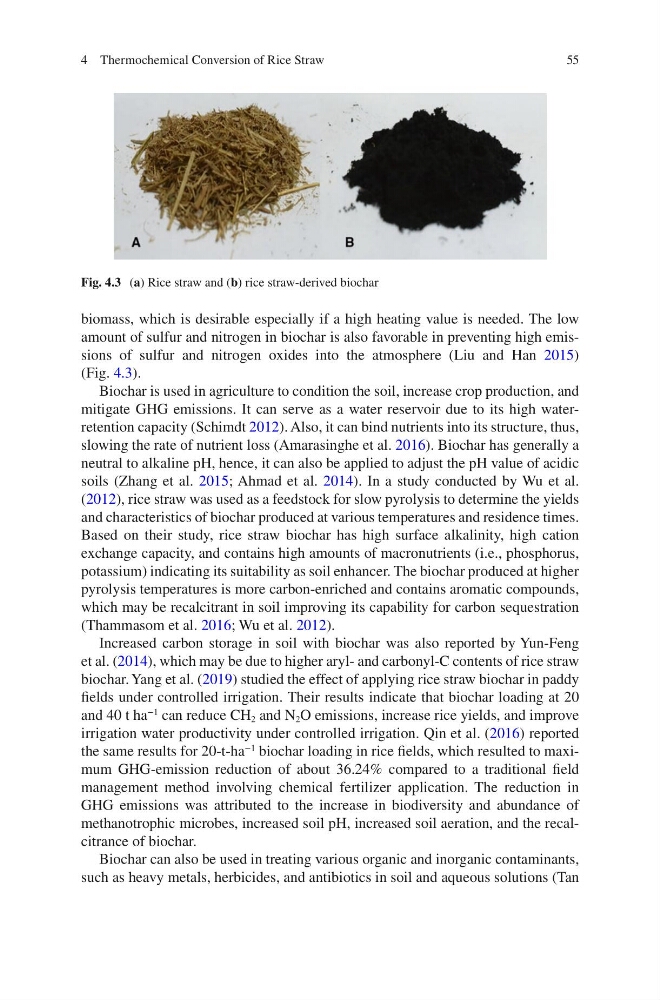
amount of sulfur and nitrogen in biochar is also favorable in preventing high emissions of sulfur and nitrogen oxides into the atmosphere (Liu and Han 2015)
(Fig. 4.3).
Biochar is used in agriculture to condition the soil, increase crop production, and
mitigate GHG emissions. It can serve as a water reservoir due to its high waterretention capacity (Schimdt 2012). Also, it can bind nutrients into its structure, thus,
slowing the rate of nutrient loss (Amarasinghe et al. 2016). Biochar has generally a
neutral to alkaline pH, hence, it can also be applied to adjust the pH value of acidic
soils (Zhang et al. 2015; Ahmad et al. 2014). In a study conducted by Wu et al.
(2012), rice straw was used as a feedstock for slow pyrolysis to determine the yields
and characteristics of biochar produced at various temperatures and residence times.
Based on their study, rice straw biochar has high surface alkalinity, high cation
exchange capacity, and contains high amounts of macronutrients (i.e., phosphorus,
potassium) indicating its suitability as soil enhancer. The biochar produced at higher
pyrolysis temperatures is more carbon-enriched and contains aromatic compounds,
which may be recalcitrant in soil improving its capability for carbon sequestration
(Thammasom et al. 2016; Wu et al. 2012).
Increased carbon storage in soil with biochar was also reported by Yun-Feng
et al. (2014), which may be due to higher aryl- and carbonyl-C contents of rice straw
biochar. Yang et al. (2019) studied the effect of applying rice straw biochar in paddy
fields under controlled irrigation. Their results indicate that biochar loading at 20
and 40 t ha
−1
can reduce CH 2 and N 2 O emissions, increase rice yields, and improve
irrigation water productivity under controlled irrigation. Qin et al. (2016) reported
the same results for 20-t-ha
−1
biochar loading in rice fields, which resulted to maximum GHG-emission reduction of about 36.24% compared to a traditional field
management method involving chemical fertilizer application. The reduction in
GHG emissions was attributed to the increase in biodiversity and abundance of
methanotrophic microbes, increased soil pH, increased soil aeration, and the recalcitrance of biochar.
Biochar can also be used in treating various organic and inorganic contaminants,
such as heavy metals, herbicides, and antibiotics in soil and aqueous solutions (Tan
Fig. 4.3 (a) Rice straw and (b) rice straw-derived biochar
4 Thermochemical Conversion of Rice Straw
biomass, which is desirable especially if a high heating value is needed. The low
amount of sulfur and nitrogen in biochar is also favorable in preventing high emissions of sulfur and nitrogen oxides into the atmosphere (Liu and Han 2015)
(Fig. 4.3).
Biochar is used in agriculture to condition the soil, increase crop production, and
mitigate GHG emissions. It can serve as a water reservoir due to its high waterretention capacity (Schimdt 2012). Also, it can bind nutrients into its structure, thus,
slowing the rate of nutrient loss (Amarasinghe et al. 2016). Biochar has generally a
neutral to alkaline pH, hence, it can also be applied to adjust the pH value of acidic
soils (Zhang et al. 2015; Ahmad et al. 2014). In a study conducted by Wu et al.
(2012), rice straw was used as a feedstock for slow pyrolysis to determine the yields
and characteristics of biochar produced at various temperatures and residence times.
Based on their study, rice straw biochar has high surface alkalinity, high cation
exchange capacity, and contains high amounts of macronutrients (i.e., phosphorus,
potassium) indicating its suitability as soil enhancer. The biochar produced at higher
pyrolysis temperatures is more carbon-enriched and contains aromatic compounds,
which may be recalcitrant in soil improving its capability for carbon sequestration
(Thammasom et al. 2016; Wu et al. 2012).
Increased carbon storage in soil with biochar was also reported by Yun-Feng
et al. (2014), which may be due to higher aryl- and carbonyl-C contents of rice straw
biochar. Yang et al. (2019) studied the effect of applying rice straw biochar in paddy
fields under controlled irrigation. Their results indicate that biochar loading at 20
and 40 t ha
−1
can reduce CH 2 and N 2 O emissions, increase rice yields, and improve
irrigation water productivity under controlled irrigation. Qin et al. (2016) reported
the same results for 20-t-ha
−1
biochar loading in rice fields, which resulted to maximum GHG-emission reduction of about 36.24% compared to a traditional field
management method involving chemical fertilizer application. The reduction in
GHG emissions was attributed to the increase in biodiversity and abundance of
methanotrophic microbes, increased soil pH, increased soil aeration, and the recalcitrance of biochar.
Biochar can also be used in treating various organic and inorganic contaminants,
such as heavy metals, herbicides, and antibiotics in soil and aqueous solutions (Tan
Fig. 4.3 (a) Rice straw and (b) rice straw-derived biochar
4 Thermochemical Conversion of Rice Straw