

28
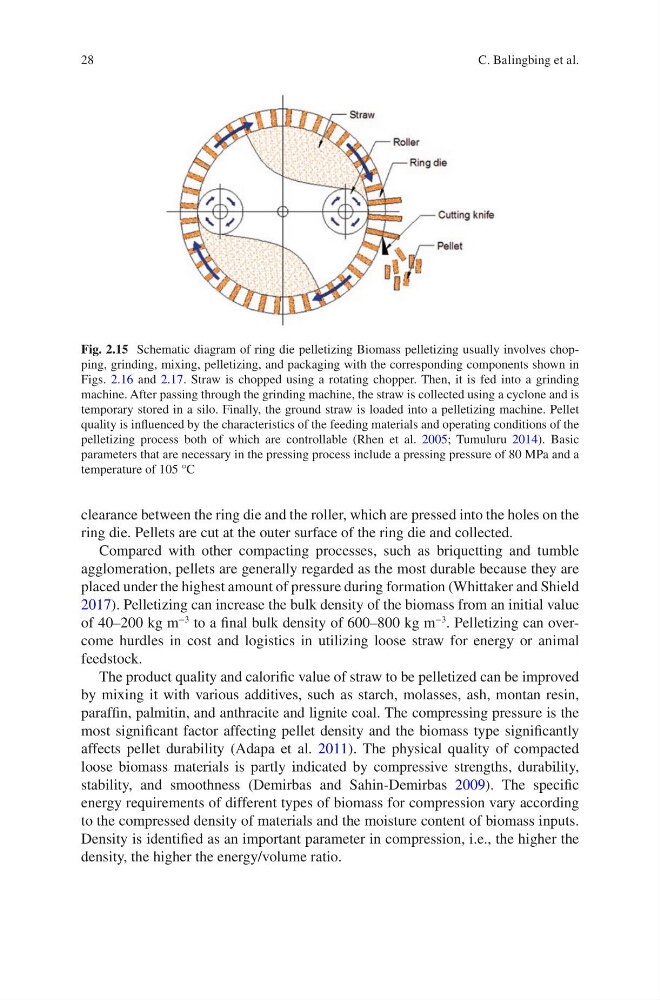
clearance between the ring die and the roller, which are pressed into the holes on the
ring die. Pellets are cut at the outer surface of the ring die and collected.
Compared with other compacting processes, such as briquetting and tumble
agglomeration, pellets are generally regarded as the most durable because they are
placed under the highest amount of pressure during formation (Whittaker and Shield
2017). Pelletizing can increase the bulk density of the biomass from an initial value
of 40–200 kg m
−3
to a final bulk density of 600–800 kg m
−3
. Pelletizing can overcome hurdles in cost and logistics in utilizing loose straw for energy or animal
feedstock.
The product quality and calorific value of straw to be pelletized can be improved
by mixing it with various additives, such as starch, molasses, ash, montan resin,
paraffin, palmitin, and anthracite and lignite coal. The compressing pressure is the
most significant factor affecting pellet density and the biomass type significantly
affects pellet durability (Adapa et al. 2011). The physical quality of compacted
loose biomass materials is partly indicated by compressive strengths, durability,
stability, and smoothness (Demirbas and Sahin-Demirbas 2009). The specific
energy requirements of different types of biomass for compression vary according
to the compressed density of materials and the moisture content of biomass inputs.
Density is identified as an important parameter in compression, i.e., the higher the
density, the higher the energy/volume ratio.
Fig. 2.15 Schematic diagram of ring die pelletizing Biomass pelletizing usually involves chopping, grinding, mixing, pelletizing, and packaging with the corresponding components shown in
Figs. 2.16 and 2.17. Straw is chopped using a rotating chopper. Then, it is fed into a grinding
machine. After passing through the grinding machine, the straw is collected using a cyclone and is
temporary stored in a silo. Finally, the ground straw is loaded into a pelletizing machine. Pellet
quality is influenced by the characteristics of the feeding materials and operating conditions of the
pelletizing process both of which are controllable (Rhen et al. 2005; Tumuluru 2014). Basic
parameters that are necessary in the pressing process include a pressing pressure of 80 MPa and a
temperature of 105 °C
C. Balingbing et al.
clearance between the ring die and the roller, which are pressed into the holes on the
ring die. Pellets are cut at the outer surface of the ring die and collected.
Compared with other compacting processes, such as briquetting and tumble
agglomeration, pellets are generally regarded as the most durable because they are
placed under the highest amount of pressure during formation (Whittaker and Shield
2017). Pelletizing can increase the bulk density of the biomass from an initial value
of 40–200 kg m
−3
to a final bulk density of 600–800 kg m
−3
. Pelletizing can overcome hurdles in cost and logistics in utilizing loose straw for energy or animal
feedstock.
The product quality and calorific value of straw to be pelletized can be improved
by mixing it with various additives, such as starch, molasses, ash, montan resin,
paraffin, palmitin, and anthracite and lignite coal. The compressing pressure is the
most significant factor affecting pellet density and the biomass type significantly
affects pellet durability (Adapa et al. 2011). The physical quality of compacted
loose biomass materials is partly indicated by compressive strengths, durability,
stability, and smoothness (Demirbas and Sahin-Demirbas 2009). The specific
energy requirements of different types of biomass for compression vary according
to the compressed density of materials and the moisture content of biomass inputs.
Density is identified as an important parameter in compression, i.e., the higher the
density, the higher the energy/volume ratio.
Fig. 2.15 Schematic diagram of ring die pelletizing Biomass pelletizing usually involves chopping, grinding, mixing, pelletizing, and packaging with the corresponding components shown in
Figs. 2.16 and 2.17. Straw is chopped using a rotating chopper. Then, it is fed into a grinding
machine. After passing through the grinding machine, the straw is collected using a cyclone and is
temporary stored in a silo. Finally, the ground straw is loaded into a pelletizing machine. Pellet
quality is influenced by the characteristics of the feeding materials and operating conditions of the
pelletizing process both of which are controllable (Rhen et al. 2005; Tumuluru 2014). Basic
parameters that are necessary in the pressing process include a pressing pressure of 80 MPa and a
temperature of 105 °C
C. Balingbing et al.