

26
8 MPa is achieved, the piston starts to operate and densifies the feedstock in an
X-direction. At the open end of the pressing block, a pressing clamp is installed that
opens to eject the produced briquette. The pressure at which the pressing clamp
opens, which varies from 4 to 8 MPa, is related to the compaction density of the
briquettes (Munder 2013).
Briquettes are also produced through: (1) the press-chamber principle, which
consists of two parts: a heated die that acts as a press and a punch that fits in tight;
(2) the screw principle, based on continuous extrusion of the feedstock by a screw
through a heated tape die; and (3) a piston press, where a reciprocating ram presses
the straw biomass in a die. The finished products would have varying energy density
depending on the technology used (Munder 2013).
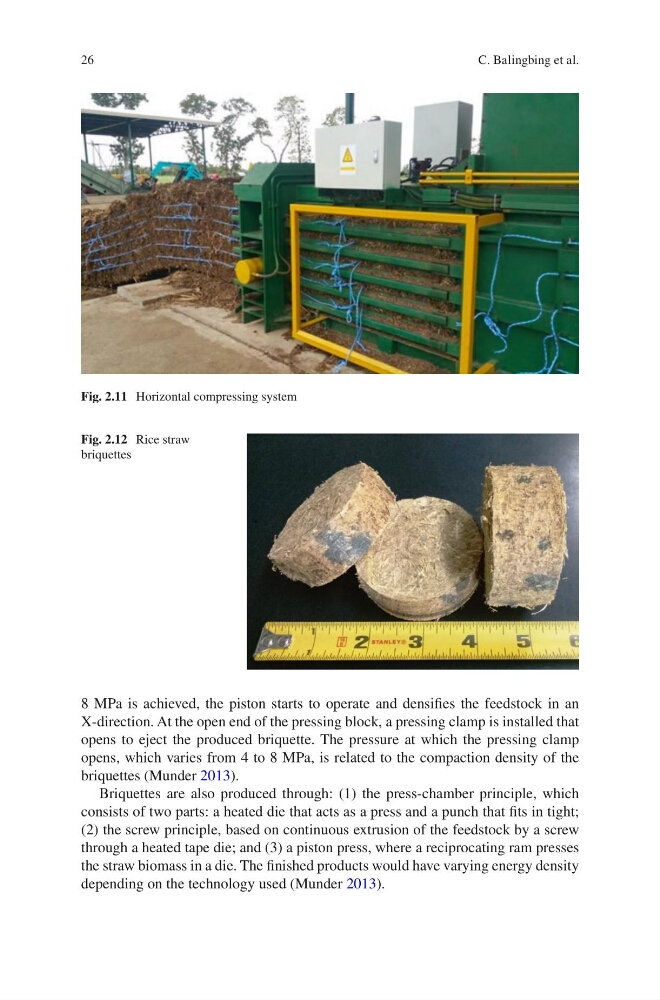
Fig. 2.11 Horizontal compressing system
Fig. 2.12 Rice straw
briquettes
C. Balingbing et al.
8 MPa is achieved, the piston starts to operate and densifies the feedstock in an
X-direction. At the open end of the pressing block, a pressing clamp is installed that
opens to eject the produced briquette. The pressure at which the pressing clamp
opens, which varies from 4 to 8 MPa, is related to the compaction density of the
briquettes (Munder 2013).
Briquettes are also produced through: (1) the press-chamber principle, which
consists of two parts: a heated die that acts as a press and a punch that fits in tight;
(2) the screw principle, based on continuous extrusion of the feedstock by a screw
through a heated tape die; and (3) a piston press, where a reciprocating ram presses
the straw biomass in a die. The finished products would have varying energy density
depending on the technology used (Munder 2013).
Fig. 2.11 Horizontal compressing system
Fig. 2.12 Rice straw
briquettes
C. Balingbing et al.