

22
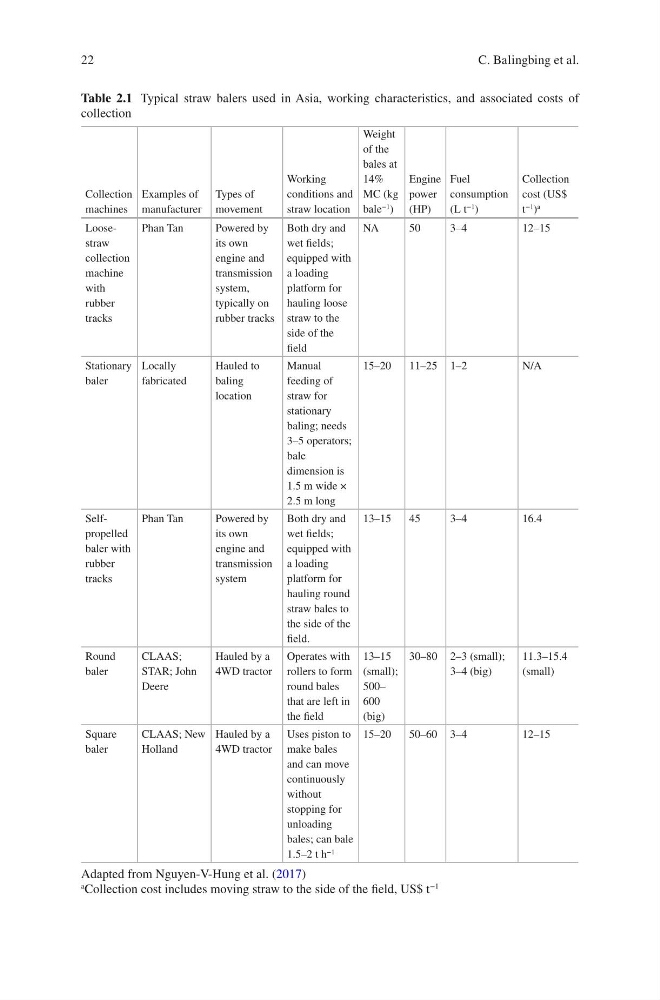
Table 2.1 Typical straw balers used in Asia, working characteristics, and associated costs of
collection
Collection
machines
Examples of
manufacturer
Types of
movement
Working
conditions and
straw location
Weight
of the
bales at
14%
MC (kg
bale
−1
)
Engine
power
(HP)
Fuel
consumption
(L t
−1 )
Collection
cost (US$
t
−1 )
a
Loosestraw
collection
machine
with
rubber
tracks
Phan Tan
Powered by
its own
engine and
transmission
system,
typically on
rubber tracks
Both dry and
wet fields;
equipped with
a loading
platform for
hauling loose
straw to the
side of the
field
NA
50
3–4
12–15
Stationary
baler
Locally
fabricated
Hauled to
baling
location
Manual
feeding of
straw for
stationary
baling; needs
3–5 operators;
bale
dimension is
1.5 m wide ×
2.5 m long
15–20
11–25 1–2
N/A
Selfpropelled
baler with
rubber
tracks
Phan Tan
Powered by
its own
engine and
transmission
system
Both dry and
wet fields;
equipped with
a loading
platform for
hauling round
straw bales to
the side of the
field.
13–15
45
3–4
16.4
Round
baler
CLAAS;
STAR; John
Deere
Hauled by a
4WD tractor
Operates with
rollers to form
round bales
that are left in
the field
13–15
(small);
500–
600
(big)
30–80 2–3 (small);
3–4 (big)
11.3–15.4
(small)
Square
baler
CLAAS; New
Holland
Hauled by a
4WD tractor
Uses piston to
make bales
and can move
continuously
without
stopping for
unloading
bales; can bale
1.5–2 t h
−1
15–20
50–60 3–4
12–15
Adapted from Nguyen-V-Hung et al. (2017)
a
Collection cost includes moving straw to the side of the field, US$ t
−1
C. Balingbing et al.
Table 2.1 Typical straw balers used in Asia, working characteristics, and associated costs of
collection
Collection
machines
Examples of
manufacturer
Types of
movement
Working
conditions and
straw location
Weight
of the
bales at
14%
MC (kg
bale
−1
)
Engine
power
(HP)
Fuel
consumption
(L t
−1 )
Collection
cost (US$
t
−1 )
a
Loosestraw
collection
machine
with
rubber
tracks
Phan Tan
Powered by
its own
engine and
transmission
system,
typically on
rubber tracks
Both dry and
wet fields;
equipped with
a loading
platform for
hauling loose
straw to the
side of the
field
NA
50
3–4
12–15
Stationary
baler
Locally
fabricated
Hauled to
baling
location
Manual
feeding of
straw for
stationary
baling; needs
3–5 operators;
bale
dimension is
1.5 m wide ×
2.5 m long
15–20
11–25 1–2
N/A
Selfpropelled
baler with
rubber
tracks
Phan Tan
Powered by
its own
engine and
transmission
system
Both dry and
wet fields;
equipped with
a loading
platform for
hauling round
straw bales to
the side of the
field.
13–15
45
3–4
16.4
Round
baler
CLAAS;
STAR; John
Deere
Hauled by a
4WD tractor
Operates with
rollers to form
round bales
that are left in
the field
13–15
(small);
500–
600
(big)
30–80 2–3 (small);
3–4 (big)
11.3–15.4
(small)
Square
baler
CLAAS; New
Holland
Hauled by a
4WD tractor
Uses piston to
make bales
and can move
continuously
without
stopping for
unloading
bales; can bale
1.5–2 t h
−1
15–20
50–60 3–4
12–15
Adapted from Nguyen-V-Hung et al. (2017)
a
Collection cost includes moving straw to the side of the field, US$ t
−1
C. Balingbing et al.