

186
which is stipulated by trading capacity, quantity, quality, and price management in
the current market. “Influence” relates to the power of a stakeholder to facilitate or
impede the achievement of an activity’s objective. In this analysis, the criterion used
to evaluate the influence of the stakeholders was their contribution to the success of
expanding the RSM subsectors (including increasing both volume and sales). Then,
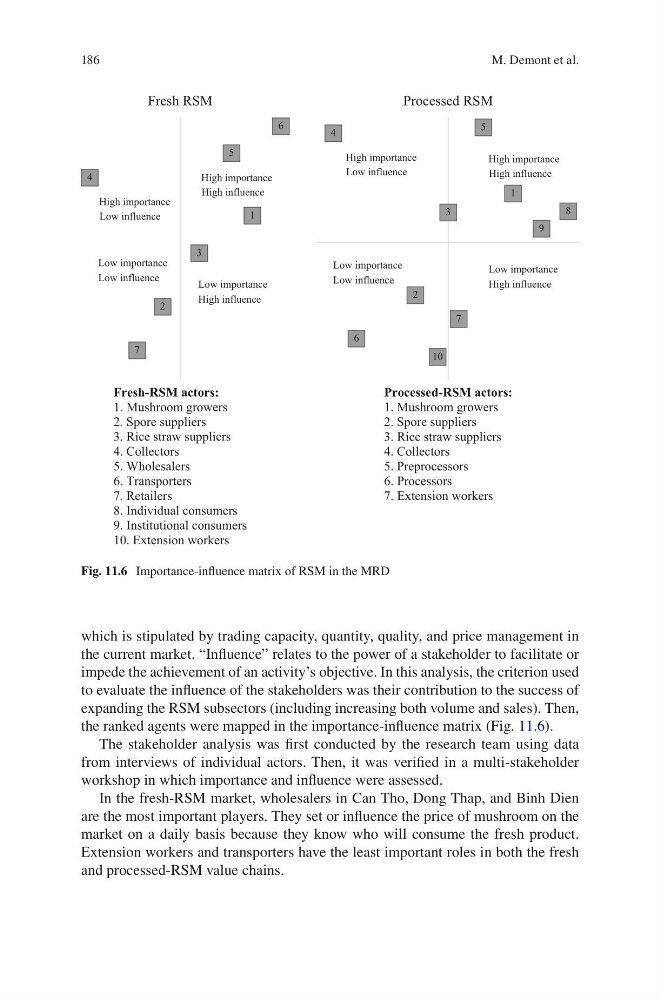
the ranked agents were mapped in the importance-influence matrix (Fig. 11.6).
The stakeholder analysis was first conducted by the research team using data
from interviews of individual actors. Then, it was verified in a multi-stakeholder
workshop in which importance and influence were assessed.
In the fresh-RSM market, wholesalers in Can Tho, Dong Thap, and Binh Dien
are the most important players. They set or influence the price of mushroom on the
market on a daily basis because they know who will consume the fresh product.
Extension workers and transporters have the least important roles in both the fresh
and processed-RSM value chains.
Fresh RSM
P rocessed RSM
High importance
Low importance
Low influence
Low importance
Low influence
Low importance
High influence
Low importance
High influence
Low influence
High importance
4
High influence
High importance
High influence
High importance
Low influence
Fresh-RSM actors:
1. Mushroom growers
2. Spore suppliers
3. Rice straw suppliers
4. Collectors
5. Wholesalers
6. Transporters
7. Retailers
8. Individual consumers
9. Institutional consumers
10. Extension workers
Processed-RSM actors:
1. Mushroom growers
2. Spore suppliers
3. Rice straw suppliers
4. Collectors
5. Preprocessors
6. Processors
7. Extension workers
5
1
3
2
7
6
4
5
1
8
9
3
7
2
6
10
Fig. 11.6 Importance-influence matrix of RSM in the MRD
M. Demont et al.
which is stipulated by trading capacity, quantity, quality, and price management in
the current market. “Influence” relates to the power of a stakeholder to facilitate or
impede the achievement of an activity’s objective. In this analysis, the criterion used
to evaluate the influence of the stakeholders was their contribution to the success of
expanding the RSM subsectors (including increasing both volume and sales). Then,
the ranked agents were mapped in the importance-influence matrix (Fig. 11.6).
The stakeholder analysis was first conducted by the research team using data
from interviews of individual actors. Then, it was verified in a multi-stakeholder
workshop in which importance and influence were assessed.
In the fresh-RSM market, wholesalers in Can Tho, Dong Thap, and Binh Dien
are the most important players. They set or influence the price of mushroom on the
market on a daily basis because they know who will consume the fresh product.
Extension workers and transporters have the least important roles in both the fresh
and processed-RSM value chains.
Fresh RSM
P rocessed RSM
High importance
Low importance
Low influence
Low importance
Low influence
Low importance
High influence
Low importance
High influence
Low influence
High importance
4
High influence
High importance
High influence
High importance
Low influence
Fresh-RSM actors:
1. Mushroom growers
2. Spore suppliers
3. Rice straw suppliers
4. Collectors
5. Wholesalers
6. Transporters
7. Retailers
8. Individual consumers
9. Institutional consumers
10. Extension workers
Processed-RSM actors:
1. Mushroom growers
2. Spore suppliers
3. Rice straw suppliers
4. Collectors
5. Preprocessors
6. Processors
7. Extension workers
5
1
3
2
7
6
4
5
1
8
9
3
7
2
6
10
Fig. 11.6 Importance-influence matrix of RSM in the MRD
M. Demont et al.