

179
Rice straw value chains for the three countries are affected by many influencing
factors, such as climate variability, rice variety, cropping systems employed, policies, technology availability, financial support systems, and extension systems.
11.3 Case Study of Rice Straw Mushroom Value Chains
in Vietnam’s Mekong River Delta (MRD)
11.3.1 Mapping Value Chains
Rice straw mushroom (Volvariella volvacea) (RSM) has been produced in the
MRD for more than 20 years (Truc et al. 2013). However, the utilization of rice
straw for mushroom production is still limited, using less than 5% of the total rice
straw produced in the MRD. Can Tho City (CTC) and Dong Thap Province are
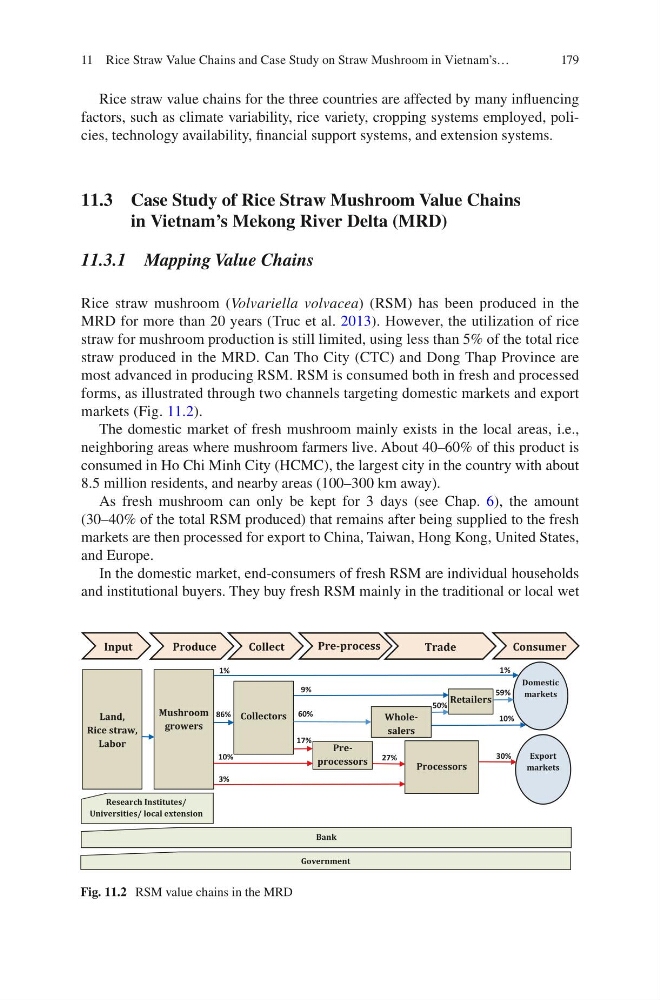
most advanced in producing RSM. RSM is consumed both in fresh and processed
forms, as illustrated through two channels targeting domestic markets and export
markets (Fig. 11.2).
The domestic market of fresh mushroom mainly exists in the local areas, i.e.,
neighboring areas where mushroom farmers live. About 40–60% of this product is
consumed in Ho Chi Minh City (HCMC), the largest city in the country with about
8.5 million residents, and nearby areas (100–300 km away).
As fresh mushroom can only be kept for 3 days (see Chap. 6), the amount
(30–40% of the total RSM produced) that remains after being supplied to the fresh
markets are then processed for export to China, Taiwan, Hong Kong, United States,
and Europe.
In the domestic market, end-consumers of fresh RSM are individual households
and institutional buyers. They buy fresh RSM mainly in the traditional or local wet
Input
Produce
Collect
Pre-process
Trade
Consumer
Land,
Rice straw,
Labor
Mushroom
growers
Preprocessors
Wholesalers
Retailers
Processors
Collectors
Domestic
markets
Research Institutes/
Universities/ local extension
Bank
Government
Export
markets
1%
1%
86%
10%
3%
9%
60%
17%
30%
27%
10%
50%
59%
Fig. 11.2 RSM value chains in the MRD
11 Rice Straw Value Chains and Case Study on Straw Mushroom in Vietnam’s…
Rice straw value chains for the three countries are affected by many influencing
factors, such as climate variability, rice variety, cropping systems employed, policies, technology availability, financial support systems, and extension systems.
11.3 Case Study of Rice Straw Mushroom Value Chains
in Vietnam’s Mekong River Delta (MRD)
11.3.1 Mapping Value Chains
Rice straw mushroom (Volvariella volvacea) (RSM) has been produced in the
MRD for more than 20 years (Truc et al. 2013). However, the utilization of rice
straw for mushroom production is still limited, using less than 5% of the total rice
straw produced in the MRD. Can Tho City (CTC) and Dong Thap Province are
most advanced in producing RSM. RSM is consumed both in fresh and processed
forms, as illustrated through two channels targeting domestic markets and export
markets (Fig. 11.2).
The domestic market of fresh mushroom mainly exists in the local areas, i.e.,
neighboring areas where mushroom farmers live. About 40–60% of this product is
consumed in Ho Chi Minh City (HCMC), the largest city in the country with about
8.5 million residents, and nearby areas (100–300 km away).
As fresh mushroom can only be kept for 3 days (see Chap. 6), the amount
(30–40% of the total RSM produced) that remains after being supplied to the fresh
markets are then processed for export to China, Taiwan, Hong Kong, United States,
and Europe.
In the domestic market, end-consumers of fresh RSM are individual households
and institutional buyers. They buy fresh RSM mainly in the traditional or local wet
Input
Produce
Collect
Pre-process
Trade
Consumer
Land,
Rice straw,
Labor
Mushroom
growers
Preprocessors
Wholesalers
Retailers
Processors
Collectors
Domestic
markets
Research Institutes/
Universities/ local extension
Bank
Government
Export
markets
1%
1%
86%
10%
3%
9%
60%
17%
30%
27%
10%
50%
59%
Fig. 11.2 RSM value chains in the MRD
11 Rice Straw Value Chains and Case Study on Straw Mushroom in Vietnam’s…