

136
C. Soil water and nutrient holding capacity were also increased, likely due to the
porous nature of biochar, with an indirect increase in rice yield. A separate study
conducted in Thai Binh, Hung Yen, and Hai Duong provinces in the Red Delta in
Vietnam showed significant improvement in soil fertility following the addition of
rice straw and products from rice straw (biochar, compost, compost from rice straw
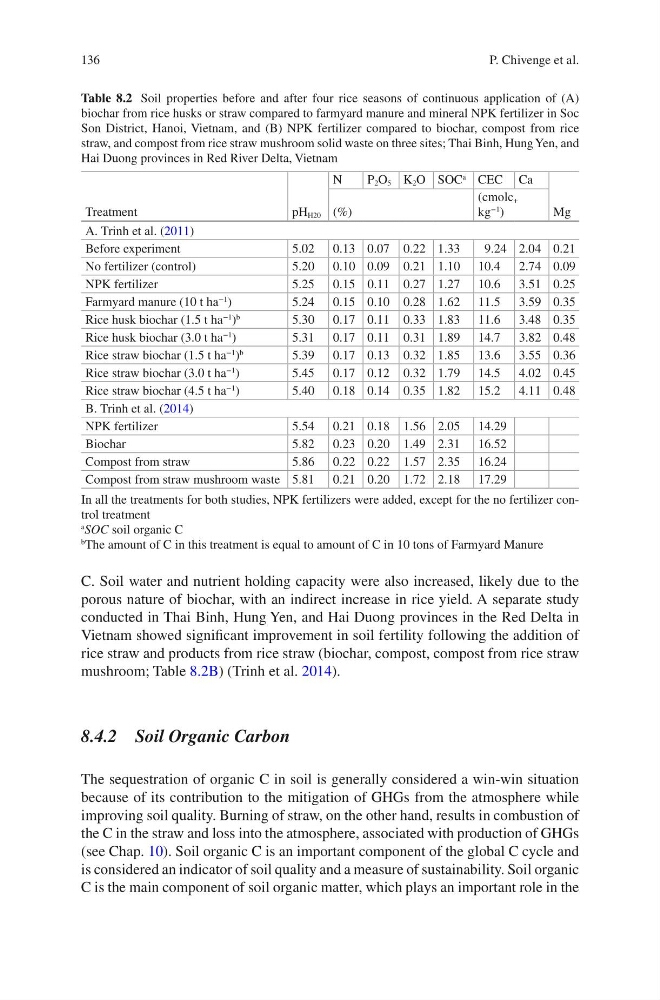
mushroom; Table 8.2B) (Trinh et al. 2014).
8.4.2 Soil Organic Carbon
The sequestration of organic C in soil is generally considered a win-win situation
because of its contribution to the mitigation of GHGs from the atmosphere while
improving soil quality. Burning of straw, on the other hand, results in combustion of
the C in the straw and loss into the atmosphere, associated with production of GHGs
(see Chap. 10). Soil organic C is an important component of the global C cycle and
is considered an indicator of soil quality and a measure of sustainability. Soil organic
C is the main component of soil organic matter, which plays an important role in the
Table 8.2 Soil properties before and after four rice seasons of continuous application of (A)
biochar from rice husks or straw compared to farmyard manure and mineral NPK fertilizer in Soc
Son District, Hanoi, Vietnam, and (B) NPK fertilizer compared to biochar, compost from rice
straw, and compost from rice straw mushroom solid waste on three sites; Thai Binh, Hung Yen, and
Hai Duong provinces in Red River Delta, Vietnam
Treatment
pH H20
N
P 2 O 5 K 2 O SOC
a
CEC Ca
Mg
(%)
(cmolc +
kg
−1 )
A. Trinh et al. (2011)
Before experiment
5.02 0.13 0.07 0.22 1.33
9.24 2.04 0.21
No fertilizer (control)
5.20 0.10 0.09 0.21 1.10 10.4 2.74 0.09
NPK fertilizer
5.25 0.15 0.11 0.27 1.27 10.6 3.51 0.25
Farmyard manure (10 t ha
−1 )
5.24 0.15 0.10 0.28 1.62 11.5 3.59 0.35
Rice husk biochar (1.5 t ha
−1 )
b
5.30 0.17 0.11 0.33 1.83 11.6 3.48 0.35
Rice husk biochar (3.0 t ha
−1 )
5.31 0.17 0.11 0.31 1.89 14.7 3.82 0.48
Rice straw biochar (1.5 t ha
−1 )
b
5.39 0.17 0.13 0.32 1.85 13.6 3.55 0.36
Rice straw biochar (3.0 t ha
−1 )
5.45 0.17 0.12 0.32 1.79 14.5 4.02 0.45
Rice straw biochar (4.5 t ha
−1 )
5.40 0.18 0.14 0.35 1.82 15.2 4.11 0.48
B. Trinh et al. (2014)
NPK fertilizer
5.54 0.21 0.18 1.56 2.05 14.29
Biochar
5.82 0.23 0.20 1.49 2.31 16.52
Compost from straw
5.86 0.22 0.22 1.57 2.35 16.24
Compost from straw mushroom waste 5.81 0.21 0.20 1.72 2.18 17.29
In all the treatments for both studies, NPK fertilizers were added, except for the no fertilizer control treatment
a
SOC soil organic C
b
The amount of C in this treatment is equal to amount of C in 10 tons of Farmyard Manure
P. Chivenge et al.
C. Soil water and nutrient holding capacity were also increased, likely due to the
porous nature of biochar, with an indirect increase in rice yield. A separate study
conducted in Thai Binh, Hung Yen, and Hai Duong provinces in the Red Delta in
Vietnam showed significant improvement in soil fertility following the addition of
rice straw and products from rice straw (biochar, compost, compost from rice straw
mushroom; Table 8.2B) (Trinh et al. 2014).
8.4.2 Soil Organic Carbon
The sequestration of organic C in soil is generally considered a win-win situation
because of its contribution to the mitigation of GHGs from the atmosphere while
improving soil quality. Burning of straw, on the other hand, results in combustion of
the C in the straw and loss into the atmosphere, associated with production of GHGs
(see Chap. 10). Soil organic C is an important component of the global C cycle and
is considered an indicator of soil quality and a measure of sustainability. Soil organic
C is the main component of soil organic matter, which plays an important role in the
Table 8.2 Soil properties before and after four rice seasons of continuous application of (A)
biochar from rice husks or straw compared to farmyard manure and mineral NPK fertilizer in Soc
Son District, Hanoi, Vietnam, and (B) NPK fertilizer compared to biochar, compost from rice
straw, and compost from rice straw mushroom solid waste on three sites; Thai Binh, Hung Yen, and
Hai Duong provinces in Red River Delta, Vietnam
Treatment
pH H20
N
P 2 O 5 K 2 O SOC
a
CEC Ca
Mg
(%)
(cmolc +
kg
−1 )
A. Trinh et al. (2011)
Before experiment
5.02 0.13 0.07 0.22 1.33
9.24 2.04 0.21
No fertilizer (control)
5.20 0.10 0.09 0.21 1.10 10.4 2.74 0.09
NPK fertilizer
5.25 0.15 0.11 0.27 1.27 10.6 3.51 0.25
Farmyard manure (10 t ha
−1 )
5.24 0.15 0.10 0.28 1.62 11.5 3.59 0.35
Rice husk biochar (1.5 t ha
−1 )
b
5.30 0.17 0.11 0.33 1.83 11.6 3.48 0.35
Rice husk biochar (3.0 t ha
−1 )
5.31 0.17 0.11 0.31 1.89 14.7 3.82 0.48
Rice straw biochar (1.5 t ha
−1 )
b
5.39 0.17 0.13 0.32 1.85 13.6 3.55 0.36
Rice straw biochar (3.0 t ha
−1 )
5.45 0.17 0.12 0.32 1.79 14.5 4.02 0.45
Rice straw biochar (4.5 t ha
−1 )
5.40 0.18 0.14 0.35 1.82 15.2 4.11 0.48
B. Trinh et al. (2014)
NPK fertilizer
5.54 0.21 0.18 1.56 2.05 14.29
Biochar
5.82 0.23 0.20 1.49 2.31 16.52
Compost from straw
5.86 0.22 0.22 1.57 2.35 16.24
Compost from straw mushroom waste 5.81 0.21 0.20 1.72 2.18 17.29
In all the treatments for both studies, NPK fertilizers were added, except for the no fertilizer control treatment
a
SOC soil organic C
b
The amount of C in this treatment is equal to amount of C in 10 tons of Farmyard Manure
P. Chivenge et al.