

134
8.4 Straw Effects on Soil Properties
8.4.1 Nutrient Cycling
The incorporation of rice straw can improve soil quality through enhanced nutrient
cycling and soil organic C sequestration. Straw incorporation has been shown to
enhance nutrient recycling and provide soil fertility benefits (Dobermann and
Fairhurst 2000; Ponnamperuma 1984; Yadvinder-Singh et al. 2004). The straw is the
main organic material that is available for most rice farmers and serves as an important source of K. Ponnamperuma (1984) indicated that, at harvest, the straw contains 0.57% N, 0.07% P 2 O 5 , 1.5% K 2 O, 0.1% (sulfur) S, and 5% silicon (Si). In
agreement, Dobermann and Fairhurst (2002) also showed that rice straw at harvest
can contain 0.5–0.8% N, 0.07–0.12% P 2 O 5 , 1.16–1.66% K 2 O, 0.05–0.1% S, and
4–7% Si. This translates to about 40%, 30–35%, 80–85%, 40–50%, and 80%,
respectively, of the N, P 2 O 5 , K 2 O, S, and Si taken up by the plant. The addition of
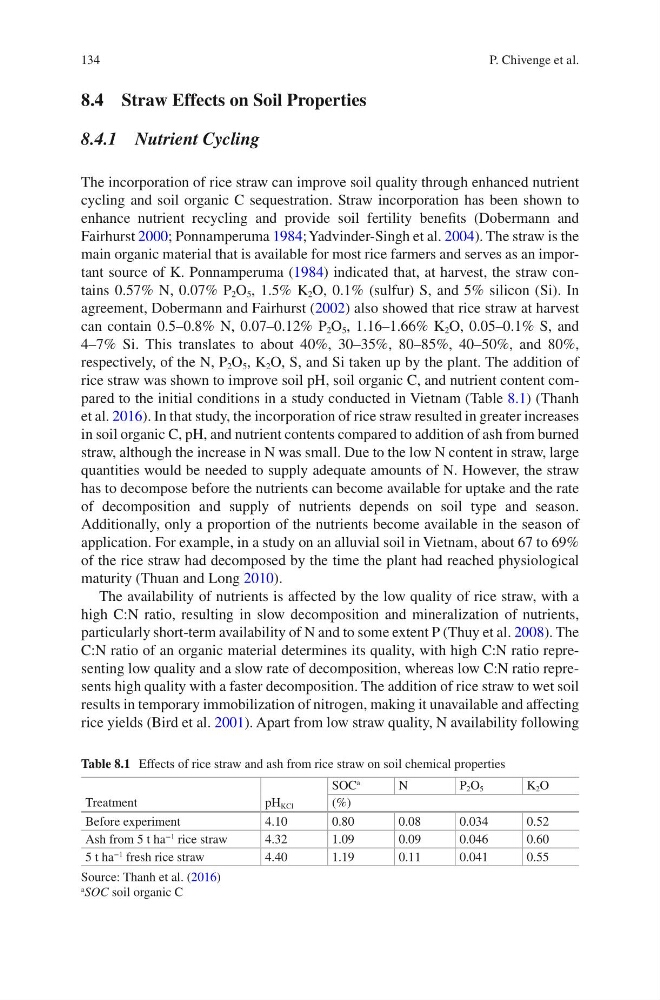
rice straw was shown to improve soil pH, soil organic C, and nutrient content compared to the initial conditions in a study conducted in Vietnam (Table 8.1) (Thanh
et al. 2016). In that study, the incorporation of rice straw resulted in greater increases
in soil organic C, pH, and nutrient contents compared to addition of ash from burned
straw, although the increase in N was small. Due to the low N content in straw, large
quantities would be needed to supply adequate amounts of N. However, the straw
has to decompose before the nutrients can become available for uptake and the rate
of decomposition and supply of nutrients depends on soil type and season.
Additionally, only a proportion of the nutrients become available in the season of
application. For example, in a study on an alluvial soil in Vietnam, about 67 to 69%
of the rice straw had decomposed by the time the plant had reached physiological
maturity (Thuan and Long 2010).
The availability of nutrients is affected by the low quality of rice straw, with a
high C:N ratio, resulting in slow decomposition and mineralization of nutrients,
particularly short-term availability of N and to some extent P (Thuy et al. 2008). The
C:N ratio of an organic material determines its quality, with high C:N ratio representing low quality and a slow rate of decomposition, whereas low C:N ratio represents high quality with a faster decomposition. The addition of rice straw to wet soil
results in temporary immobilization of nitrogen, making it unavailable and affecting
rice yields (Bird et al. 2001). Apart from low straw quality, N availability following
Table 8.1 Effects of rice straw and ash from rice straw on soil chemical properties
Treatment
pH KCl
SOC
a
N
P 2 O 5
K 2 O
(%)
Before experiment
4.10
0.80
0.08
0.034
0.52
Ash from 5 t ha
−1 rice straw
4.32
1.09
0.09
0.046
0.60
5 t ha
−1 fresh rice straw
4.40
1.19
0.11
0.041
0.55
Source: Thanh et al. (2016)
a
SOC soil organic C
P. Chivenge et al.
8.4 Straw Effects on Soil Properties
8.4.1 Nutrient Cycling
The incorporation of rice straw can improve soil quality through enhanced nutrient
cycling and soil organic C sequestration. Straw incorporation has been shown to
enhance nutrient recycling and provide soil fertility benefits (Dobermann and
Fairhurst 2000; Ponnamperuma 1984; Yadvinder-Singh et al. 2004). The straw is the
main organic material that is available for most rice farmers and serves as an important source of K. Ponnamperuma (1984) indicated that, at harvest, the straw contains 0.57% N, 0.07% P 2 O 5 , 1.5% K 2 O, 0.1% (sulfur) S, and 5% silicon (Si). In
agreement, Dobermann and Fairhurst (2002) also showed that rice straw at harvest
can contain 0.5–0.8% N, 0.07–0.12% P 2 O 5 , 1.16–1.66% K 2 O, 0.05–0.1% S, and
4–7% Si. This translates to about 40%, 30–35%, 80–85%, 40–50%, and 80%,
respectively, of the N, P 2 O 5 , K 2 O, S, and Si taken up by the plant. The addition of
rice straw was shown to improve soil pH, soil organic C, and nutrient content compared to the initial conditions in a study conducted in Vietnam (Table 8.1) (Thanh
et al. 2016). In that study, the incorporation of rice straw resulted in greater increases
in soil organic C, pH, and nutrient contents compared to addition of ash from burned
straw, although the increase in N was small. Due to the low N content in straw, large
quantities would be needed to supply adequate amounts of N. However, the straw
has to decompose before the nutrients can become available for uptake and the rate
of decomposition and supply of nutrients depends on soil type and season.
Additionally, only a proportion of the nutrients become available in the season of
application. For example, in a study on an alluvial soil in Vietnam, about 67 to 69%
of the rice straw had decomposed by the time the plant had reached physiological
maturity (Thuan and Long 2010).
The availability of nutrients is affected by the low quality of rice straw, with a
high C:N ratio, resulting in slow decomposition and mineralization of nutrients,
particularly short-term availability of N and to some extent P (Thuy et al. 2008). The
C:N ratio of an organic material determines its quality, with high C:N ratio representing low quality and a slow rate of decomposition, whereas low C:N ratio represents high quality with a faster decomposition. The addition of rice straw to wet soil
results in temporary immobilization of nitrogen, making it unavailable and affecting
rice yields (Bird et al. 2001). Apart from low straw quality, N availability following
Table 8.1 Effects of rice straw and ash from rice straw on soil chemical properties
Treatment
pH KCl
SOC
a
N
P 2 O 5
K 2 O
(%)
Before experiment
4.10
0.80
0.08
0.034
0.52
Ash from 5 t ha
−1 rice straw
4.32
1.09
0.09
0.046
0.60
5 t ha
−1 fresh rice straw
4.40
1.19
0.11
0.041
0.55
Source: Thanh et al. (2016)
a
SOC soil organic C
P. Chivenge et al.