

2
1.1 Rice Straw Availability
Rice straw is a residual byproduct of rice production at harvest. The total biomass
of this residue depends on various factors such as varieties, soils and nutrient management and weather. At harvest, rice straw is piled or spread in the field depending
on the harvesting methods, using stationary threshers or self-propelled combine
harvesters, respectively. The amount of rice straw taken off the field depends mainly
on the cutting height (i.e., height of the stubble left in the field). Rice straw that
remains in the field after harvest can be collected, burned, or left to decompose (soil
incorporation). The “stubble”—the uncut portion of the rice straw after harvest—
remains, and can be burned or incorporated into the soil in preparation for the next
crop. The ratio of straw to paddy varies, ranging from 1.0 to 4.3 (Zafar 2015) and
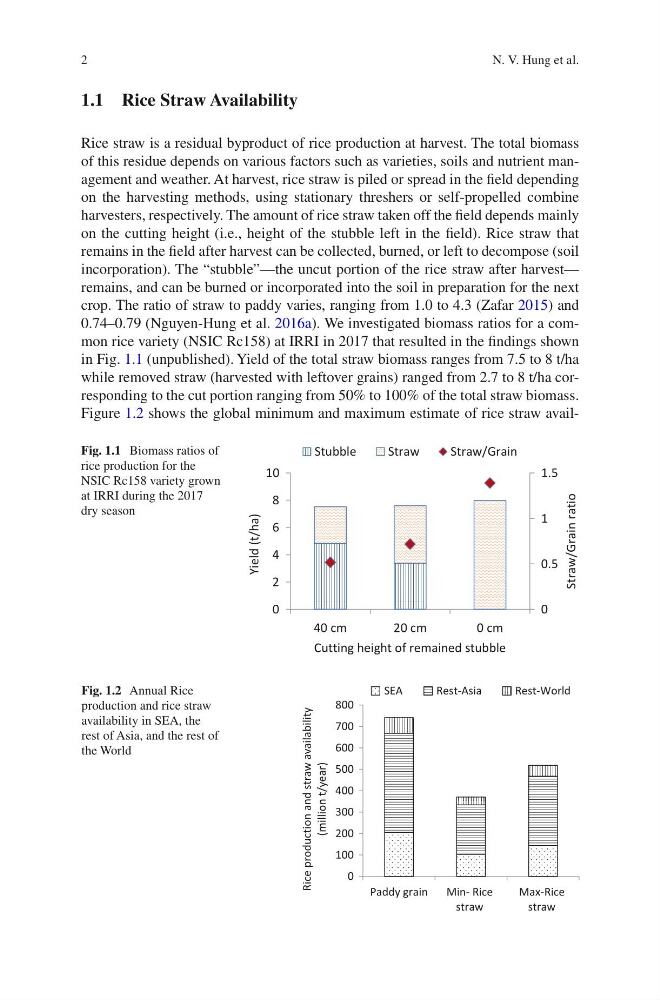
0.74–0.79 (Nguyen-Hung et al. 2016a). We investigated biomass ratios for a common rice variety (NSIC Rc158) at IRRI in 2017 that resulted in the findings shown
in Fig. 1.1 (unpublished). Yield of the total straw biomass ranges from 7.5 to 8 t/ha
while removed straw (harvested with leftover grains) ranged from 2.7 to 8 t/ha corresponding to the cut portion ranging from 50% to 100% of the total straw biomass.
Figure 1.2 shows the global minimum and maximum estimate of rice straw avail0
0.5
1
1.5
0
2
4
6
8
10
40 cm
20 cm
0 cm
Straw/Grain ratio
Yield (t/ha)
Cutting height of remained stubble
Stubble
Straw
Straw/Grain
Fig. 1.1 Biomass ratios of
rice production for the
NSIC Rc158 variety grown
at IRRI during the 2017
dry season
0
100
200
300
400
500
600
700
800
Paddy grain
Min- Rice
straw
Max-Rice
straw
y
t
i
l
i
b
a
l
i
a
v
a
w
a
r
t
s
d
n
a
n
o
i
t
c
u
d
o
r
p
e
c
i
R
)
r
a
e
y
/
t
n
o
i
l
l
i
m
(
SEA
Rest-Asia
Rest-World
Fig. 1.2 Annual Rice
production and rice straw
availability in SEA, the
rest of Asia, and the rest of
the World
N. V. Hung et al.
1.1 Rice Straw Availability
Rice straw is a residual byproduct of rice production at harvest. The total biomass
of this residue depends on various factors such as varieties, soils and nutrient management and weather. At harvest, rice straw is piled or spread in the field depending
on the harvesting methods, using stationary threshers or self-propelled combine
harvesters, respectively. The amount of rice straw taken off the field depends mainly
on the cutting height (i.e., height of the stubble left in the field). Rice straw that
remains in the field after harvest can be collected, burned, or left to decompose (soil
incorporation). The “stubble”—the uncut portion of the rice straw after harvest—
remains, and can be burned or incorporated into the soil in preparation for the next
crop. The ratio of straw to paddy varies, ranging from 1.0 to 4.3 (Zafar 2015) and
0.74–0.79 (Nguyen-Hung et al. 2016a). We investigated biomass ratios for a common rice variety (NSIC Rc158) at IRRI in 2017 that resulted in the findings shown
in Fig. 1.1 (unpublished). Yield of the total straw biomass ranges from 7.5 to 8 t/ha
while removed straw (harvested with leftover grains) ranged from 2.7 to 8 t/ha corresponding to the cut portion ranging from 50% to 100% of the total straw biomass.
Figure 1.2 shows the global minimum and maximum estimate of rice straw avail0
0.5
1
1.5
0
2
4
6
8
10
40 cm
20 cm
0 cm
Straw/Grain ratio
Yield (t/ha)
Cutting height of remained stubble
Stubble
Straw
Straw/Grain
Fig. 1.1 Biomass ratios of
rice production for the
NSIC Rc158 variety grown
at IRRI during the 2017
dry season
0
100
200
300
400
500
600
700
800
Paddy grain
Min- Rice
straw
Max-Rice
straw
y
t
i
l
i
b
a
l
i
a
v
a
w
a
r
t
s
d
n
a
n
o
i
t
c
u
d
o
r
p
e
c
i
R
)
r
a
e
y
/
t
n
o
i
l
l
i
m
(
SEA
Rest-Asia
Rest-World
Fig. 1.2 Annual Rice
production and rice straw
availability in SEA, the
rest of Asia, and the rest of
the World
N. V. Hung et al.