

8 Moon Farside Protection, Moon Village …
81
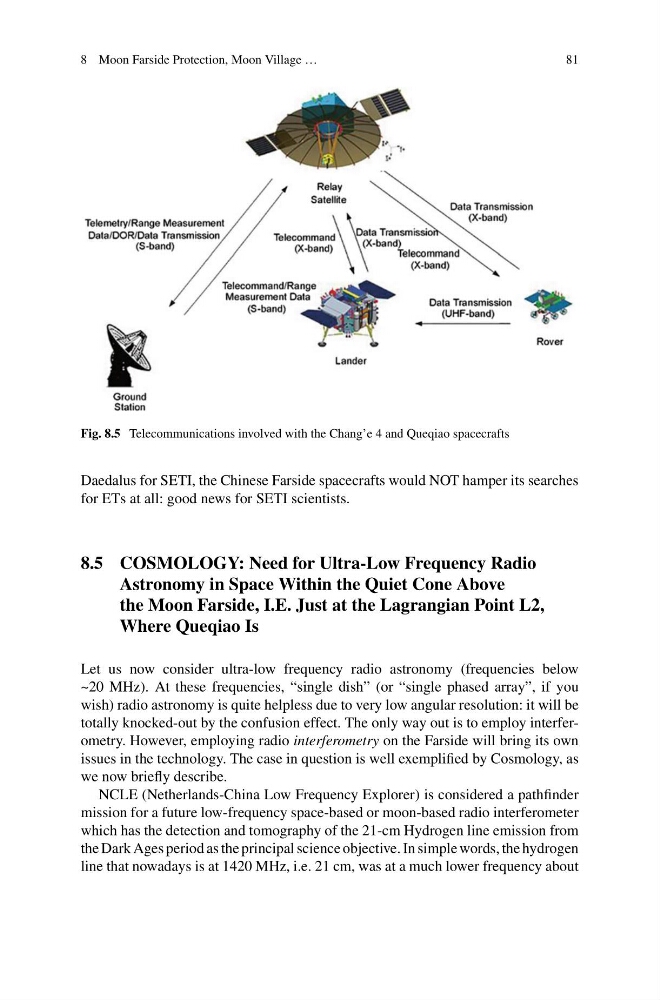
Fig. 8.5 Telecommunications involved with the Chang’e 4 and Queqiao spacecrafts
Daedalus for SETI, the Chinese Farside spacecrafts would NOT hamper its searches
for ETs at all: good news for SETI scientists.
8.5 COSMOLOGY: Need for Ultra-Low Frequency Radio
Astronomy in Space Within the Quiet Cone Above
the Moon Farside, I.E. Just at the Lagrangian Point L2,
Where Queqiao Is
Let us now consider ultra-low frequency radio astronomy (frequencies below
~20 MHz). At these frequencies, “single dish” (or “single phased array”, if you
wish) radio astronomy is quite helpless due to very low angular resolution: it will be
totally knocked-out by the confusion effect. The only way out is to employ interferometry. However, employing radio interferometry on the Farside will bring its own
issues in the technology. The case in question is well exemplified by Cosmology, as
we now briefly describe.
NCLE (Netherlands-China Low Frequency Explorer) is considered a pathfinder
mission for a future low-frequency space-based or moon-based radio interferometer
which has the detection and tomography of the 21-cm Hydrogen line emission from
the Dark Ages period as the principal science objective. In simple words, the hydrogen
line that nowadays is at 1420 MHz, i.e. 21 cm, was at a much lower frequency about
81
Fig. 8.5 Telecommunications involved with the Chang’e 4 and Queqiao spacecrafts
Daedalus for SETI, the Chinese Farside spacecrafts would NOT hamper its searches
for ETs at all: good news for SETI scientists.
8.5 COSMOLOGY: Need for Ultra-Low Frequency Radio
Astronomy in Space Within the Quiet Cone Above
the Moon Farside, I.E. Just at the Lagrangian Point L2,
Where Queqiao Is
Let us now consider ultra-low frequency radio astronomy (frequencies below
~20 MHz). At these frequencies, “single dish” (or “single phased array”, if you
wish) radio astronomy is quite helpless due to very low angular resolution: it will be
totally knocked-out by the confusion effect. The only way out is to employ interferometry. However, employing radio interferometry on the Farside will bring its own
issues in the technology. The case in question is well exemplified by Cosmology, as
we now briefly describe.
NCLE (Netherlands-China Low Frequency Explorer) is considered a pathfinder
mission for a future low-frequency space-based or moon-based radio interferometer
which has the detection and tomography of the 21-cm Hydrogen line emission from
the Dark Ages period as the principal science objective. In simple words, the hydrogen
line that nowadays is at 1420 MHz, i.e. 21 cm, was at a much lower frequency about