

8 Moon Farside Protection, Moon Village …
79
to come to an agreement reserving the PAC for astronomical exploration only,
since crater Daedalus is the closest location to Earth where the radio pollution
produced by Humankind does not still practically reach. This activity would
be especially important for SETI, the Search for Extra Terrestrial Intelligence
that NASA now calls “Searching for Technosignatures” just to avoid the “toopolitical” word SETI. Actually, setting up more than one radio telescope inside
Daedalus would enable interferometry, the best technique for radio astronomical
searches ever. Even more precisely, these radio telescopes would not be dishes
at all: they would be phased arrays, i.e. planar deployable surfaces with dipoles
commanded by computers, of course much easier to be landed inside Daedalus
than big dishes.
(4) However, the communications relay satellite Queqiao now at L2 changes
this idyllic picture. In fact, it is obvious that the future astronomical observatory Daedalus will have to abandon radio exploration on the X and S
bands because blinded by Queqiao, unless negotiations between China and the
other space-faring nations will reach a general agreement on which bands are
reserved for what. This is a task for international organizations like ITU (International Telecommunications Union), the American CORF (Committee on
Radio Frequencies) and the European CRAF (Committee of Radio Astronomy
Frequencies), plus other related organizations worldwide, like the Moon Village
Association (MVA).
(5) On March 27, 2019 this author, on behalf of the IAA, intends to organize in
Paris an IAA International Conference by the title of “Moon Farside 2019”:
the first attempt ever to reach an international agreement about the frequencies
allowed or not allowed over the PAC in the future.
8.3 The Farside Spectrum Still is Not Polluted
(in December 2020) Except in the S, X and UHF Bands
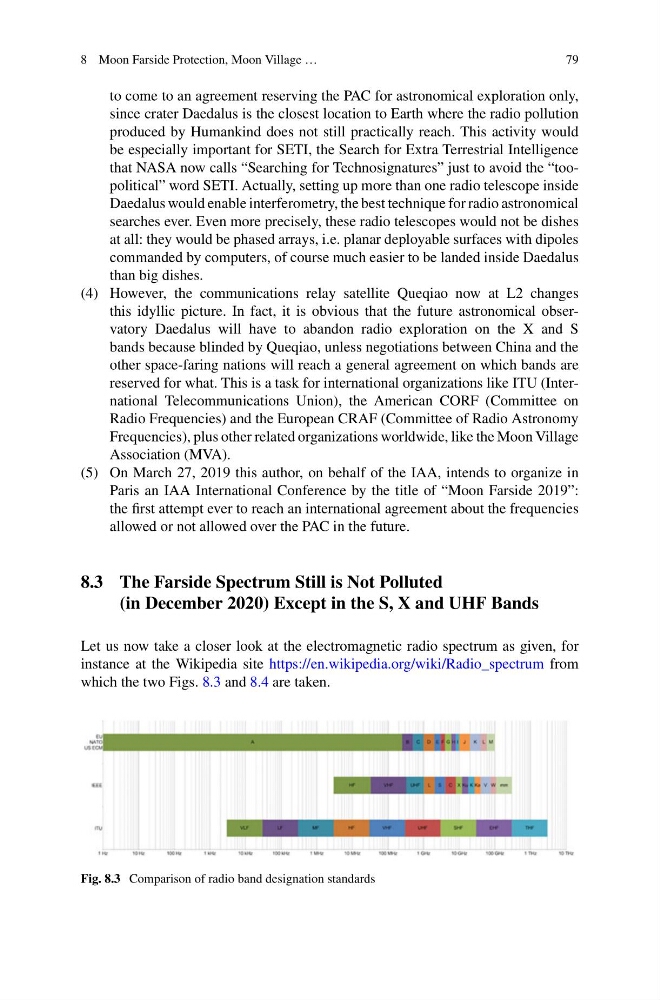
Let us now take a closer look at the electromagnetic radio spectrum as given, for
instance at the Wikipedia site https://en.wikipedia.org/wiki/Radio_spectrum from
which the two Figs. 8.3 and 8.4 are taken.
Fig. 8.3 Comparison of radio band designation standards
79
to come to an agreement reserving the PAC for astronomical exploration only,
since crater Daedalus is the closest location to Earth where the radio pollution
produced by Humankind does not still practically reach. This activity would
be especially important for SETI, the Search for Extra Terrestrial Intelligence
that NASA now calls “Searching for Technosignatures” just to avoid the “toopolitical” word SETI. Actually, setting up more than one radio telescope inside
Daedalus would enable interferometry, the best technique for radio astronomical
searches ever. Even more precisely, these radio telescopes would not be dishes
at all: they would be phased arrays, i.e. planar deployable surfaces with dipoles
commanded by computers, of course much easier to be landed inside Daedalus
than big dishes.
(4) However, the communications relay satellite Queqiao now at L2 changes
this idyllic picture. In fact, it is obvious that the future astronomical observatory Daedalus will have to abandon radio exploration on the X and S
bands because blinded by Queqiao, unless negotiations between China and the
other space-faring nations will reach a general agreement on which bands are
reserved for what. This is a task for international organizations like ITU (International Telecommunications Union), the American CORF (Committee on
Radio Frequencies) and the European CRAF (Committee of Radio Astronomy
Frequencies), plus other related organizations worldwide, like the Moon Village
Association (MVA).
(5) On March 27, 2019 this author, on behalf of the IAA, intends to organize in
Paris an IAA International Conference by the title of “Moon Farside 2019”:
the first attempt ever to reach an international agreement about the frequencies
allowed or not allowed over the PAC in the future.
8.3 The Farside Spectrum Still is Not Polluted
(in December 2020) Except in the S, X and UHF Bands
Let us now take a closer look at the electromagnetic radio spectrum as given, for
instance at the Wikipedia site https://en.wikipedia.org/wiki/Radio_spectrum from
which the two Figs. 8.3 and 8.4 are taken.
Fig. 8.3 Comparison of radio band designation standards