

7 SETI Program at the Medicina INAF Radioastronomy …
69
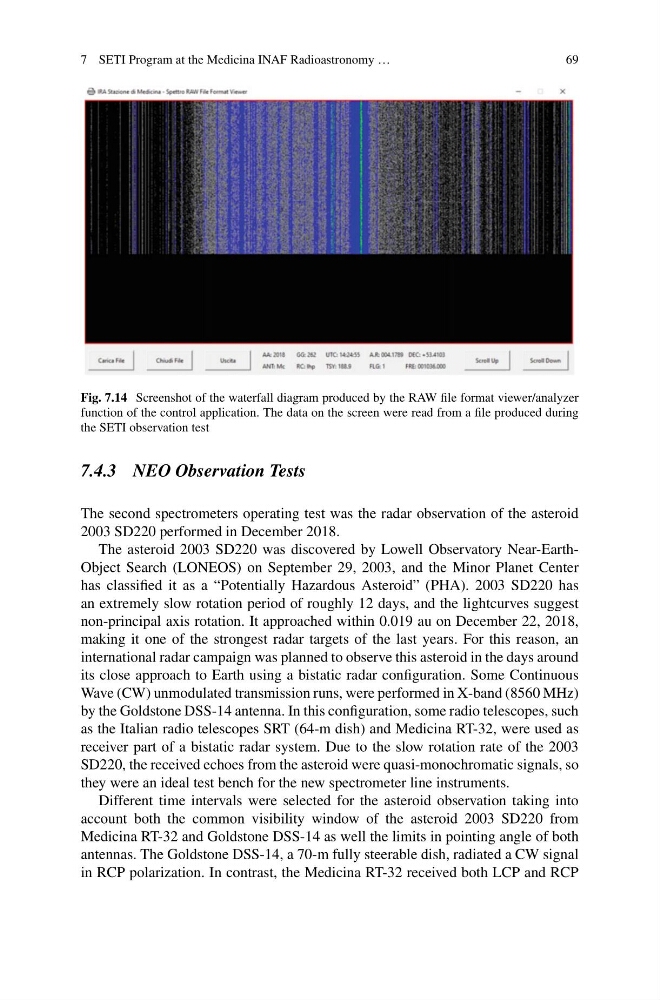
Fig. 7.14 Screenshot of the waterfall diagram produced by the RAW file format viewer/analyzer
function of the control application. The data on the screen were read from a file produced during
the SETI observation test
7.4.3 NEO Observation Tests
The second spectrometers operating test was the radar observation of the asteroid
2003 SD220 performed in December 2018.
The asteroid 2003 SD220 was discovered by Lowell Observatory Near-EarthObject Search (LONEOS) on September 29, 2003, and the Minor Planet Center
has classified it as a “Potentially Hazardous Asteroid” (PHA). 2003 SD220 has
an extremely slow rotation period of roughly 12 days, and the lightcurves suggest
non-principal axis rotation. It approached within 0.019 au on December 22, 2018,
making it one of the strongest radar targets of the last years. For this reason, an
international radar campaign was planned to observe this asteroid in the days around
its close approach to Earth using a bistatic radar configuration. Some Continuous
Wave (CW) unmodulated transmission runs, were performed in X-band (8560 MHz)
by the Goldstone DSS-14 antenna. In this configuration, some radio telescopes, such
as the Italian radio telescopes SRT (64-m dish) and Medicina RT-32, were used as
receiver part of a bistatic radar system. Due to the slow rotation rate of the 2003
SD220, the received echoes from the asteroid were quasi-monochromatic signals, so
they were an ideal test bench for the new spectrometer line instruments.
Different time intervals were selected for the asteroid observation taking into
account both the common visibility window of the asteroid 2003 SD220 from
Medicina RT-32 and Goldstone DSS-14 as well the limits in pointing angle of both
antennas. The Goldstone DSS-14, a 70-m fully steerable dish, radiated a CW signal
in RCP polarization. In contrast, the Medicina RT-32 received both LCP and RCP
69
Fig. 7.14 Screenshot of the waterfall diagram produced by the RAW file format viewer/analyzer
function of the control application. The data on the screen were read from a file produced during
the SETI observation test
7.4.3 NEO Observation Tests
The second spectrometers operating test was the radar observation of the asteroid
2003 SD220 performed in December 2018.
The asteroid 2003 SD220 was discovered by Lowell Observatory Near-EarthObject Search (LONEOS) on September 29, 2003, and the Minor Planet Center
has classified it as a “Potentially Hazardous Asteroid” (PHA). 2003 SD220 has
an extremely slow rotation period of roughly 12 days, and the lightcurves suggest
non-principal axis rotation. It approached within 0.019 au on December 22, 2018,
making it one of the strongest radar targets of the last years. For this reason, an
international radar campaign was planned to observe this asteroid in the days around
its close approach to Earth using a bistatic radar configuration. Some Continuous
Wave (CW) unmodulated transmission runs, were performed in X-band (8560 MHz)
by the Goldstone DSS-14 antenna. In this configuration, some radio telescopes, such
as the Italian radio telescopes SRT (64-m dish) and Medicina RT-32, were used as
receiver part of a bistatic radar system. Due to the slow rotation rate of the 2003
SD220, the received echoes from the asteroid were quasi-monochromatic signals, so
they were an ideal test bench for the new spectrometer line instruments.
Different time intervals were selected for the asteroid observation taking into
account both the common visibility window of the asteroid 2003 SD220 from
Medicina RT-32 and Goldstone DSS-14 as well the limits in pointing angle of both
antennas. The Goldstone DSS-14, a 70-m fully steerable dish, radiated a CW signal
in RCP polarization. In contrast, the Medicina RT-32 received both LCP and RCP