

7 SETI Program at the Medicina INAF Radioastronomy …
63
all the data computations are charged to the GPUs, while the CPU has coordination
tasks only.
The use of two GPUs was forced by the data transfer timings analysis that was
of the same order of the FFT computation timings so very high time-consuming
operation.
In this design, each data block produced by the DAQ board is transferred on a
GPU that carry-out all the complete operation chains in a maximum time of 2 s. In
the meanwhile, the next data block is transferred to the other GPU in an interleaved
way. The GPU memory must contain all the data structures necessary for a single
data block computation, accepting a maximum signal bandwidth proportional to the
memory available. As shown in Fig. 7.4, a GPU with 4 GB of memory can analyze
signals with a 150 MHz bandwidth, having 12 GB of memory let it possible to reach
a 450 MHz bandwidth.
7.3.4 The First Final Project
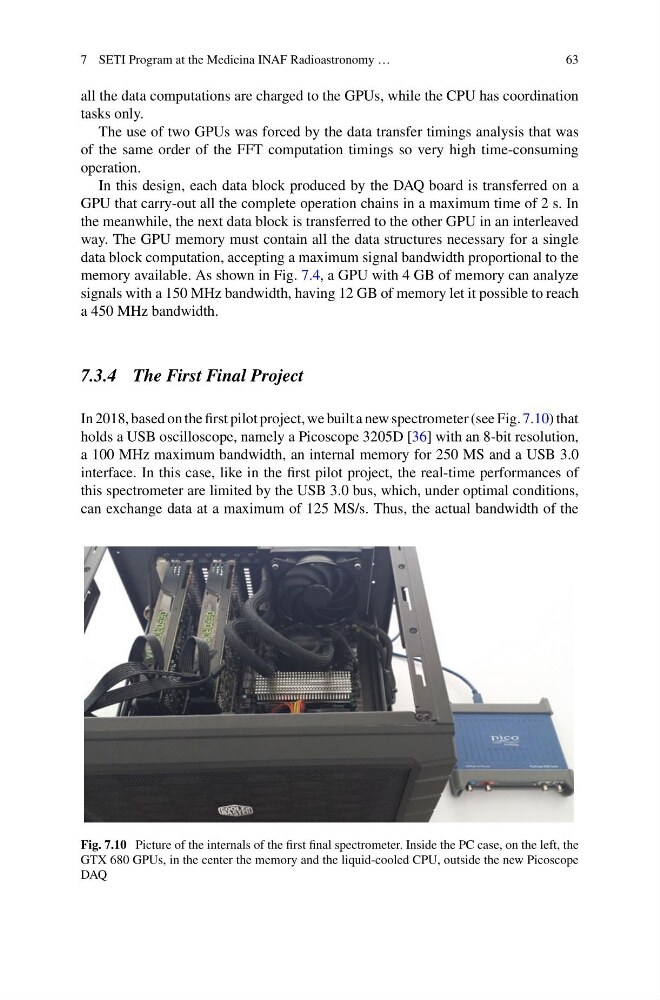
In 2018, based on the first pilot project, we built a new spectrometer (see Fig. 7.10) that
holds a USB oscilloscope, namely a Picoscope 3205D [36] with an 8-bit resolution,
a 100 MHz maximum bandwidth, an internal memory for 250 MS and a USB 3.0
interface. In this case, like in the first pilot project, the real-time performances of
this spectrometer are limited by the USB 3.0 bus, which, under optimal conditions,
can exchange data at a maximum of 125 MS/s. Thus, the actual bandwidth of the
Fig. 7.10 Picture of the internals of the first final spectrometer. Inside the PC case, on the left, the
GTX 680 GPUs, in the center the memory and the liquid-cooled CPU, outside the new Picoscope
DAQ
63
all the data computations are charged to the GPUs, while the CPU has coordination
tasks only.
The use of two GPUs was forced by the data transfer timings analysis that was
of the same order of the FFT computation timings so very high time-consuming
operation.
In this design, each data block produced by the DAQ board is transferred on a
GPU that carry-out all the complete operation chains in a maximum time of 2 s. In
the meanwhile, the next data block is transferred to the other GPU in an interleaved
way. The GPU memory must contain all the data structures necessary for a single
data block computation, accepting a maximum signal bandwidth proportional to the
memory available. As shown in Fig. 7.4, a GPU with 4 GB of memory can analyze
signals with a 150 MHz bandwidth, having 12 GB of memory let it possible to reach
a 450 MHz bandwidth.
7.3.4 The First Final Project
In 2018, based on the first pilot project, we built a new spectrometer (see Fig. 7.10) that
holds a USB oscilloscope, namely a Picoscope 3205D [36] with an 8-bit resolution,
a 100 MHz maximum bandwidth, an internal memory for 250 MS and a USB 3.0
interface. In this case, like in the first pilot project, the real-time performances of
this spectrometer are limited by the USB 3.0 bus, which, under optimal conditions,
can exchange data at a maximum of 125 MS/s. Thus, the actual bandwidth of the
Fig. 7.10 Picture of the internals of the first final spectrometer. Inside the PC case, on the left, the
GTX 680 GPUs, in the center the memory and the liquid-cooled CPU, outside the new Picoscope
DAQ