

60
R. Lulli et al.
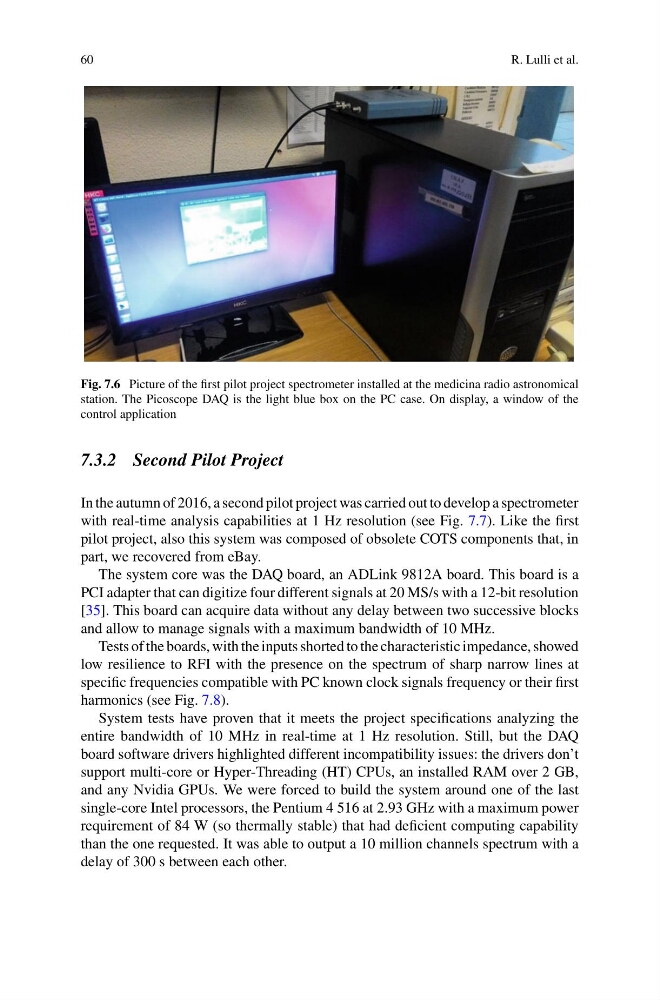
Fig. 7.6 Picture of the first pilot project spectrometer installed at the medicina radio astronomical
station. The Picoscope DAQ is the light blue box on the PC case. On display, a window of the
control application
7.3.2 Second Pilot Project
In the autumn of 2016, a second pilot project was carried out to develop a spectrometer
with real-time analysis capabilities at 1 Hz resolution (see Fig. 7.7). Like the first
pilot project, also this system was composed of obsolete COTS components that, in
part, we recovered from eBay.
The system core was the DAQ board, an ADLink 9812A board. This board is a
PCI adapter that can digitize four different signals at 20 MS/s with a 12-bit resolution
[35]. This board can acquire data without any delay between two successive blocks
and allow to manage signals with a maximum bandwidth of 10 MHz.
Tests of the boards, with the inputs shorted to the characteristic impedance, showed
low resilience to RFI with the presence on the spectrum of sharp narrow lines at
specific frequencies compatible with PC known clock signals frequency or their first
harmonics (see Fig. 7.8).
System tests have proven that it meets the project specifications analyzing the
entire bandwidth of 10 MHz in real-time at 1 Hz resolution. Still, but the DAQ
board software drivers highlighted different incompatibility issues: the drivers don’t
support multi-core or Hyper-Threading (HT) CPUs, an installed RAM over 2 GB,
and any Nvidia GPUs. We were forced to build the system around one of the last
single-core Intel processors, the Pentium 4 516 at 2.93 GHz with a maximum power
requirement of 84 W (so thermally stable) that had deficient computing capability
than the one requested. It was able to output a 10 million channels spectrum with a
delay of 300 s between each other.
R. Lulli et al.
Fig. 7.6 Picture of the first pilot project spectrometer installed at the medicina radio astronomical
station. The Picoscope DAQ is the light blue box on the PC case. On display, a window of the
control application
7.3.2 Second Pilot Project
In the autumn of 2016, a second pilot project was carried out to develop a spectrometer
with real-time analysis capabilities at 1 Hz resolution (see Fig. 7.7). Like the first
pilot project, also this system was composed of obsolete COTS components that, in
part, we recovered from eBay.
The system core was the DAQ board, an ADLink 9812A board. This board is a
PCI adapter that can digitize four different signals at 20 MS/s with a 12-bit resolution
[35]. This board can acquire data without any delay between two successive blocks
and allow to manage signals with a maximum bandwidth of 10 MHz.
Tests of the boards, with the inputs shorted to the characteristic impedance, showed
low resilience to RFI with the presence on the spectrum of sharp narrow lines at
specific frequencies compatible with PC known clock signals frequency or their first
harmonics (see Fig. 7.8).
System tests have proven that it meets the project specifications analyzing the
entire bandwidth of 10 MHz in real-time at 1 Hz resolution. Still, but the DAQ
board software drivers highlighted different incompatibility issues: the drivers don’t
support multi-core or Hyper-Threading (HT) CPUs, an installed RAM over 2 GB,
and any Nvidia GPUs. We were forced to build the system around one of the last
single-core Intel processors, the Pentium 4 516 at 2.93 GHz with a maximum power
requirement of 84 W (so thermally stable) that had deficient computing capability
than the one requested. It was able to output a 10 million channels spectrum with a
delay of 300 s between each other.