

48
R. Lulli et al.
comet asteroids, etc.) detection and tracking, to larger bands typical for SETI observations. Here following, we report all the developed systems, their performances, the
real field tests we carried out till now, and the guidelines for further developments.
7.1 Introduction
7.1.1 PC Based Spectrometers of the 90s at the Medicina
Radio Astronomical Station
At the Medicina Radio Astronomical Station, the development of PC based digital
spectrometer started in the 1990s as soon as CPU processing capabilities showed a
significant increase with the availability on the market of Intel Pentium and Pentium
II class processors.
The first projects named Sentinel 1 and Sentinel 2 were spectrometers dedicated
to the Radio Frequency Interference (RFI) detecting and monitoring, a problem that
at the Medicina Radio Astronomical Station in the 1990s became more significant.
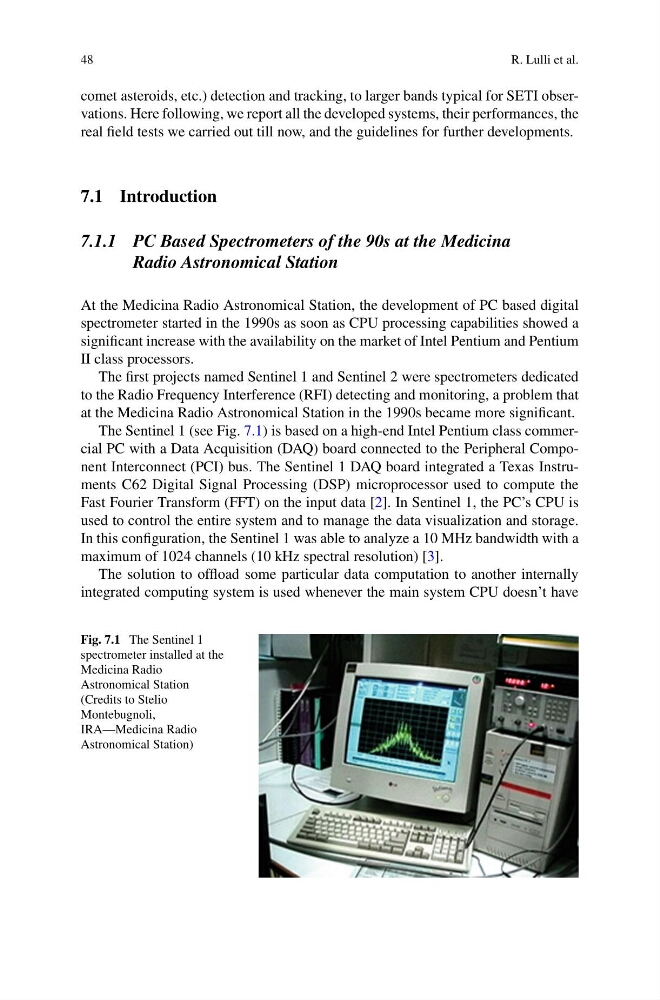
The Sentinel 1 (see Fig. 7.1) is based on a high-end Intel Pentium class commercial PC with a Data Acquisition (DAQ) board connected to the Peripheral Component Interconnect (PCI) bus. The Sentinel 1 DAQ board integrated a Texas Instruments C62 Digital Signal Processing (DSP) microprocessor used to compute the
Fast Fourier Transform (FFT) on the input data [2]. In Sentinel 1, the PC’s CPU is
used to control the entire system and to manage the data visualization and storage.
In this configuration, the Sentinel 1 was able to analyze a 10 MHz bandwidth with a
maximum of 1024 channels (10 kHz spectral resolution) [3].
The solution to offload some particular data computation to another internally
integrated computing system is used whenever the main system CPU doesn’t have
Fig. 7.1 The Sentinel 1
spectrometer installed at the
Medicina Radio
Astronomical Station
(Credits to Stelio
Montebugnoli,
IRA—Medicina Radio
Astronomical Station)
R. Lulli et al.
comet asteroids, etc.) detection and tracking, to larger bands typical for SETI observations. Here following, we report all the developed systems, their performances, the
real field tests we carried out till now, and the guidelines for further developments.
7.1 Introduction
7.1.1 PC Based Spectrometers of the 90s at the Medicina
Radio Astronomical Station
At the Medicina Radio Astronomical Station, the development of PC based digital
spectrometer started in the 1990s as soon as CPU processing capabilities showed a
significant increase with the availability on the market of Intel Pentium and Pentium
II class processors.
The first projects named Sentinel 1 and Sentinel 2 were spectrometers dedicated
to the Radio Frequency Interference (RFI) detecting and monitoring, a problem that
at the Medicina Radio Astronomical Station in the 1990s became more significant.
The Sentinel 1 (see Fig. 7.1) is based on a high-end Intel Pentium class commercial PC with a Data Acquisition (DAQ) board connected to the Peripheral Component Interconnect (PCI) bus. The Sentinel 1 DAQ board integrated a Texas Instruments C62 Digital Signal Processing (DSP) microprocessor used to compute the
Fast Fourier Transform (FFT) on the input data [2]. In Sentinel 1, the PC’s CPU is
used to control the entire system and to manage the data visualization and storage.
In this configuration, the Sentinel 1 was able to analyze a 10 MHz bandwidth with a
maximum of 1024 channels (10 kHz spectral resolution) [3].
The solution to offload some particular data computation to another internally
integrated computing system is used whenever the main system CPU doesn’t have
Fig. 7.1 The Sentinel 1
spectrometer installed at the
Medicina Radio
Astronomical Station
(Credits to Stelio
Montebugnoli,
IRA—Medicina Radio
Astronomical Station)