

6 COGITO in Space
37
to better understand the relevance of radio transmissions in contemporary thought
and their great cultural impact. My questioning focused especially on how radio
waves transmissions have been expanding the human reach into the cosmos, towards
places where manned space exploration might never be able to reach, allowing us
to remotely explore outer space and exposing the conventional perception of our
surroundings to a virtual yet uncannily real and detailed landscape, made of matter
still to be defined (see Fig. 6.2). Radio waves have gradually become the mean for
the virtual human space travel and the carriers of a new-found cosmic awareness and
cultural contents, exceeding their scientific and technological functions. One of the
questions that originated from my research and that eventually became one of the
leading concepts of COGITO in Space is “how does the knowledge acquired through
remote observation of the universe influence our cognition and how does the mind
interact with the matter of such distant universe and vice versa?” [3].
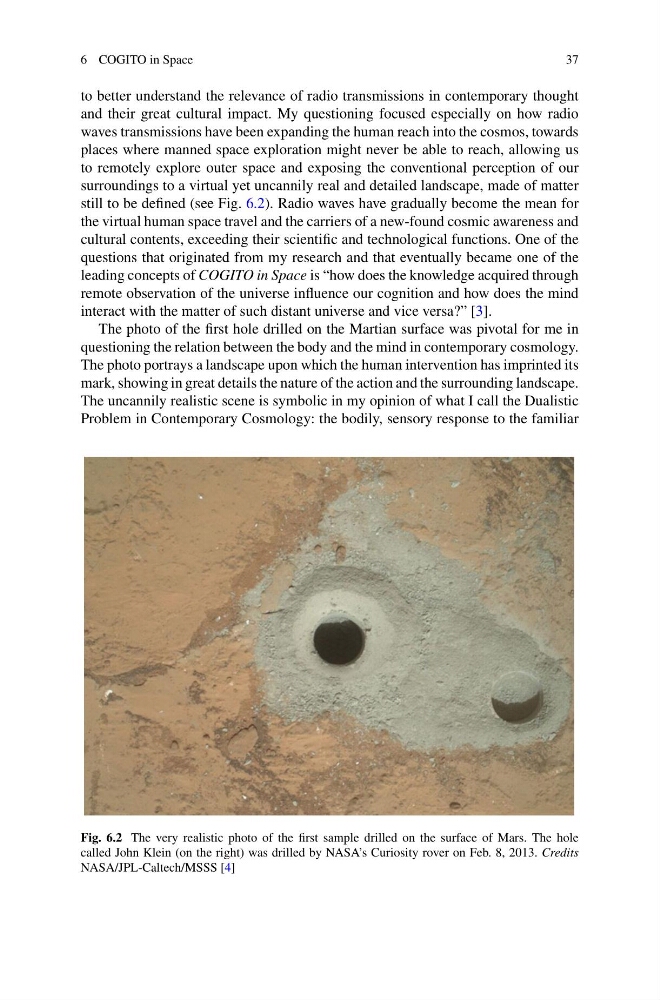
The photo of the first hole drilled on the Martian surface was pivotal for me in
questioning the relation between the body and the mind in contemporary cosmology.
The photo portrays a landscape upon which the human intervention has imprinted its
mark, showing in great details the nature of the action and the surrounding landscape.
The uncannily realistic scene is symbolic in my opinion of what I call the Dualistic
Problem in Contemporary Cosmology: the bodily, sensory response to the familiar
Fig. 6.2 The very realistic photo of the first sample drilled on the surface of Mars. The hole
called John Klein (on the right) was drilled by NASA’s Curiosity rover on Feb. 8, 2013. Credits
NASA/JPL-Caltech/MSSS [4]
37
to better understand the relevance of radio transmissions in contemporary thought
and their great cultural impact. My questioning focused especially on how radio
waves transmissions have been expanding the human reach into the cosmos, towards
places where manned space exploration might never be able to reach, allowing us
to remotely explore outer space and exposing the conventional perception of our
surroundings to a virtual yet uncannily real and detailed landscape, made of matter
still to be defined (see Fig. 6.2). Radio waves have gradually become the mean for
the virtual human space travel and the carriers of a new-found cosmic awareness and
cultural contents, exceeding their scientific and technological functions. One of the
questions that originated from my research and that eventually became one of the
leading concepts of COGITO in Space is “how does the knowledge acquired through
remote observation of the universe influence our cognition and how does the mind
interact with the matter of such distant universe and vice versa?” [3].
The photo of the first hole drilled on the Martian surface was pivotal for me in
questioning the relation between the body and the mind in contemporary cosmology.
The photo portrays a landscape upon which the human intervention has imprinted its
mark, showing in great details the nature of the action and the surrounding landscape.
The uncannily realistic scene is symbolic in my opinion of what I call the Dualistic
Problem in Contemporary Cosmology: the bodily, sensory response to the familiar
Fig. 6.2 The very realistic photo of the first sample drilled on the surface of Mars. The hole
called John Klein (on the right) was drilled by NASA’s Curiosity rover on Feb. 8, 2013. Credits
NASA/JPL-Caltech/MSSS [4]