

100
A. Melis et al.
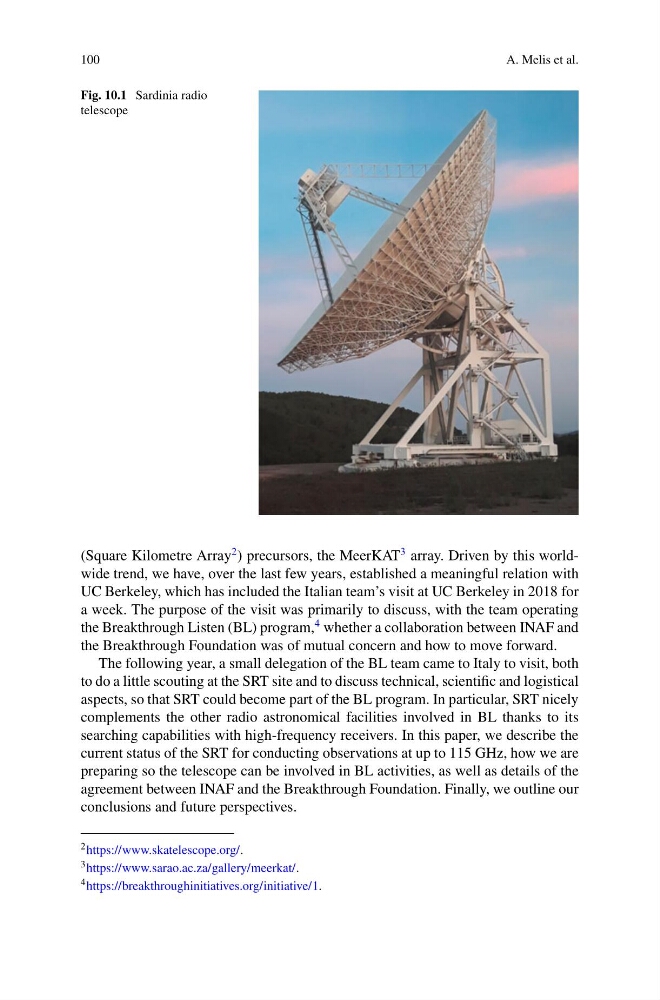
Fig. 10.1 Sardinia radio
telescope
(Square Kilometre Array
2 ) precursors, the MeerKAT
3 array. Driven by this worldwide trend, we have, over the last few years, established a meaningful relation with
UC Berkeley, which has included the Italian team’s visit at UC Berkeley in 2018 for
a week. The purpose of the visit was primarily to discuss, with the team operating
the Breakthrough Listen (BL) program,
4 whether a collaboration between INAF and
the Breakthrough Foundation was of mutual concern and how to move forward.
The following year, a small delegation of the BL team came to Italy to visit, both
to do a little scouting at the SRT site and to discuss technical, scientific and logistical
aspects, so that SRT could become part of the BL program. In particular, SRT nicely
complements the other radio astronomical facilities involved in BL thanks to its
searching capabilities with high-frequency receivers. In this paper, we describe the
current status of the SRT for conducting observations at up to 115 GHz, how we are
preparing so the telescope can be involved in BL activities, as well as details of the
agreement between INAF and the Breakthrough Foundation. Finally, we outline our
conclusions and future perspectives.
2 https://www.skatelescope.org/.
3 https://www.sarao.ac.za/gallery/meerkat/.
4 https://breakthroughinitiatives.org/initiative/1.
A. Melis et al.
Fig. 10.1 Sardinia radio
telescope
(Square Kilometre Array
2 ) precursors, the MeerKAT
3 array. Driven by this worldwide trend, we have, over the last few years, established a meaningful relation with
UC Berkeley, which has included the Italian team’s visit at UC Berkeley in 2018 for
a week. The purpose of the visit was primarily to discuss, with the team operating
the Breakthrough Listen (BL) program,
4 whether a collaboration between INAF and
the Breakthrough Foundation was of mutual concern and how to move forward.
The following year, a small delegation of the BL team came to Italy to visit, both
to do a little scouting at the SRT site and to discuss technical, scientific and logistical
aspects, so that SRT could become part of the BL program. In particular, SRT nicely
complements the other radio astronomical facilities involved in BL thanks to its
searching capabilities with high-frequency receivers. In this paper, we describe the
current status of the SRT for conducting observations at up to 115 GHz, how we are
preparing so the telescope can be involved in BL activities, as well as details of the
agreement between INAF and the Breakthrough Foundation. Finally, we outline our
conclusions and future perspectives.
2 https://www.skatelescope.org/.
3 https://www.sarao.ac.za/gallery/meerkat/.
4 https://breakthroughinitiatives.org/initiative/1.