

9 Exobiolab: Different Life on Different Planets
89
Hypergravity not only suppresses the growth of stretching, but promotes lateral
expansion of plant organs. Plant organs are highly resistant to gravitational acceleration and growth parameters vary in proportion to the logarithm of the magnitude of
gravitational acceleration up to 300 g. In [4] we see how in microgravity conditions,
the intrinsic structural and physiological anisotropies of plant organs could cause
a spontaneous automorphic curvature, while in the presence of gravity, the organs
are forced to grow along the vector of gravity, leading to gravitropic curvature. Let
us take into account too [5] to become familiar with fundamental aspects of the
microcravity environment of space and with plants on Earth (pigment, chlorophyll,
different species of plants).
9.2.6 Biosignatures
In the right environment, Super-Earths could be the cradle of alien life that could
modify the chemical composition of their atmospheres. So, the search for life signatures requires as the first step the knowledge of planet atmospheres. Indeed, the
quest for the determination of the chemical composition of those planetary atmospheres rises also more general interest than that given by the mere directory of the
atmospheric compounds. It opens out to the more general speculation on what such
detection might tell us about the presence of life on those planets. As, for now, we
have only one example of life in the universe, we are bound to study terrestrial organisms to assess possibilities of life on other planets and guide our search for possible
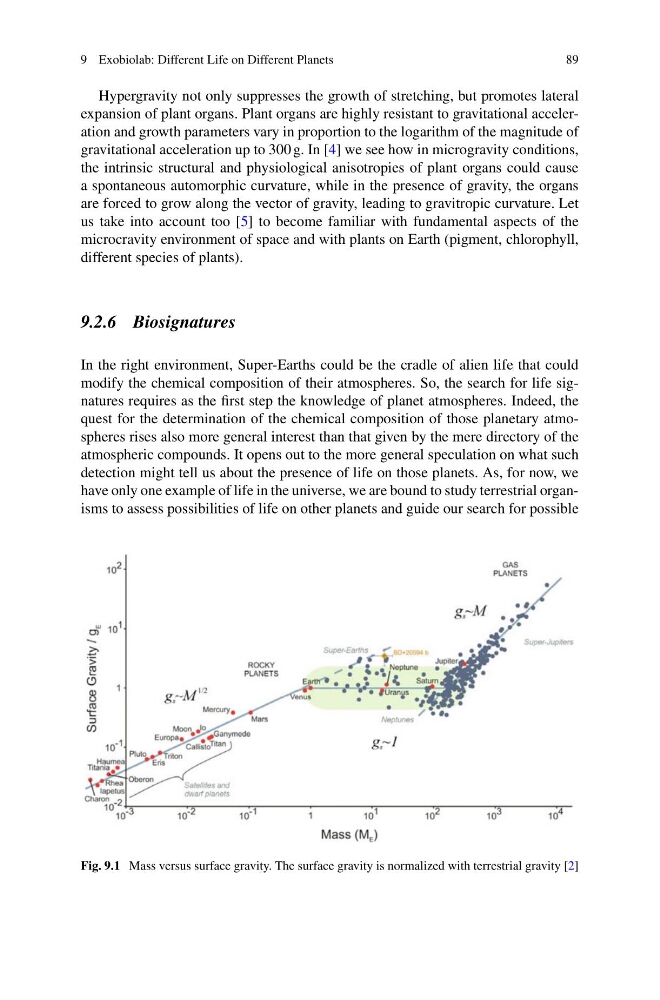
Fig. 9.1 Mass versus surface gravity. The surface gravity is normalized with terrestrial gravity [2]
89
Hypergravity not only suppresses the growth of stretching, but promotes lateral
expansion of plant organs. Plant organs are highly resistant to gravitational acceleration and growth parameters vary in proportion to the logarithm of the magnitude of
gravitational acceleration up to 300 g. In [4] we see how in microgravity conditions,
the intrinsic structural and physiological anisotropies of plant organs could cause
a spontaneous automorphic curvature, while in the presence of gravity, the organs
are forced to grow along the vector of gravity, leading to gravitropic curvature. Let
us take into account too [5] to become familiar with fundamental aspects of the
microcravity environment of space and with plants on Earth (pigment, chlorophyll,
different species of plants).
9.2.6 Biosignatures
In the right environment, Super-Earths could be the cradle of alien life that could
modify the chemical composition of their atmospheres. So, the search for life signatures requires as the first step the knowledge of planet atmospheres. Indeed, the
quest for the determination of the chemical composition of those planetary atmospheres rises also more general interest than that given by the mere directory of the
atmospheric compounds. It opens out to the more general speculation on what such
detection might tell us about the presence of life on those planets. As, for now, we
have only one example of life in the universe, we are bound to study terrestrial organisms to assess possibilities of life on other planets and guide our search for possible
Fig. 9.1 Mass versus surface gravity. The surface gravity is normalized with terrestrial gravity [2]