

9 Exobiolab: Different Life on Different Planets
87
conditions on any given planet can be very different. Other boundary conditions that
may help to sustain life are energy sources (light, chemical) and magnetic fields to
protect from ionising particle radiation.
9.2.2 Life on Exoplanets
We have no precise information on the structure of the surfaces of extrasolar planets.
Still, we have some hints on the chemical composition of their atmospheres, and on
the internal chemical composition of their interiors (if they are rocky or fluffy, that is).
It is also possible to use the Earth as a model in order to estimate its ecological limits
to life and understand, should approximately Earth-like planets be found, whether
these parameters could apply. Of course, this does not mean that there is life, but that
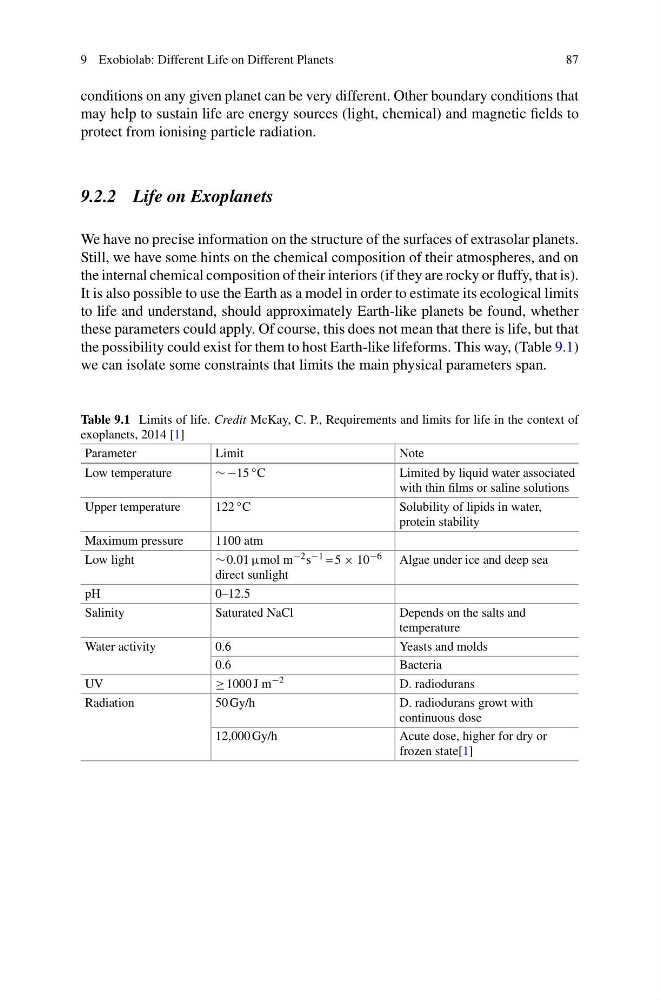
the possibility could exist for them to host Earth-like lifeforms. This way, (Table 9.1)
we can isolate some constraints that limits the main physical parameters span.
Table 9.1 Limits of life. Credit McKay, C. P., Requirements and limits for life in the context of
exoplanets, 2014 [1]
Parameter
Limit
Note
Low temperature
∼−15 ◦ C
Limited by liquid water associated
with thin films or saline solutions
Upper temperature
122 ◦ C
Solubility of lipids in water,
protein stability
Maximum pressure
1100 atm
Low light
∼ 0.01 µmol m −2 s −1 = 5 × 10 −6
direct sunlight
Algae under ice and deep sea
pH
0–12.5
Salinity
Saturated NaCl
Depends on the salts and
temperature
Water activity
0.6
Yeasts and molds
0.6
Bacteria
UV
≥ 1000 J m −2
D. radiodurans
Radiation
50 Gy/h
D. radiodurans growt with
continuous dose
12,000 Gy/h
Acute dose, higher for dry or
frozen state[1]
87
conditions on any given planet can be very different. Other boundary conditions that
may help to sustain life are energy sources (light, chemical) and magnetic fields to
protect from ionising particle radiation.
9.2.2 Life on Exoplanets
We have no precise information on the structure of the surfaces of extrasolar planets.
Still, we have some hints on the chemical composition of their atmospheres, and on
the internal chemical composition of their interiors (if they are rocky or fluffy, that is).
It is also possible to use the Earth as a model in order to estimate its ecological limits
to life and understand, should approximately Earth-like planets be found, whether
these parameters could apply. Of course, this does not mean that there is life, but that
the possibility could exist for them to host Earth-like lifeforms. This way, (Table 9.1)
we can isolate some constraints that limits the main physical parameters span.
Table 9.1 Limits of life. Credit McKay, C. P., Requirements and limits for life in the context of
exoplanets, 2014 [1]
Parameter
Limit
Note
Low temperature
∼−15 ◦ C
Limited by liquid water associated
with thin films or saline solutions
Upper temperature
122 ◦ C
Solubility of lipids in water,
protein stability
Maximum pressure
1100 atm
Low light
∼ 0.01 µmol m −2 s −1 = 5 × 10 −6
direct sunlight
Algae under ice and deep sea
pH
0–12.5
Salinity
Saturated NaCl
Depends on the salts and
temperature
Water activity
0.6
Yeasts and molds
0.6
Bacteria
UV
≥ 1000 J m −2
D. radiodurans
Radiation
50 Gy/h
D. radiodurans growt with
continuous dose
12,000 Gy/h
Acute dose, higher for dry or
frozen state[1]