

4.11 Implementing a Modular MEL System for CCAFS
Building on the above, a CCAFS Monitoring, Learning and Evaluation Strategy
was approved by the program’s management committee and its advisory board
(Schuetz et al. 2014g). The overall goal of the CCAFS MEL strategy is to develop
an “evaluative culture” within CCAFS that encourages self-reflection and selfexamination, seeks evidence, takes time to learn, encourages experimentation and
change so that MEL becomes an integrated mechanism. The strategy includes a
conceptual framework, guided by overall program principles for partnership,
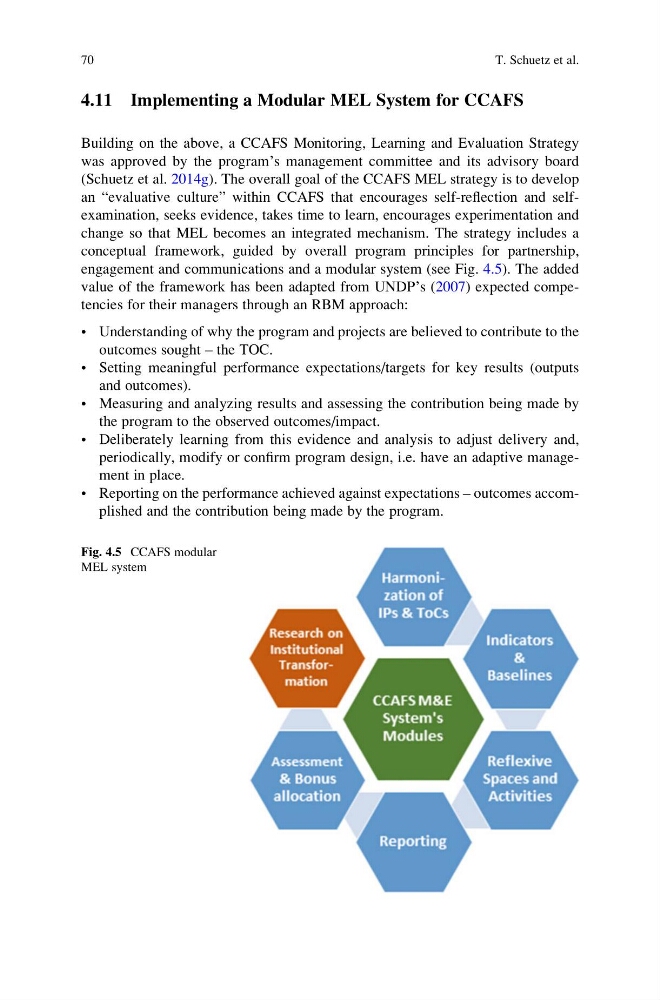
engagement and communications and a modular system (see Fig. 4.5). The added
value of the framework has been adapted from UNDP’s (2007) expected competencies for their managers through an RBM approach:
• Understanding of why the program and projects are believed to contribute to the
outcomes sought – the TOC.
• Setting meaningful performance expectations/targets for key results (outputs
and outcomes).
• Measuring and analyzing results and assessing the contribution being made by
the program to the observed outcomes/impact.
• Deliberately learning from this evidence and analysis to adjust delivery and,
periodically, modify or confirm program design, i.e. have an adaptive management in place.
• Reporting on the performance achieved against expectations – outcomes accomplished and the contribution being made by the program.
Fig. 4.5 CCAFS modular
MEL system
70
T. Schuetz et al.
Building on the above, a CCAFS Monitoring, Learning and Evaluation Strategy
was approved by the program’s management committee and its advisory board
(Schuetz et al. 2014g). The overall goal of the CCAFS MEL strategy is to develop
an “evaluative culture” within CCAFS that encourages self-reflection and selfexamination, seeks evidence, takes time to learn, encourages experimentation and
change so that MEL becomes an integrated mechanism. The strategy includes a
conceptual framework, guided by overall program principles for partnership,
engagement and communications and a modular system (see Fig. 4.5). The added
value of the framework has been adapted from UNDP’s (2007) expected competencies for their managers through an RBM approach:
• Understanding of why the program and projects are believed to contribute to the
outcomes sought – the TOC.
• Setting meaningful performance expectations/targets for key results (outputs
and outcomes).
• Measuring and analyzing results and assessing the contribution being made by
the program to the observed outcomes/impact.
• Deliberately learning from this evidence and analysis to adjust delivery and,
periodically, modify or confirm program design, i.e. have an adaptive management in place.
• Reporting on the performance achieved against expectations – outcomes accomplished and the contribution being made by the program.
Fig. 4.5 CCAFS modular
MEL system
70
T. Schuetz et al.