

4.5 Findings and Analysis
4.5.1 Moving Away from a Logframe
In line with funding agency requirements, CCAFS also initiated its programmatic
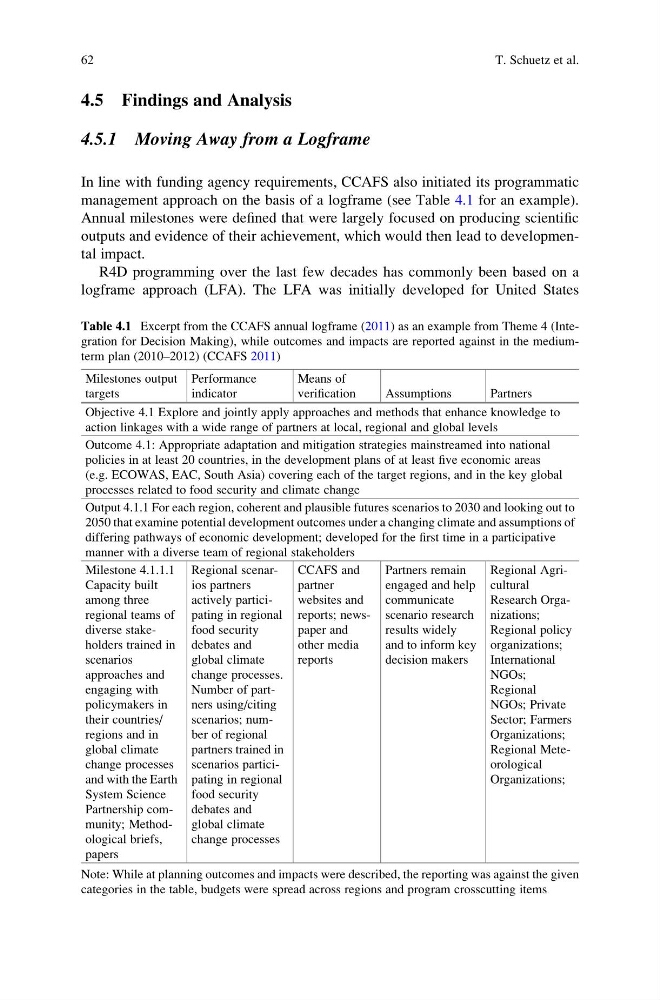
management approach on the basis of a logframe (see Table 4.1 for an example).
Annual milestones were defined that were largely focused on producing scientific
outputs and evidence of their achievement, which would then lead to developmental impact.
R4D programming over the last few decades has commonly been based on a
logframe approach (LFA). The LFA was initially developed for United States
Table 4.1 Excerpt from the CCAFS annual logframe (2011) as an example from Theme 4 (Integration for Decision Making), while outcomes and impacts are reported against in the mediumterm plan (2010–2012) (CCAFS 2011)
Milestones output
targets
Performance
indicator
Means of
verification
Assumptions
Partners
Objective 4.1 Explore and jointly apply approaches and methods that enhance knowledge to
action linkages with a wide range of partners at local, regional and global levels
Outcome 4.1: Appropriate adaptation and mitigation strategies mainstreamed into national
policies in at least 20 countries, in the development plans of at least five economic areas
(e.g. ECOWAS, EAC, South Asia) covering each of the target regions, and in the key global
processes related to food security and climate change
Output 4.1.1 For each region, coherent and plausible futures scenarios to 2030 and looking out to
2050 that examine potential development outcomes under a changing climate and assumptions of
differing pathways of economic development; developed for the first time in a participative
manner with a diverse team of regional stakeholders
Milestone 4.1.1.1
Capacity built
among three
regional teams of
diverse stakeholders trained in
scenarios
approaches and
engaging with
policymakers in
their countries/
regions and in
global climate
change processes
and with the Earth
System Science
Partnership community; Methodological briefs,
papers
Regional scenarios partners
actively participating in regional
food security
debates and
global climate
change processes.
Number of partners using/citing
scenarios; number of regional
partners trained in
scenarios participating in regional
food security
debates and
global climate
change processes
CCAFS and
partner
websites and
reports; newspaper and
other media
reports
Partners remain
engaged and help
communicate
scenario research
results widely
and to inform key
decision makers
Regional Agricultural
Research Organizations;
Regional policy
organizations;
International
NGOs;
Regional
NGOs; Private
Sector; Farmers
Organizations;
Regional Meteorological
Organizations;
Note: While at planning outcomes and impacts were described, the reporting was against the given
categories in the table, budgets were spread across regions and program crosscutting items
62
T. Schuetz et al.
4.5.1 Moving Away from a Logframe
In line with funding agency requirements, CCAFS also initiated its programmatic
management approach on the basis of a logframe (see Table 4.1 for an example).
Annual milestones were defined that were largely focused on producing scientific
outputs and evidence of their achievement, which would then lead to developmental impact.
R4D programming over the last few decades has commonly been based on a
logframe approach (LFA). The LFA was initially developed for United States
Table 4.1 Excerpt from the CCAFS annual logframe (2011) as an example from Theme 4 (Integration for Decision Making), while outcomes and impacts are reported against in the mediumterm plan (2010–2012) (CCAFS 2011)
Milestones output
targets
Performance
indicator
Means of
verification
Assumptions
Partners
Objective 4.1 Explore and jointly apply approaches and methods that enhance knowledge to
action linkages with a wide range of partners at local, regional and global levels
Outcome 4.1: Appropriate adaptation and mitigation strategies mainstreamed into national
policies in at least 20 countries, in the development plans of at least five economic areas
(e.g. ECOWAS, EAC, South Asia) covering each of the target regions, and in the key global
processes related to food security and climate change
Output 4.1.1 For each region, coherent and plausible futures scenarios to 2030 and looking out to
2050 that examine potential development outcomes under a changing climate and assumptions of
differing pathways of economic development; developed for the first time in a participative
manner with a diverse team of regional stakeholders
Milestone 4.1.1.1
Capacity built
among three
regional teams of
diverse stakeholders trained in
scenarios
approaches and
engaging with
policymakers in
their countries/
regions and in
global climate
change processes
and with the Earth
System Science
Partnership community; Methodological briefs,
papers
Regional scenarios partners
actively participating in regional
food security
debates and
global climate
change processes.
Number of partners using/citing
scenarios; number of regional
partners trained in
scenarios participating in regional
food security
debates and
global climate
change processes
CCAFS and
partner
websites and
reports; newspaper and
other media
reports
Partners remain
engaged and help
communicate
scenario research
results widely
and to inform key
decision makers
Regional Agricultural
Research Organizations;
Regional policy
organizations;
International
NGOs;
Regional
NGOs; Private
Sector; Farmers
Organizations;
Regional Meteorological
Organizations;
Note: While at planning outcomes and impacts were described, the reporting was against the given
categories in the table, budgets were spread across regions and program crosscutting items
62
T. Schuetz et al.