

4.3 Approach
This section describes the approach to results-based management taken by one
research for development program of CGIAR, CCAFS. The description is combined with theoretical and practical references to development agencies that started
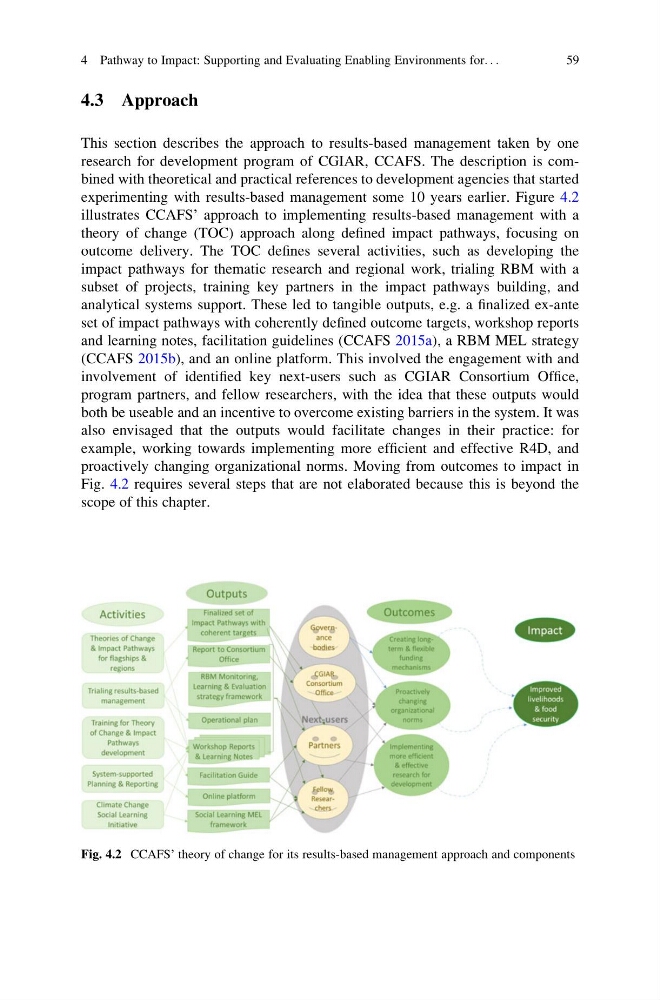
experimenting with results-based management some 10 years earlier. Figure 4.2
illustrates CCAFS’ approach to implementing results-based management with a
theory of change (TOC) approach along defined impact pathways, focusing on
outcome delivery. The TOC defines several activities, such as developing the
impact pathways for thematic research and regional work, trialing RBM with a
subset of projects, training key partners in the impact pathways building, and
analytical systems support. These led to tangible outputs, e.g. a finalized ex-ante
set of impact pathways with coherently defined outcome targets, workshop reports
and learning notes, facilitation guidelines (CCAFS 2015a), a RBM MEL strategy
(CCAFS 2015b), and an online platform. This involved the engagement with and
involvement of identified key next-users such as CGIAR Consortium Office,
program partners, and fellow researchers, with the idea that these outputs would
both be useable and an incentive to overcome existing barriers in the system. It was
also envisaged that the outputs would facilitate changes in their practice: for
example, working towards implementing more efficient and effective R4D, and
proactively changing organizational norms. Moving from outcomes to impact in
Fig. 4.2 requires several steps that are not elaborated because this is beyond the
scope of this chapter.
Fig. 4.2 CCAFS’ theory of change for its results-based management approach and components
4 Pathway to Impact: Supporting and Evaluating Enabling Environments for. . .
59
This section describes the approach to results-based management taken by one
research for development program of CGIAR, CCAFS. The description is combined with theoretical and practical references to development agencies that started
experimenting with results-based management some 10 years earlier. Figure 4.2
illustrates CCAFS’ approach to implementing results-based management with a
theory of change (TOC) approach along defined impact pathways, focusing on
outcome delivery. The TOC defines several activities, such as developing the
impact pathways for thematic research and regional work, trialing RBM with a
subset of projects, training key partners in the impact pathways building, and
analytical systems support. These led to tangible outputs, e.g. a finalized ex-ante
set of impact pathways with coherently defined outcome targets, workshop reports
and learning notes, facilitation guidelines (CCAFS 2015a), a RBM MEL strategy
(CCAFS 2015b), and an online platform. This involved the engagement with and
involvement of identified key next-users such as CGIAR Consortium Office,
program partners, and fellow researchers, with the idea that these outputs would
both be useable and an incentive to overcome existing barriers in the system. It was
also envisaged that the outputs would facilitate changes in their practice: for
example, working towards implementing more efficient and effective R4D, and
proactively changing organizational norms. Moving from outcomes to impact in
Fig. 4.2 requires several steps that are not elaborated because this is beyond the
scope of this chapter.
Fig. 4.2 CCAFS’ theory of change for its results-based management approach and components
4 Pathway to Impact: Supporting and Evaluating Enabling Environments for. . .
59