

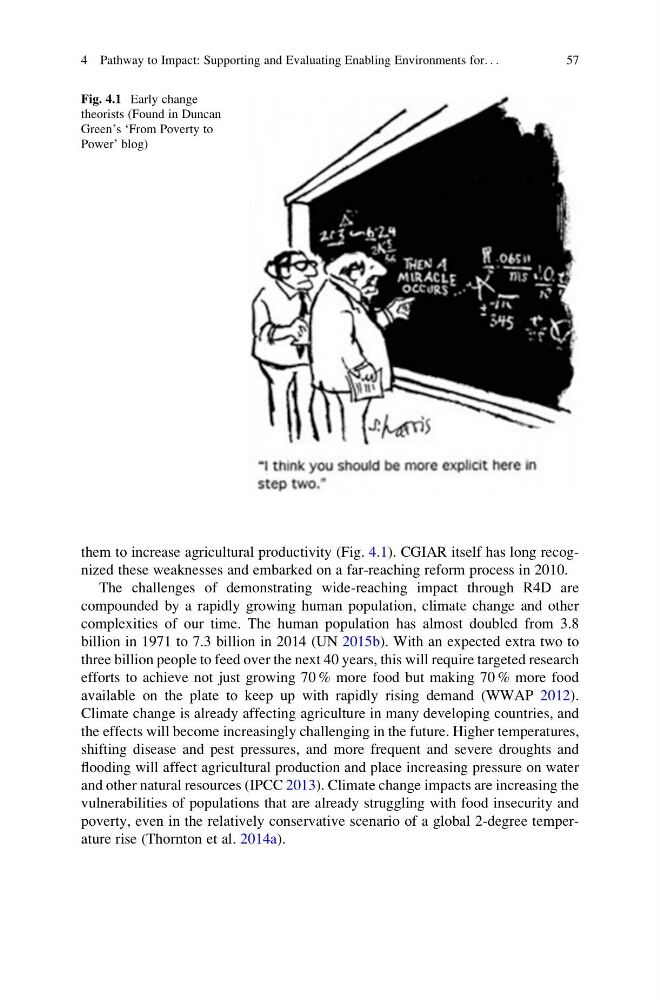
them to increase agricultural productivity (Fig. 4.1). CGIAR itself has long recognized these weaknesses and embarked on a far-reaching reform process in 2010.
The challenges of demonstrating wide-reaching impact through R4D are
compounded by a rapidly growing human population, climate change and other
complexities of our time. The human population has almost doubled from 3.8
billion in 1971 to 7.3 billion in 2014 (UN 2015b). With an expected extra two to
three billion people to feed over the next 40 years, this will require targeted research
efforts to achieve not just growing 70 % more food but making 70 % more food
available on the plate to keep up with rapidly rising demand (WWAP 2012).
Climate change is already affecting agriculture in many developing countries, and
the effects will become increasingly challenging in the future. Higher temperatures,
shifting disease and pest pressures, and more frequent and severe droughts and
flooding will affect agricultural production and place increasing pressure on water
and other natural resources (IPCC 2013). Climate change impacts are increasing the
vulnerabilities of populations that are already struggling with food insecurity and
poverty, even in the relatively conservative scenario of a global 2-degree temperature rise (Thornton et al. 2014a).
Fig. 4.1 Early change
theorists (Found in Duncan
Green’s ‘From Poverty to
Power’ blog)
4 Pathway to Impact: Supporting and Evaluating Enabling Environments for. . .
57
The challenges of demonstrating wide-reaching impact through R4D are
compounded by a rapidly growing human population, climate change and other
complexities of our time. The human population has almost doubled from 3.8
billion in 1971 to 7.3 billion in 2014 (UN 2015b). With an expected extra two to
three billion people to feed over the next 40 years, this will require targeted research
efforts to achieve not just growing 70 % more food but making 70 % more food
available on the plate to keep up with rapidly rising demand (WWAP 2012).
Climate change is already affecting agriculture in many developing countries, and
the effects will become increasingly challenging in the future. Higher temperatures,
shifting disease and pest pressures, and more frequent and severe droughts and
flooding will affect agricultural production and place increasing pressure on water
and other natural resources (IPCC 2013). Climate change impacts are increasing the
vulnerabilities of populations that are already struggling with food insecurity and
poverty, even in the relatively conservative scenario of a global 2-degree temperature rise (Thornton et al. 2014a).
Fig. 4.1 Early change
theorists (Found in Duncan
Green’s ‘From Poverty to
Power’ blog)
4 Pathway to Impact: Supporting and Evaluating Enabling Environments for. . .
57