

of different sources of evidence (including monitoring data on Greenhouse Gas
emissions) and use a mixed methods approach (as advocated by Bamberger 2012).
3.7 Using Space and Scale to Identify Approaches
When the two dimensional cut of space and scale are taken out the three dimensional time, space and scale matrix, at first sight a less well covered picture
emerges, with some clear gaps where currently no favourite tool or method for
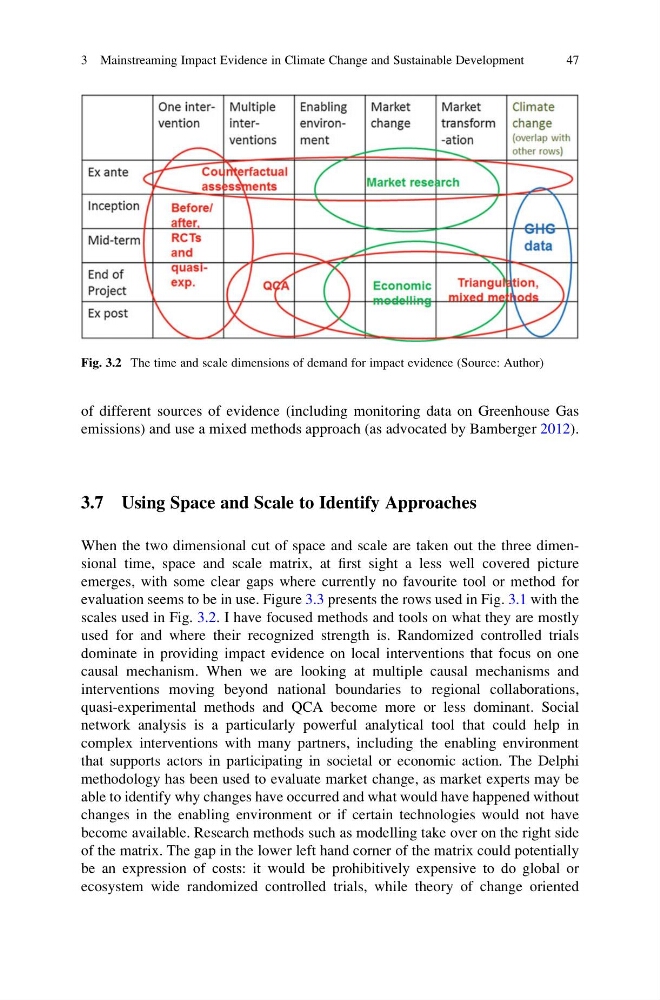
evaluation seems to be in use. Figure 3.3 presents the rows used in Fig. 3.1 with the
scales used in Fig. 3.2. I have focused methods and tools on what they are mostly
used for and where their recognized strength is. Randomized controlled trials
dominate in providing impact evidence on local interventions that focus on one
causal mechanism. When we are looking at multiple causal mechanisms and
interventions moving beyond national boundaries to regional collaborations,
quasi-experimental methods and QCA become more or less dominant. Social
network analysis is a particularly powerful analytical tool that could help in
complex interventions with many partners, including the enabling environment
that supports actors in participating in societal or economic action. The Delphi
methodology has been used to evaluate market change, as market experts may be
able to identify why changes have occurred and what would have happened without
changes in the enabling environment or if certain technologies would not have
become available. Research methods such as modelling take over on the right side
of the matrix. The gap in the lower left hand corner of the matrix could potentially
be an expression of costs: it would be prohibitively expensive to do global or
ecosystem wide randomized controlled trials, while theory of change oriented
Fig. 3.2 The time and scale dimensions of demand for impact evidence (Source: Author)
3 Mainstreaming Impact Evidence in Climate Change and Sustainable Development
47
emissions) and use a mixed methods approach (as advocated by Bamberger 2012).
3.7 Using Space and Scale to Identify Approaches
When the two dimensional cut of space and scale are taken out the three dimensional time, space and scale matrix, at first sight a less well covered picture
emerges, with some clear gaps where currently no favourite tool or method for
evaluation seems to be in use. Figure 3.3 presents the rows used in Fig. 3.1 with the
scales used in Fig. 3.2. I have focused methods and tools on what they are mostly
used for and where their recognized strength is. Randomized controlled trials
dominate in providing impact evidence on local interventions that focus on one
causal mechanism. When we are looking at multiple causal mechanisms and
interventions moving beyond national boundaries to regional collaborations,
quasi-experimental methods and QCA become more or less dominant. Social
network analysis is a particularly powerful analytical tool that could help in
complex interventions with many partners, including the enabling environment
that supports actors in participating in societal or economic action. The Delphi
methodology has been used to evaluate market change, as market experts may be
able to identify why changes have occurred and what would have happened without
changes in the enabling environment or if certain technologies would not have
become available. Research methods such as modelling take over on the right side
of the matrix. The gap in the lower left hand corner of the matrix could potentially
be an expression of costs: it would be prohibitively expensive to do global or
ecosystem wide randomized controlled trials, while theory of change oriented
Fig. 3.2 The time and scale dimensions of demand for impact evidence (Source: Author)
3 Mainstreaming Impact Evidence in Climate Change and Sustainable Development
47