

state and municipal level secretariats, technical agencies, universities and research
centers, non-governmental organizations (including river basin committees), and
the private sector.
Inspired by successful models and lessons from other countries
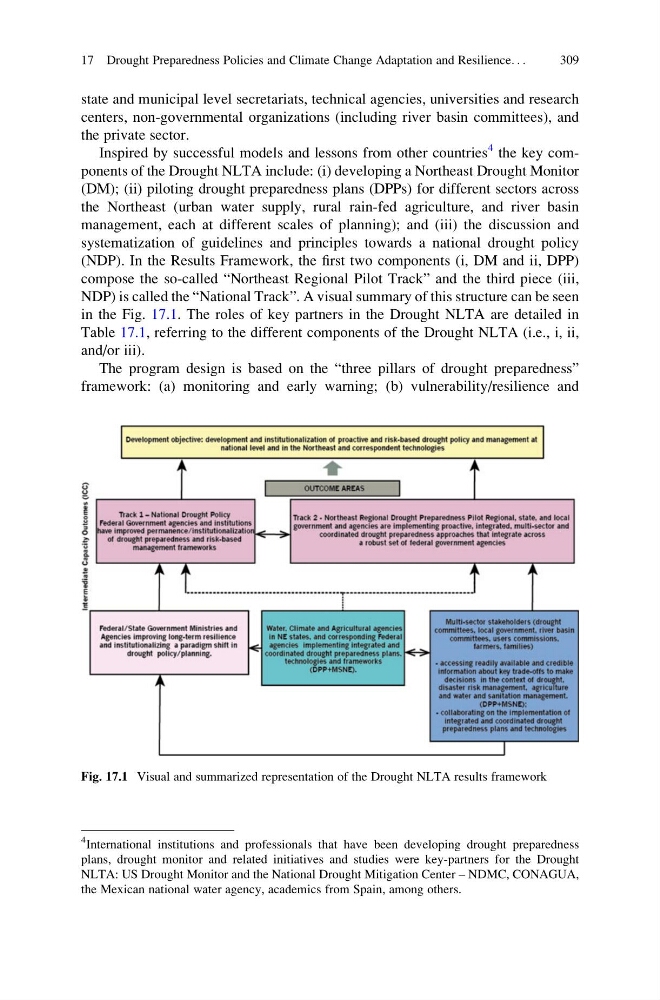
4 the key components of the Drought NLTA include: (i) developing a Northeast Drought Monitor
(DM); (ii) piloting drought preparedness plans (DPPs) for different sectors across
the Northeast (urban water supply, rural rain-fed agriculture, and river basin
management, each at different scales of planning); and (iii) the discussion and
systematization of guidelines and principles towards a national drought policy
(NDP). In the Results Framework, the first two components (i, DM and ii, DPP)
compose the so-called “Northeast Regional Pilot Track” and the third piece (iii,
NDP) is called the “National Track”. A visual summary of this structure can be seen
in the Fig. 17.1. The roles of key partners in the Drought NLTA are detailed in
Table 17.1, referring to the different components of the Drought NLTA (i.e., i, ii,
and/or iii).
The program design is based on the “three pillars of drought preparedness”
framework: (a) monitoring and early warning; (b) vulnerability/resilience and
Fig. 17.1 Visual and summarized representation of the Drought NLTA results framework
4 International institutions and professionals that have been developing drought preparedness
plans, drought monitor and related initiatives and studies were key-partners for the Drought
NLTA: US Drought Monitor and the National Drought Mitigation Center – NDMC, CONAGUA,
the Mexican national water agency, academics from Spain, among others.
17 Drought Preparedness Policies and Climate Change Adaptation and Resilience. . .
309
centers, non-governmental organizations (including river basin committees), and
the private sector.
Inspired by successful models and lessons from other countries
4 the key components of the Drought NLTA include: (i) developing a Northeast Drought Monitor
(DM); (ii) piloting drought preparedness plans (DPPs) for different sectors across
the Northeast (urban water supply, rural rain-fed agriculture, and river basin
management, each at different scales of planning); and (iii) the discussion and
systematization of guidelines and principles towards a national drought policy
(NDP). In the Results Framework, the first two components (i, DM and ii, DPP)
compose the so-called “Northeast Regional Pilot Track” and the third piece (iii,
NDP) is called the “National Track”. A visual summary of this structure can be seen
in the Fig. 17.1. The roles of key partners in the Drought NLTA are detailed in
Table 17.1, referring to the different components of the Drought NLTA (i.e., i, ii,
and/or iii).
The program design is based on the “three pillars of drought preparedness”
framework: (a) monitoring and early warning; (b) vulnerability/resilience and
Fig. 17.1 Visual and summarized representation of the Drought NLTA results framework
4 International institutions and professionals that have been developing drought preparedness
plans, drought monitor and related initiatives and studies were key-partners for the Drought
NLTA: US Drought Monitor and the National Drought Mitigation Center – NDMC, CONAGUA,
the Mexican national water agency, academics from Spain, among others.
17 Drought Preparedness Policies and Climate Change Adaptation and Resilience. . .
309