

following pilot, “ground-truthing” focus group discussions (FGDs) with children
and youth to ensure they reflected children’s experiences. From a rights-based
perspective, participants should ideally be involved in setting the evaluation
agenda.
28 In this case, the team sought to reflect participants’ views in the indicator
set through the process of iterative FGDs, and incorporating children’s voices to
refine the indicator set.
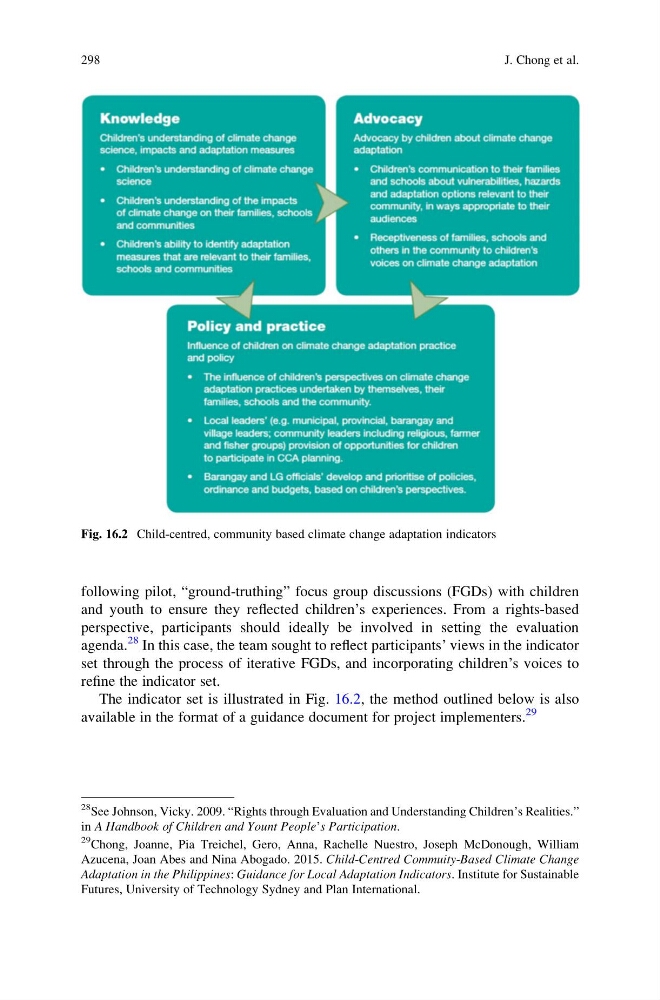
The indicator set is illustrated in Fig. 16.2, the method outlined below is also
available in the format of a guidance document for project implementers.
29
Fig. 16.2 Child-centred, community based climate change adaptation indicators
28 See Johnson, Vicky. 2009. “Rights through Evaluation and Understanding Children’s Realities.”
in A Handbook of Children and Yount People’s Participation.
29 Chong, Joanne, Pia Treichel, Gero, Anna, Rachelle Nuestro, Joseph McDonough, William
Azucena, Joan Abes and Nina Abogado. 2015. Child-Centred Commuity-Based Climate Change
Adaptation in the Philippines: Guidance for Local Adaptation Indicators. Institute for Sustainable
Futures, University of Technology Sydney and Plan International.
298
J. Chong et al.
and youth to ensure they reflected children’s experiences. From a rights-based
perspective, participants should ideally be involved in setting the evaluation
agenda.
28 In this case, the team sought to reflect participants’ views in the indicator
set through the process of iterative FGDs, and incorporating children’s voices to
refine the indicator set.
The indicator set is illustrated in Fig. 16.2, the method outlined below is also
available in the format of a guidance document for project implementers.
29
Fig. 16.2 Child-centred, community based climate change adaptation indicators
28 See Johnson, Vicky. 2009. “Rights through Evaluation and Understanding Children’s Realities.”
in A Handbook of Children and Yount People’s Participation.
29 Chong, Joanne, Pia Treichel, Gero, Anna, Rachelle Nuestro, Joseph McDonough, William
Azucena, Joan Abes and Nina Abogado. 2015. Child-Centred Commuity-Based Climate Change
Adaptation in the Philippines: Guidance for Local Adaptation Indicators. Institute for Sustainable
Futures, University of Technology Sydney and Plan International.
298
J. Chong et al.